Tab and Slot Construction: Self-Fixturing Designs for Welded Assemblies
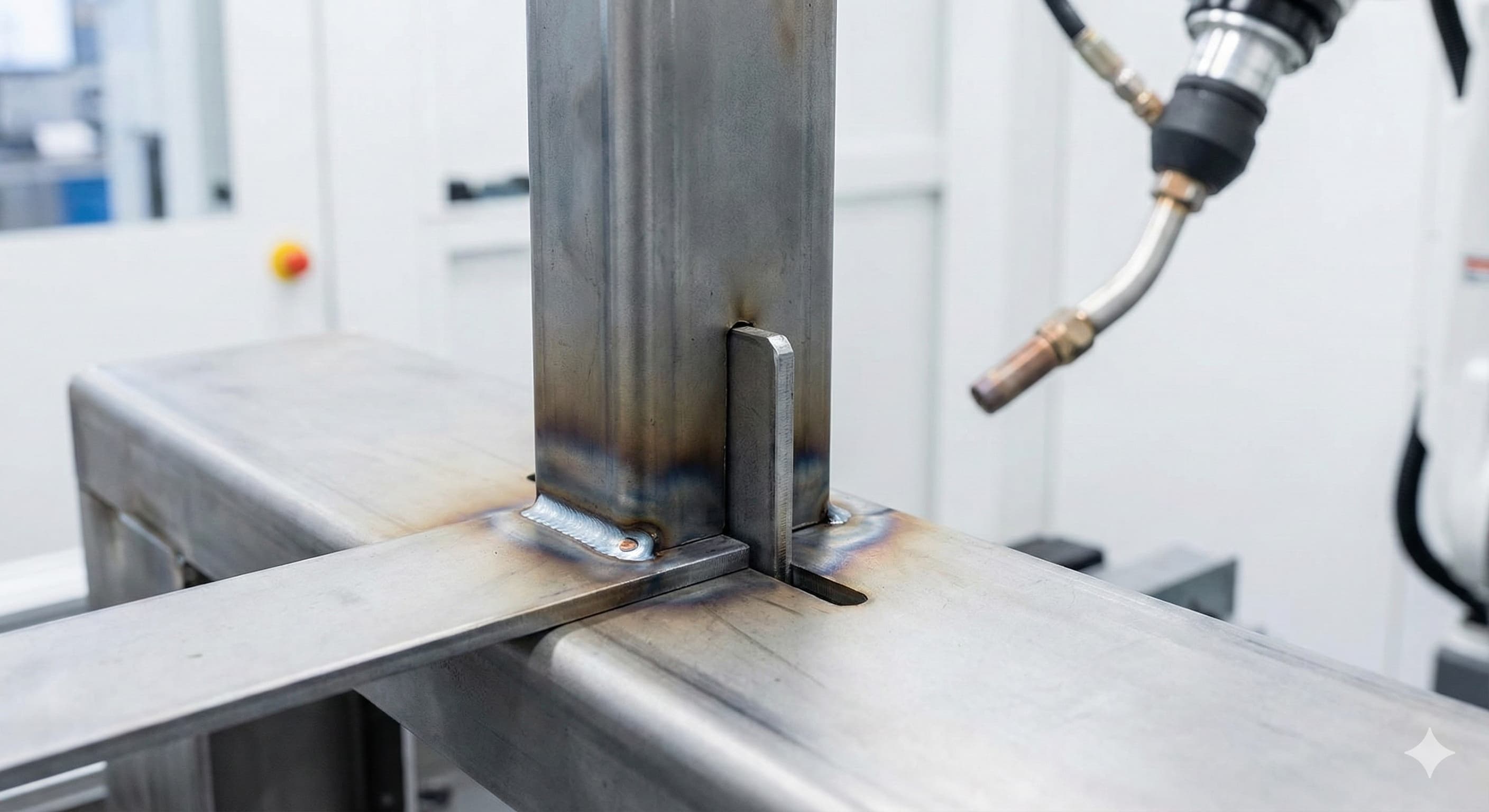
Tab and slot construction represents one of the most efficient methods for creating self-fixturing designs in welded assemblies. This technique eliminates the need for complex external jigs while ensuring precise alignment and repeatability in production environments. When properly implemented, tab and slot systems reduce setup time by up to 70% while maintaining dimensional accuracy within ±0.1 mm tolerances.
The fundamental principle behind tab and slot construction lies in creating interlocking geometric features that position components automatically during assembly. Unlike traditional fixturing methods that rely on external clamps and positioning devices, self-fixturing designs incorporate alignment features directly into the part geometry, creating a more streamlined manufacturing process.
- Key Takeaways:
- Tab and slot construction reduces setup time by 60-70% compared to traditional external fixturing methods
- Self-fixturing designs maintain dimensional accuracy within ±0.1 mm when properly engineered
- Material selection significantly impacts joint strength, with steel tabs providing 40% higher shear resistance than aluminum
- Proper clearance calculations prevent binding while ensuring adequate positioning accuracy for welding operations
Design Fundamentals and Geometric Considerations
The success of tab and slot construction depends heavily on understanding the geometric relationships between mating components. The basic principle involves creating a protruding tab on one component that fits precisely into a corresponding slot on the mating component. This seemingly simple concept requires careful consideration of multiple engineering factors to achieve optimal results.
Tab geometry must account for material thickness, welding distortion, and thermal expansion during the welding process. For steel assemblies using materials like AISI 1018 or A36, tabs should be designed with a minimum length-to-thickness ratio of 3:1 to prevent buckling during thermal cycling. When working with aluminum alloys such as 6061-T6, this ratio can be reduced to 2.5:1 due to the material's lower thermal expansion coefficient.
Slot dimensions require precise calculation to balance ease of assembly with positioning accuracy. The clearance between tab and slot walls typically ranges from 0.05 mm to 0.2 mm, depending on the material combination and required precision. Tighter clearances provide better positioning accuracy but may cause assembly difficulties due to material tolerances and surface finish variations.
| Material Combination | Recommended Clearance | Tolerance Grade | Typical Application |
|---|---|---|---|
| Steel to Steel | 0.05-0.1 mm | IT7-IT8 | Precision assemblies |
| Aluminum to Aluminum | 0.1-0.15 mm | IT8-IT9 | General fabrication |
| Mixed Materials | 0.15-0.2 mm | IT9-IT10 | Cost-sensitive applications |
Edge preparation plays a crucial role in tab and slot effectiveness. Sharp edges can cause stress concentrations that lead to crack initiation during thermal cycling. Chamfering tab edges at 45 degrees with a 0.5 mm dimension reduces stress concentrations by approximately 30% while facilitating easier assembly.
Material Selection and Mechanical Properties
Material selection significantly impacts both the manufacturability and performance of tab and slot assemblies. The choice affects not only the machining or cutting processes required to create the features but also the long-term durability of the connection under operational loads.
Steel materials offer excellent strength characteristics for tab and slot applications. AISI 1018 provides good weldability and moderate strength, making it suitable for general-purpose applications where tabs will experience primarily compressive loading. For higher-stress applications, AISI 4140 steel offers superior tensile strength (980 MPa minimum) and better fatigue resistance, though it requires more careful welding procedures to prevent heat-affected zone brittleness.
Aluminum alloys present unique considerations for tab and slot construction. The 6061-T6 alloy provides an excellent balance of strength (minimum 275 MPa yield strength) and weldability, though the T6 temper will be lost in the heat-affected zone during welding. This strength reduction can be compensated by increasing tab cross-sectional area by 15-20% compared to equivalent steel designs.
| Material | Yield Strength (MPa) | Shear Strength (MPa) | Relative Cost | Weldability Rating |
|---|---|---|---|---|
| AISI 1018 Steel | 370 | 300 | 1.0x | Excellent |
| AISI 4140 Steel | 685 | 415 | 1.3x | Good |
| Al 6061-T6 | 275 | 210 | 2.1x | Very Good |
| Al 7075-T6 | 505 | 330 | 2.8x | Poor |
Stainless steel grades like 304 or 316 offer corrosion resistance benefits but require special consideration for tab and slot design. The work-hardening characteristics of austenitic stainless steels can cause galling during assembly if clearances are too tight. Increasing clearances to 0.15-0.25 mm and using anti-seize compounds during assembly helps prevent this issue.
For high-volume production, the manufacturing method used to create tabs and slots significantly affects cost and quality. Laser cutting provides excellent edge quality and dimensional accuracy but may create heat-affected zones that alter material properties near the cut edge. Water jet cutting eliminates thermal effects but operates at slower speeds, increasing per-part costs for thin materials.
Load Analysis and Stress Distribution
Understanding load paths and stress distribution in tab and slot connections is essential for creating reliable designs. Unlike welded joints where stress distributes across the entire weld length, tab and slot assemblies concentrate loads at specific geometric features, requiring careful analysis to prevent failure.
The primary load-bearing mechanism in tab and slot assemblies involves shear stress in the tab material and bearing stress at the slot walls. For a tab with width 'w', thickness 't', and length 'l', the maximum shear stress occurs at the tab base where it connects to the parent material. This stress concentration can be calculated using the formula τ = 1.5F/(w×t), where F represents the applied force and the 1.5 factor accounts for the parabolic stress distribution across the thickness.
Bearing stress at the slot walls depends on the contact area between tab and slot surfaces. When loads are perpendicular to the tab axis, bearing stress σb = F/(t×lc), where lc represents the effective contact length. This contact length rarely equals the full tab length due to manufacturing tolerances and deflections under load.
For high-precision results, Receive a detailed quote within 24 hours from Microns Hub.
Fatigue considerations become critical in applications involving cyclic loading. The stress concentration at the tab-to-base transition typically ranges from 2.0 to 3.5, depending on the fillet radius used. Increasing the fillet radius from 1.0 mm to 3.0 mm can reduce the stress concentration factor by approximately 25%, significantly improving fatigue life.
Finite element analysis proves invaluable for optimizing tab and slot geometries under complex loading conditions. Modern FEA software can accurately predict stress distributions and identify potential failure modes before physical prototyping begins. This analysis becomes particularly important when designing assemblies that must meet specific safety factors or certification requirements.
Manufacturing Processes and Tolerances
The choice of manufacturing process for creating tab and slot features directly impacts both dimensional accuracy and production costs. Each process offers distinct advantages and limitations that must be considered during the design phase.
Laser cutting represents the most common method for creating precise tab and slot features in sheet metal applications. Modern fiber lasers can maintain dimensional tolerances of ±0.05 mm on materials up to 20 mm thickness, making them ideal for precision applications. The heat-affected zone typically extends 0.1-0.2 mm from the cut edge, which must be considered when calculating final clearances.
Water jet cutting eliminates thermal effects entirely, making it preferred for materials sensitive to heat input or when maintaining full material properties near the cut edge is critical. While slower than laser cutting, water jet processes achieve excellent edge quality and can handle much thicker materials, up to 200 mm for steel applications.
CNC machining offers the highest precision for tab and slot features, particularly in thicker materials where cutting processes may struggle with edge quality. Machined features can achieve tolerances of ±0.02 mm routinely, though the increased setup time and material removal makes this approach more expensive for high-volume production.
| Process | Typical Tolerance | Material Thickness Range | Edge Quality | Relative Cost |
|---|---|---|---|---|
| Laser Cutting | ±0.05 mm | 0.5-20 mm | Good | 1.0x |
| Water Jet | ±0.08 mm | 5-200 mm | Excellent | 1.5x |
| CNC Machining | ±0.02 mm | 3-100 mm | Excellent | 3.0x |
| Punching | ±0.1 mm | 1-10 mm | Fair | 0.7x |
Punching operations provide the lowest cost per part for high-volume production but are limited in geometric complexity and edge quality. Punch-formed tabs often require secondary operations to achieve the surface finish needed for smooth assembly, particularly in applications requiring repeated assembly and disassembly.
When specifying tolerances for tab and slot features, designers must consider the cumulative effect of multiple tolerance stack-ups. A typical assembly involving two tabs and corresponding slots can accumulate tolerances that affect final positioning by ±0.2 mm or more if not carefully controlled. Implementing geometric dimensioning and tolerancing (GD&T) principles helps minimize these cumulative effects.
Welding Considerations and Joint Design
The integration of tab and slot features with welded joints requires careful consideration of welding processes, access, and distortion control. Self-fixturing designs must accommodate welding equipment while providing adequate joint penetration and quality.
Fillet welds represent the most common joint type used with tab and slot assemblies. The slot depth should provide sufficient access for welding equipment while maintaining structural integrity. For manual welding processes, minimum access clearances of 12 mm are typically required, while automated welding systems may operate in more restricted spaces.
Weld size calculation for tab and slot assemblies follows standard procedures, but the geometric constraints may limit achievable weld sizes. The effective throat thickness of fillet welds around tabs is often limited by the tab thickness itself, requiring designers to increase tab dimensions or use multiple smaller tabs to achieve required load capacity.
Distortion control becomes more challenging in self-fixturing assemblies because the rigid positioning provided by tabs and slots can create high restraint stresses during welding. These stresses can cause warping or cracking if not properly managed through welding sequence optimization and preheat procedures.
When working with aluminum assemblies, the rapid heat dissipation requires modified welding parameters compared to steel. PEM fasteners for thin aluminum applications often complement tab and slot designs in complex assemblies requiring additional mechanical connections.
Gas metal arc welding (GMAW) proves most suitable for tab and slot assemblies due to its versatility and controllability. The directed heat input allows welding in the confined spaces typical of these assemblies while maintaining good penetration characteristics. For thinner materials below 3 mm, gas tungsten arc welding (GTAW) provides better heat control and reduces distortion risk.
Cost Optimization Strategies
Implementing cost-effective tab and slot designs requires balancing multiple factors including material utilization, manufacturing complexity, and assembly time. Strategic design decisions can significantly impact overall project costs while maintaining required performance levels.
Material nesting optimization plays a crucial role in minimizing waste when cutting tab and slot features. Arranging parts on raw material sheets to maximize utilization can reduce material costs by 15-25% compared to random layouts. Modern CAM software includes nesting algorithms that automatically optimize part arrangements while considering cutting path efficiency.
Standardizing tab and slot dimensions across product lines reduces tooling costs and simplifies inventory management. Using common sizes like 10 mm, 15 mm, and 20 mm widths allows sharing of punches, dies, and inspection tools across multiple products. This standardization approach can reduce tooling costs by 30-40% in multi-product environments.
When ordering from Microns Hub, you benefit from direct manufacturer relationships that ensure superior quality control and competitive pricing compared to marketplace platforms. Our technical expertise and personalized service approach means every project receives the attention to detail it deserves, particularly for complex self-fixturing assemblies requiring precise tolerances.
Labor cost optimization focuses on minimizing assembly time and complexity. Self-fixturing designs inherently reduce assembly time, but additional benefits can be achieved through thoughtful feature placement and orientation. Positioning tabs and slots for easy access and visual verification can reduce assembly time by an additional 20-30% beyond the base self-fixturing advantage.
Volume considerations significantly affect process selection and unit costs. For quantities below 100 pieces, laser cutting typically provides the best cost-performance balance. Production volumes above 1000 pieces may justify punch tooling costs, while extremely high volumes above 10,000 pieces can support progressive die investments for integrated forming and cutting operations.
Quality control costs can be minimized through design for inspection principles. Creating tab and slot features that are easily measured with standard tools reduces inspection time and equipment requirements. Features designed around common gage pin sizes facilitate quick go/no-go inspections on the production floor.
Advanced Applications and Design Variations
Tab and slot construction extends beyond basic rectangular features to include sophisticated geometries that address specific application requirements. Advanced designs incorporate multiple constraint axes, progressive assembly sequences, and integrated functionality that streamlines manufacturing processes.
Dovetail tab configurations provide enhanced pull-out resistance compared to straight-sided tabs. The angular geometry prevents separation under tensile loads while still allowing controlled assembly and disassembly when required. Typical dovetail angles range from 60 to 75 degrees, with steeper angles providing better retention at the cost of increased assembly force requirements.
Multi-axis constraint systems use orthogonal tab and slot arrangements to control position and orientation simultaneously. These designs prove particularly valuable in complex assemblies where multiple components must maintain precise relationships during welding operations. Careful tolerance analysis ensures that constraint conflicts don't create over-constraint conditions that prevent assembly.
Progressive assembly sequences utilize staged tab and slot engagement to guide assembly operations. Initial tabs provide coarse positioning, while secondary features refine alignment as assembly progresses. This approach works particularly well in large assemblies where manual handling makes precise initial positioning difficult.
For applications requiring environmental sealing, IP65 sealing strategies for sheet metal can be integrated with tab and slot designs to maintain both structural alignment and environmental protection. This integration requires careful consideration of seal compression and tab deflection under load.
Integrated functionality designs incorporate additional features into tab and slot geometries. Examples include wire routing channels, mounting bosses for additional components, and inspection access ports. While these additions increase geometric complexity, they can eliminate secondary operations and reduce overall assembly costs.
Quick-release variations use spring-loaded or cam-actuated mechanisms to enable rapid assembly and disassembly. These designs find application in maintenance-intensive equipment where periodic access is required. The additional mechanical complexity must be balanced against improved serviceability benefits.
Industry-specific applications often drive unique tab and slot requirements. Aerospace applications demand lightweight designs with high strength-to-weight ratios, leading to complex tapered geometries and exotic material combinations. Automotive applications emphasize high-volume manufacturability and crash energy absorption characteristics. Each industry brings specific performance requirements that influence optimal design approaches.
Modern manufacturing capabilities continue to expand the possibilities for tab and slot construction. Additive manufacturing enables complex internal geometries impossible with traditional methods, while advanced simulation tools allow optimization of designs before physical prototyping. These technological advances are expanding the application range for self-fixturing designs across multiple industries.
Integration with our manufacturing services allows optimization of tab and slot designs for specific production environments and quality requirements. This collaborative approach ensures that design intent translates effectively into manufactured results while maintaining cost-effectiveness and delivery schedules.
Frequently Asked Questions
What clearances should I specify between tabs and slots for steel assemblies?
For steel assemblies, clearances between 0.05-0.1 mm typically provide the best balance of positioning accuracy and assembly ease. Precision applications requiring tight tolerances should use 0.05 mm clearances with IT7-IT8 tolerance grades, while general fabrication can accommodate 0.1 mm clearances with IT8-IT9 tolerances. Consider material thickness and surface finish when selecting final clearance values.
How do I calculate the required tab length for adequate strength?
Tab length should maintain a minimum 3:1 length-to-thickness ratio for steel applications to prevent buckling during thermal cycling. Calculate shear stress using τ = 1.5F/(w×t) where F is applied force, w is tab width, and t is thickness. Ensure maximum shear stress remains below 60% of material yield strength to provide adequate safety factors for welded assemblies.
Can tab and slot designs work effectively with automated welding systems?
Yes, tab and slot designs work excellently with automated welding systems and often provide better repeatability than external fixturing. Ensure minimum clearances of 8-10 mm around weld areas for robotic torch access, and design tab geometries to avoid interference with welding cables or sensors. The consistent positioning provided by self-fixturing actually improves automated welding quality and reduces programming complexity.
What manufacturing process provides the best edge quality for tab and slot features?
Water jet cutting provides the best edge quality with no heat-affected zone, making it ideal for applications requiring full material properties near cut edges. CNC machining achieves the highest dimensional accuracy (±0.02 mm) but costs more for complex geometries. Laser cutting offers the best balance of speed, accuracy (±0.05 mm), and cost for most sheet metal applications under 20 mm thickness.
How do I prevent galvanic corrosion in mixed-material tab and slot assemblies?
Prevent galvanic corrosion by avoiding direct contact between dissimilar metals like aluminum and steel. Use barrier coatings, gaskets, or isolation washers at contact points. When direct contact is unavoidable, select materials with minimal galvanic potential differences and apply protective coatings like zinc plating or anodizing. Consider environmental exposure levels when selecting protection methods.
What are the typical cost savings compared to traditional fixturing methods?
Tab and slot construction typically reduces fixturing costs by 60-70% while decreasing setup time by similar amounts. Material costs increase slightly (typically 5-10%) due to additional cutting operations, but this is offset by elimination of fixture design, fabrication, and maintenance costs. Labor savings from faster setup and assembly often provide the largest cost benefit in medium to high-volume production.
How do I account for thermal expansion in tab and slot clearances?
Calculate thermal expansion using ΔL = α × L × ΔT, where α is the coefficient of thermal expansion, L is the dimension, and ΔT is temperature change. For steel assemblies, add approximately 0.01 mm clearance per 10°C temperature rise per 100 mm of dimension. Aluminum requires roughly double this allowance due to higher thermal expansion coefficient. Consider both assembly temperature and service temperature ranges in calculations.
MICRONS HUB DV Ε.Ε. · VAT: EL803129638 · GEMI: 190254227000 · Industrial Area, Street B, Number 4, 71601 Heraklion, Crete, Greece