Short-Run Metal Casting: Alternatives to Hard Tooling for <500 Units
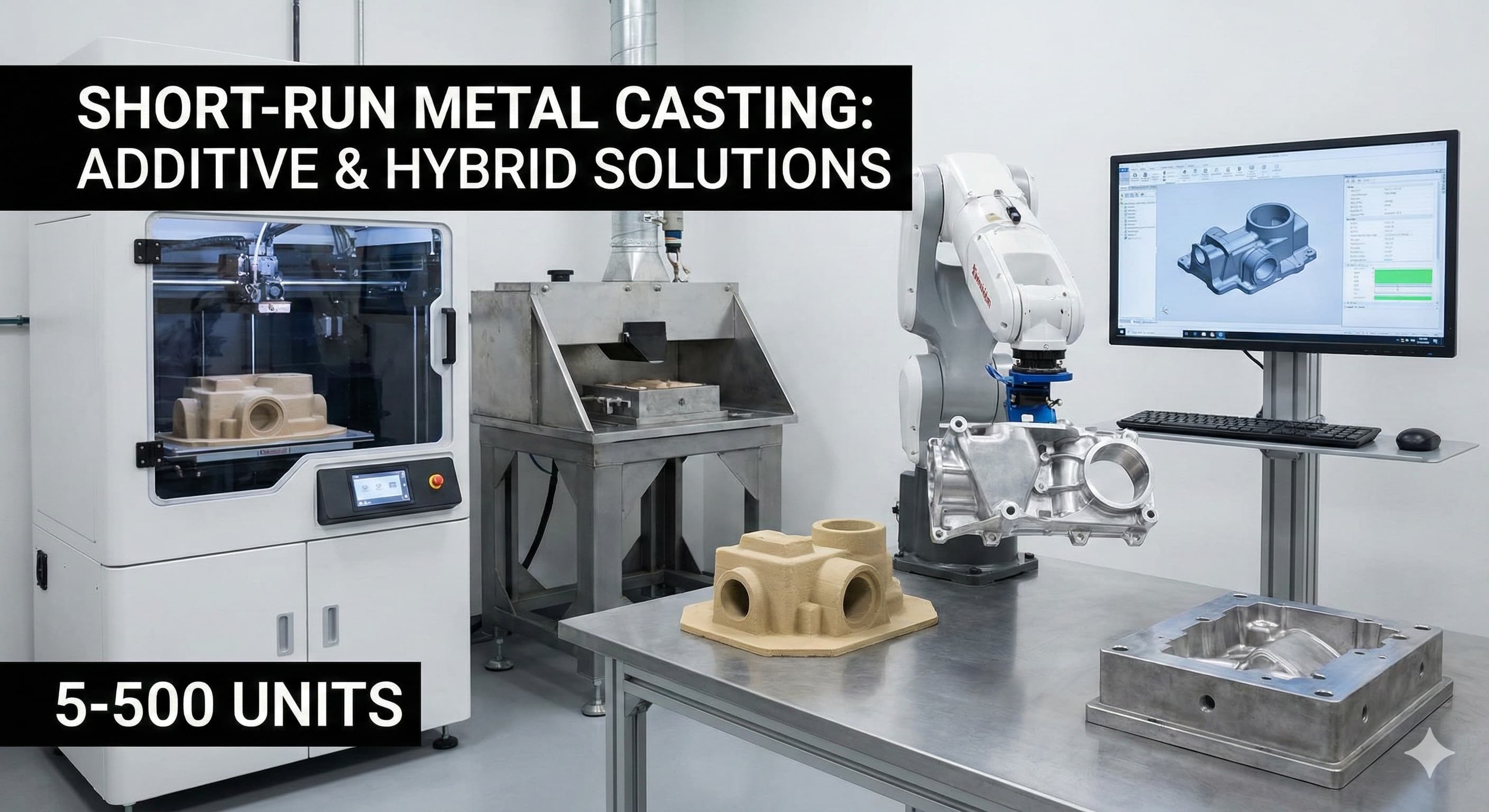
Traditional hard tooling for metal casting becomes economically prohibitive when producing fewer than 500 units. The investment in permanent steel dies can reach €50,000-200,000, making the per-unit cost unsustainable for short-run production. This manufacturing reality has driven the development of alternative casting methods that maintain dimensional accuracy while dramatically reducing initial tooling costs.
Modern short-run metal casting leverages temporary tooling materials, additive manufacturing, and hybrid processes to achieve production-ready parts at 60-80% lower initial investment compared to conventional die casting approaches.
- Sand casting with 3D-printed cores reduces tooling costs by 70% while maintaining ±0.3 mm tolerances for aluminum components
- Investment casting using rapid prototyping patterns enables complex geometries with surface finishes of Ra 3.2 μm
- Permanent mold casting with machined aluminum tooling offers the optimal balance for 100-500 unit production runs
- Hybrid approaches combining multiple techniques can reduce lead times to 2-3 weeks versus 12-16 weeks for traditional tooling
Sand Casting: The Foundation of Short-Run Production
Sand casting remains the most versatile and cost-effective method for short-run metal casting, particularly when enhanced with modern additive manufacturing techniques. The process utilizes expendable sand molds created around patterns, eliminating the need for expensive permanent tooling.
3D-Printed Sand Molds and Cores
Direct sand printing technology has revolutionized traditional sand casting by eliminating pattern requirements entirely. Machines like the ExOne S-Max Pro can produce sand molds up to 1800 x 1000 x 700 mm with dimensional accuracy of ±0.3 mm. The furan resin binder system creates molds capable of withstanding aluminum casting temperatures up to 750°C.
Core complexity becomes unlimited with 3D printing, enabling internal cooling channels, undercuts, and geometries impossible with conventional core boxes. Lead times reduce from 6-8 weeks to 3-5 days for complex castings. Material costs remain competitive at €15-25 per kilogram of sand, making this approach viable for quantities as low as 5-10 pieces.
Pattern-Based Sand Casting Optimization
When 3D-printed sand molds aren't available, rapid pattern creation using SLA or FDM printing provides significant advantages. Patterns printed in tough resin or PETG can withstand 50-100 mold impressions, suitable for production runs up to 500 units.
Pattern MaterialCost per Pattern (€)Durability (Impressions)Surface Finish (Ra μm)Dimensional Accuracy (mm)SLA Tough Resin150-300100-2001.6-3.2±0.1FDM PETG75-15050-1003.2-6.3±0.2Machined Aluminum500-15001000+0.8-1.6±0.05Traditional Wood200-800200-5006.3-12.5±0.3
The moldability factor becomes critical when selecting pattern materials. SLA patterns require draft angles of 1-2°, while FDM patterns may need 3-5° depending on layer adhesion and print orientation.
Investment Casting: Precision for Complex Geometries
Investment casting, traditionally used for high-volume production, adapts well to short-run applications when combined with rapid pattern creation. The lost-wax process eliminates draft requirements and enables near-net-shape casting with minimal machining allowances.
Rapid Pattern Creation Techniques
Direct wax printing using machines like the Solidscape 3Z Pro creates patterns with 25 μm layer resolution and surface finishes approaching Ra 1.6 μm. Alternative materials include castable resins that burn out cleanly during the dewaxing process, expanding material options beyond traditional injection-molded wax patterns.
Pattern trees can accommodate multiple part geometries, optimizing the ceramic shell investment for small quantities. A typical tree holds 10-20 small components or 2-4 larger parts, with total processing time of 7-10 days from pattern to finished casting.
Material Selection and Properties
Investment casting accommodates a broader range of alloys compared to other short-run methods. Aluminum alloys A356-T6 and A357-T6 provide excellent castability with tensile strengths reaching 310 MPa and 350 MPa respectively. Stainless steel grades 316L and 17-4 PH offer corrosion resistance and precipitation hardening capabilities.
AlloyTensile Strength (MPa)Yield Strength (MPa)Elongation (%)Typical ApplicationsA356-T6 Aluminum3102408Aerospace, automotiveA357-T6 Aluminum3502906High-stress components316L Stainless58029045Corrosive environments17-4 PH Stainless107076015High-strength applications
For high-precision results,Submit your project for a 24-hour quote from Microns Hub.
Permanent Mold Casting with Rapid Tooling
Permanent mold casting bridges the gap between sand casting and die casting by utilizing reusable metal molds without the extreme pressures of die casting. For short-run applications, rapid tooling techniques create aluminum or steel molds at significantly reduced costs.
Machined Aluminum Tooling
Aluminum 7075-T6 tooling blocks provide excellent thermal conductivity and machinability for creating permanent molds. CNC machining time typically ranges from 20-40 hours depending on complexity, with tooling costs of €3,000-12,000 for moderate-complexity parts. These molds can produce 1,000-5,000 castings before requiring refurbishment.
The thermal management advantages of aluminum tooling become apparent when casting aluminum alloys. Heat extraction rates improve casting soundness and reduce cycle times to 3-5 minutes per piece. Surface finishes of Ra 1.6-3.2 μm are achievable directly from the mold.
When permanent mold casting is combined with sheet metal fabrication services for secondary operations, manufacturers can achieve complete component solutions including brackets, housings, and mounting hardware.
Insert Tooling and Modular Approaches
Modular tooling systems allow cavity inserts to be changed while maintaining the base mold structure. This approach proves valuable when producing families of similar parts or when design iterations are expected during short-run production.
Steel inserts can be EDM machined or additively manufactured using DMLS technology. While initial costs increase to €8,000-20,000, the ability to produce multiple part variants from a single base tool provides significant flexibility for short-run applications.
Hybrid Manufacturing Approaches
Combining multiple manufacturing processes often provides optimal solutions for short-run metal casting. These hybrid approaches leverage the strengths of different techniques while mitigating individual limitations.
Cast-Then-Machine Strategy
Near-net-shape casting followed by precision machining delivers the dimensional accuracy required for functional components. Casting provides the basic geometry while CNC machining achieves critical tolerances of ±0.025 mm on selected features.
Machining allowances of 1-3 mm on critical surfaces ensure sufficient material for finishing operations. This approach works particularly well for aluminum components where machining rates are high and tool wear is minimal.
Additive-Assisted Casting
3D-printed sacrificial tooling creates complex internal geometries impossible with conventional casting methods. Water-soluble PVA supports enable intricate cooling channels in cast aluminum housings, while printed sand cores create internal features without assembly requirements.
Process CombinationTooling Cost (€)Lead Time (weeks)Typical Tolerance (mm)Optimal Quantity RangeSand Cast + Machine2,000-8,0003-5±0.110-200Investment Cast + Machine1,500-5,0004-6±0.055-100Permanent Mold + Machine5,000-15,0006-8±0.025100-5003D Print + Cast + Machine3,000-10,0004-7±0.07525-150
The selection criteria depend on part complexity, required tolerances, material specifications, and total quantity requirements. Each combination offers distinct advantages for specific applications.
Material Selection Considerations
Short-run casting processes impose different constraints on material selection compared to high-volume production. Alloy chemistry, solidification characteristics, and processing requirements become critical factors in achieving successful results.
Aluminum Alloys for Short-Run Applications
Aluminum A380 versus A356 selection depends on the specific casting process and component requirements. A380 provides superior castability for complex thin-wall sections, while A356 offers better mechanical properties after heat treatment.
A319 aluminum has gained popularity for short-run applications due to its excellent machinability and moderate strength properties. The silicon content of 5.5-6.5% provides good fluidity while maintaining reasonable mechanical properties of 240 MPa tensile strength in the T6 condition.
AlloySilicon (%)Copper (%)Fluidity RatingMachinabilityHeat Treatment ResponseA3807.5-9.53.0-4.0ExcellentGoodLimitedA3566.5-7.50.20 maxVery GoodExcellentExcellentA3195.5-6.53.0-4.0GoodExcellentGoodA3576.5-7.50.20 maxVery GoodVery GoodExcellent
Alternative Materials and Special Alloys
Magnesium alloys like AZ91D provide exceptional strength-to-weight ratios but require specialized handling due to flammability concerns. The investment in safety equipment and training may be justified for aerospace applications where weight reduction provides significant value.
Zinc alloys, particularly Zamak 3 and Zamak 5, offer excellent dimensional stability and surface finish characteristics. These alloys work well in permanent mold processes and provide an alternative to aluminum where higher density is acceptable.
Cost Analysis and Economic Considerations
Understanding the total cost structure of short-run metal casting enables informed decisions between alternative approaches. Initial tooling costs must be balanced against per-piece costs, quality requirements, and schedule constraints.
Break-Even Analysis Framework
The economic crossover point between processes depends on quantity, complexity, and tolerance requirements. Sand casting typically proves most economical for quantities under 50 pieces, while permanent mold casting becomes competitive above 100 pieces.
Fixed costs include tooling development, pattern creation, and process setup. Variable costs encompass material, labor, finishing operations, and quality inspection. The total cost per piece decreases with quantity as fixed costs are amortized over more units.
Quantity RangeOptimal ProcessTooling Cost (€)Per-Piece Cost (€)Total Cost Range (€)5-25 piecesInvestment casting1,500-3,00045-851,725-5,12525-100 piecesSand casting2,000-5,00025-452,625-9,500100-300 piecesPermanent mold8,000-15,00015-259,500-22,500300-500 piecesLimited die casting25,000-50,0008-1527,400-57,500
Hidden Costs and Considerations
Secondary operations significantly impact total project costs. Machining, heat treatment, surface finishing, and inspection add 40-80% to raw casting costs. These operations must be considered when comparing casting alternatives.
Quality costs include incoming inspection, in-process monitoring, and potential rework. Investment casting typically requires minimal secondary work but commands higher per-piece costs. Sand casting may need extensive machining but offers lower initial investment.
When ordering from Microns Hub, you benefit from direct manufacturer relationships that ensure superior quality control and competitive pricing compared to marketplace platforms. Our technical expertise and personalized service approach means every project receives the attention to detail it deserves, with comprehensive support from design optimization through final delivery.
Process Selection Guidelines
Systematic process selection requires evaluation of multiple factors including part geometry, material requirements, tolerance specifications, surface finish needs, and economic constraints. A structured approach prevents costly mistakes and ensures optimal results.
Geometric Complexity Assessment
Part complexity directly influences process selection and tooling requirements. Simple geometries with generous draft angles work well with sand casting, while complex internal features may require investment casting or hybrid approaches.
Undercuts, thin walls, and deep pockets create challenges for all casting processes. Wall thickness ratios exceeding 4:1 may cause filling problems in gravity casting, while uniform wall thickness promotes better solidification and dimensional stability.
Tolerance and Surface Finish Requirements
As-cast tolerances vary significantly between processes and must align with functional requirements. Critical dimensions may require post-casting machining regardless of the selected casting method.
Surface finish requirements influence both process selection and secondary operation planning. Investment casting achieves Ra 1.6-3.2 μm as-cast, while sand casting typically requires machining for surfaces better than Ra 6.3 μm.
Access to comprehensive our manufacturing services ensures that all aspects of component production, from initial casting through final finishing operations, can be coordinated efficiently under single-source responsibility.
Quality Control and Inspection Methods
Short-run production demands efficient quality control methods that provide confidence without excessive inspection costs. Risk-based inspection strategies focus resources on critical characteristics while maintaining overall quality standards.
In-Process Monitoring
Mold temperature monitoring ensures consistent casting conditions and helps identify process variations before they affect part quality. Infrared temperature measurement provides real-time feedback during pouring operations.
First-article inspection establishes process capability and identifies potential issues early in production runs. Dimensional measurement using CMM equipment verifies geometric accuracy and provides data for process adjustment.
Non-Destructive Testing Applications
Radiographic inspection reveals internal porosity and inclusions that may compromise component integrity. Digital radiography provides immediate results and eliminates film processing delays, making it practical for short-run applications.
Ultrasonic testing detects subsurface defects and can be applied selectively to critical areas. Penetrant testing identifies surface-breaking defects and provides cost-effective screening for structural applications.
Future Trends and Emerging Technologies
Additive manufacturing continues to expand its influence on short-run casting through improved materials, larger build volumes, and faster processing speeds. Hybrid machines combining additive and subtractive processes enable complete tooling fabrication in single setups.
Digital Integration and Industry 4.0
Digital twin technology enables virtual process optimization before physical production begins. Simulation software predicts filling patterns, solidification sequences, and potential defect locations, reducing trial-and-error iterations.
Automated quality inspection using machine vision and AI algorithms provides consistent defect detection without human subjectivity. These systems learn from production data and continuously improve detection accuracy.
Frequently Asked Questions
What is the minimum quantity that makes short-run metal casting economically viable?
Short-run metal casting becomes viable for quantities as low as 5-10 pieces, depending on part complexity and tolerance requirements. Investment casting works well for very small quantities, while sand casting provides better economics for 25+ pieces. The key is matching the process to your specific quantity and quality needs.
How do tolerances compare between short-run casting methods and traditional machining?
As-cast tolerances typically range from ±0.3 mm for sand casting to ±0.1 mm for investment casting. CNC machining can achieve ±0.025 mm or better, so critical dimensions often require post-casting machining regardless of the casting method selected. The advantage of casting is creating near-net-shape geometry with minimal material removal.
What lead times should I expect for different short-run casting processes?
Lead times vary from 2-3 weeks for sand casting with 3D-printed patterns to 6-8 weeks for permanent mold tooling. Investment casting typically requires 4-6 weeks including pattern creation and ceramic shell processing. Rush services can reduce these times by 30-40% with expedited scheduling.
Can short-run casting achieve the same material properties as high-volume production?
Yes, material properties depend on alloy chemistry and heat treatment rather than production volume. Short-run processes can achieve identical tensile strength, hardness, and other mechanical properties as high-volume methods. The key is proper process control and post-casting heat treatment procedures.
How do I select between aluminum alloys for short-run applications?
Alloy selection depends on strength requirements, machinability needs, and castability considerations. A356-T6 provides excellent strength (310 MPa tensile) and heat treatment response, while A380 offers superior castability for complex thin-wall sections. A319 provides the best machinability when extensive secondary operations are required.
What secondary operations are typically required after short-run casting?
Common secondary operations include machining of critical surfaces, drilling and tapping of holes, heat treatment for strength optimization, and surface finishing. Expect 40-80% additional cost for secondary operations depending on part complexity and tolerance requirements. Planning these operations during the design phase optimizes overall cost and quality.
How does part geometry affect the choice of short-run casting method?
Complex internal geometries favor investment casting due to unlimited draft requirements and excellent detail reproduction. Simple external shapes work well with sand casting and permanent mold processes. Thin walls under 2 mm require investment casting or specialized techniques, while thick sections over 25 mm may need careful solidification control regardless of process selection.
MICRONS HUB DV Ε.Ε. · VAT: EL803129638 · GEMI: 190254227000 · Industrial Area, Street B, Number 4, 71601 Heraklion, Crete, Greece