Permanent Mold Casting: The "Middle Ground" for Medium Volume Production
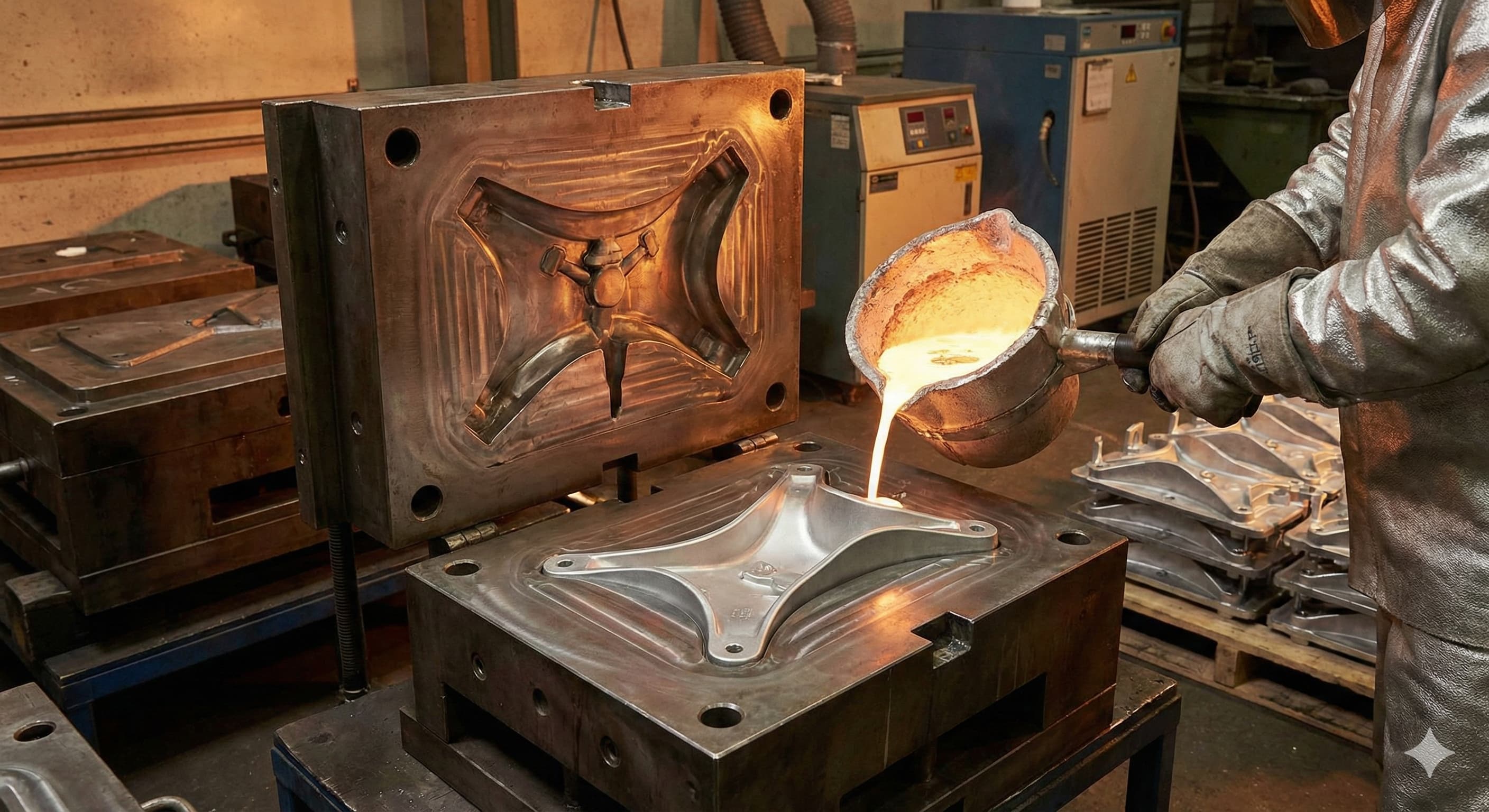
Manufacturing engineers face a recurring dilemma: sand casting offers design flexibility but lacks precision, while die casting delivers tight tolerances at volumes that may exceed project requirements. Permanent mold casting emerges as the engineered solution, delivering dimensional accuracy within ±0.13 mm while maintaining economic viability for production runs between 500 and 50,000 units.
Key Takeaways:
- Achieves tolerances of ±0.13 mm to ±0.25 mm, significantly tighter than sand casting's ±0.8 mm typical range
- Cost-effective for medium volumes (500-50,000 units) where die casting tooling costs become prohibitive
- Produces superior surface finishes (1.6-3.2 μm Ra) compared to sand casting while maintaining design flexibility
- Enables rapid cooling rates resulting in finer grain structures and enhanced mechanical properties
Understanding Permanent Mold Casting Fundamentals
Permanent mold casting utilizes reusable metal molds, typically constructed from H13 tool steel or cast iron, to produce aluminum, magnesium, and copper-based alloy components. Unlike sand casting's expendable molds or die casting's high-pressure injection, this process relies on gravity or low-pressure feed systems to fill the mold cavity at controlled rates.
The process operates within temperature ranges of 200-300°C for mold preheating, while molten aluminum enters at approximately 700-750°C. This controlled thermal environment enables directional solidification, producing castings with predictable grain structures and minimal porosity levels below 2% by volume.
Critical to success is mold design incorporating proper gating systems, risers for feed metal, and venting to eliminate trapped gases.Draft angles between 1-3 degrees facilitate part ejection while maintaining dimensional integrity throughout the production cycle.
Mold life typically ranges from 10,000 to 100,000 cycles depending on alloy selection, casting complexity, and thermal cycling management. H13 tool steel molds demonstrate superior longevity when casting aluminum alloys due to their thermal fatigue resistance and maintained hardness at elevated temperatures.
Material Selection and Alloy Performance
Aluminum alloys dominate permanent mold applications due to their favorable casting characteristics and mechanical property development.A356 aluminum provides excellent fluidity and strength, achieving tensile strengths of 290 MPa in T6 condition, while A319 offers superior machinability for components requiring extensive secondary operations.
| Alloy | Tensile Strength (MPa) | Yield Strength (MPa) | Elongation (%) | Typical Applications |
|---|---|---|---|---|
| A356-T6 | 290 | 205 | 5-7 | Automotive wheels, structural components |
| A319-T6 | 250 | 165 | 2-3 | Engine blocks, transmission cases |
| A535-F | 170 | 85 | 8-12 | Marine hardware, architectural elements |
| ZA-12 | 280 | 200 | 1-3 | Bearing housings, gear cases |
Magnesium alloys like AZ91D provide exceptional strength-to-weight ratios at 1.81 g/cm³ density, delivering 230 MPa tensile strength while reducing component weight by 35% compared to aluminum alternatives. However, magnesium requires inert atmosphere protection during casting to prevent oxidation and associated defects.
Zinc alloys, particularly ZA-12, demonstrate superior as-cast properties without heat treatment requirements. Their low melting point of 380°C reduces mold thermal stress while achieving dimensional tolerances approaching ±0.08 mm on critical features.
Process Variations and Technical Implementation
Gravity permanent mold casting represents the baseline process, utilizing atmospheric pressure to fill mold cavities at rates of 25-75 mm/second. This controlled fill rate minimizes turbulence-induced defects while maintaining adequate fluidity for complex geometries.
Low-pressure permanent mold casting applies 20-100 kPa pressure to the molten metal surface, forcing controlled cavity filling from bottom-up. This technique eliminates dross entrainment common in gravity systems while reducing shrinkage porosity through sustained feeding pressure during solidification.
Tilt-pour permanent molding introduces the mold and metal simultaneously, controlling fill dynamics through rotation speed typically ranging from 10-60 RPM. This method proves particularly effective for thin-walled castings where conventional gravity pouring creates cold shuts or incomplete fill conditions.
Vacuum-assisted permanent molding applies 50-90 kPa vacuum to the mold cavity, drawing molten metal into fine details while evacuating trapped gases. Surface finish improvements to 0.8 μm Ra become achievable through this enhanced filling mechanism.
For high-precision results,Get your custom quote delivered in 24 hours from Microns Hub.
Dimensional Accuracy and Surface Quality Analysis
Permanent mold casting achieves linear tolerances of ±0.13 mm on dimensions up to 25 mm, expanding to ±0.25 mm for features approaching 150 mm. These capabilities position the process between sand casting's ±0.8 mm typical accuracy and die casting's ±0.05 mm precision class.
| Dimension Range (mm) | Permanent Mold Tolerance | Sand Casting Tolerance | Die Casting Tolerance |
|---|---|---|---|
| 0-25 | ±0.13 | ±0.5 | ±0.05 |
| 25-50 | ±0.15 | ±0.6 | ±0.08 |
| 50-100 | ±0.20 | ±0.7 | ±0.10 |
| 100-150 | ±0.25 | ±0.8 | ±0.13 |
Surface roughness typically measures 1.6-3.2 μm Ra as-cast, representing a 60% improvement over sand casting's 6.3-12.5 μm Ra range. This enhanced surface quality often eliminates secondary finishing operations, reducing total manufacturing costs while improving fatigue life in cyclically loaded applications.
Wall thickness capabilities span 3-50 mm, with optimal performance occurring in the 6-25 mm range where solidification time allows complete cavity fill without premature freezing. Minimum section thickness relates directly to alloy fluidity and mold temperature management.
Draft angle requirements of 1-3 degrees enable consistent part ejection while maintaining dimensional stability. Complex geometries incorporating undercuts require multipart molds or soluble cores, increasing tooling complexity but preserving design freedom unavailable in die casting applications.
Economic Analysis and Production Volume Optimization
Tooling costs for permanent mold casting range from €15,000-€80,000 depending on part complexity, size, and required automation level. This investment proves economical when amortized across production volumes exceeding 500 units, where per-piece tooling costs drop below €30-€150 per casting.
| Production Volume | Tooling Cost per Part (€) | Cycle Time (minutes) | Total Part Cost (€) |
|---|---|---|---|
| 500 | 80-160 | 5-8 | 95-180 |
| 2,500 | 15-32 | 4-6 | 25-45 |
| 10,000 | 4-8 | 3-5 | 12-20 |
| 25,000 | 2-3 | 3-4 | 8-12 |
Cycle times range from 3-8 minutes depending on section thickness, alloy selection, and cooling system efficiency. Automated systems reduce handling time while improving consistency, justifying additional investment for volumes exceeding 5,000 annual units.
Labor costs remain moderate due to simplified mold handling compared to sand casting's pattern and core requirements. Skilled operators can manage 2-3 casting stations simultaneously, optimizing direct labor allocation across production schedules.
Secondary machining requirements vary by application but typically consume 15-40% of total manufacturing cost when precision CNC machining services are required for critical features. As-cast tolerances often satisfy non-critical dimensions, focusing machining operations on bearing surfaces, threaded features, and precision interfaces.
Quality Control and Defect Management
Common defects in permanent mold casting include shrinkage porosity, cold shuts, and surface oxidation. Shrinkage porosity occurs when inadequate feeding metal reaches solidifying regions, typically controlled through proper riser design and directional solidification principles.
Cold shuts result from premature metal solidification during cavity filling, prevented through optimized gating design and mold temperature control. Maintaining mold temperatures within 200-300°C ensures adequate fluidity throughout the fill sequence.
Surface oxidation appears as dross inclusions or oxide films, minimized through controlled pouring techniques and degassing treatments. Aluminum alloys benefit from grain refinement additions of 0.02-0.05% titanium-boron master alloy, reducing hot tearing susceptibility while improving mechanical properties.
Non-destructive testing methods include visual inspection, dye penetrant examination for surface defects, and radiographic evaluation for internal soundness. Critical applications may require ultrasonic testing or computed tomography for complete volumetric analysis.
Statistical process control monitoring tracks dimensional variation, surface quality metrics, and mechanical property development across production lots. Control charts identifying trends enable proactive adjustments preventing defective castings while maintaining consistent quality standards.
Comparison with Alternative Manufacturing Methods
Permanent mold casting occupies the performance space between sand casting's flexibility and die casting's precision. Sand casting offers unlimited size capability and complex coring options but sacrifices surface quality and dimensional accuracy. Die casting provides superior precision and faster cycle times but requires minimum volumes of 10,000-50,000 units for economic justification.
| Process Characteristic | Sand Casting | Permanent Mold | Die Casting |
|---|---|---|---|
| Typical Tolerance (mm) | ±0.5-0.8 | ±0.13-0.25 | ±0.05-0.10 |
| Surface Finish (μm Ra) | 6.3-12.5 | 1.6-3.2 | 0.8-1.6 |
| Minimum Volume | 1-100 | 500-1,000 | 10,000+ |
| Tooling Cost (€) | 500-5,000 | 15,000-80,000 | 50,000-300,000 |
| Cycle Time (minutes) | 15-60 | 3-8 | 1-3 |
Investment casting competes in similar volume ranges but requires longer lead times due to pattern and shell production requirements. Permanent mold casting offers faster prototype-to-production transitions while maintaining comparable dimensional accuracy for most applications.
When compared to our manufacturing services portfolio, permanent mold casting integrates effectively with secondary operations like heat treatment, machining, and surface finishing to deliver complete manufacturing solutions.
Design Guidelines and Engineering Considerations
Effective permanent mold design requires understanding thermal management, gating optimization, and ejection mechanisms. Wall thickness variations should remain within 2:1 ratios to prevent differential cooling rates that generate residual stresses and dimensional distortion.
Fillet radii of 1.5-3.0 mm eliminate stress concentrations while facilitating smooth metal flow during filling. Sharp corners create turbulence and potential defect sites, while excessively large radii increase material usage and solidification time.
Parting line placement influences surface quality and dimensional control. Locating parting lines on non-critical surfaces preserves precision requirements on functional features while simplifying mold maintenance and part finishing operations.
Core design for internal features requires consideration of thermal expansion, extraction forces, and replacement frequency. Sand cores enable complex internal geometries but require careful anchoring to prevent core shift during metal pouring. Permanent cores offer dimensional stability but limit design flexibility for undercut features.
Gating system design controls fill rate, metal flow patterns, and feeding effectiveness. Runner cross-sectional areas typically measure 1.2-2.0 times the gate area, ensuring adequate flow capacity while maintaining controlled filling velocity.
Microns Hub Advantages in Permanent Mold Casting
When ordering from Microns Hub, you benefit from direct manufacturer relationships that ensure superior quality control and competitive pricing compared to marketplace platforms. Our technical expertise in permanent mold casting design optimization and process control means every project receives the attention to detail required for consistent, high-quality results. Additionally, our integrated approach combines casting, machining, and finishing operations under one roof, reducing lead times and ensuring seamless quality control throughout the entire manufacturing process.
Future Trends and Technology Integration
Advanced simulation software enables virtual optimization of gating systems, cooling rates, and solidification patterns before physical tooling investment. Computational fluid dynamics modeling predicts fill patterns while finite element analysis evaluates residual stress development and dimensional stability.
Automated mold handling systems reduce cycle time variability while improving operator safety in high-temperature environments. Robotic systems can manage multiple casting stations, pour metal with consistent accuracy, and perform quality inspections without human intervention.
Real-time process monitoring through temperature sensors, flow meters, and pressure transducers enables immediate adjustment of process parameters. Data logging systems track performance trends and predict maintenance requirements, optimizing equipment utilization and minimizing unplanned downtime.
Additive manufacturing techniques show promise for rapid prototype tooling and complex core production. 3D-printed sand cores with integral cooling passages offer enhanced thermal management while reducing assembly complexity in permanent mold applications.
Frequently Asked Questions
What volume ranges make permanent mold casting most economical?
Permanent mold casting proves most cost-effective for production volumes between 500 and 50,000 units annually. Below 500 units, sand casting typically offers lower total costs due to minimal tooling investment. Above 50,000 units, die casting's faster cycle times and higher precision often justify the increased tooling expense.
How do permanent mold tolerances compare to machined components?
Permanent mold casting achieves ±0.13-0.25 mm tolerances, which satisfy many non-critical dimensions directly. Precision surfaces requiring ±0.025-0.050 mm tolerances need secondary machining operations. Strategic design places tight tolerance features on machined surfaces while utilizing as-cast accuracy for general dimensions.
What materials work best in permanent mold casting processes?
Aluminum alloys A356, A319, and A535 represent primary choices due to excellent fluidity and mechanical properties. Magnesium alloys like AZ91D offer superior strength-to-weight ratios for aerospace applications. Zinc alloys ZA-12 and ZA-27 provide exceptional as-cast properties without heat treatment requirements.
Can permanent mold casting produce thin-walled components effectively?
Minimum wall thickness typically measures 3-4 mm for aluminum alloys, expanding to 6-8 mm for optimal casting quality. Thin walls below 3 mm risk incomplete fill and cold shut defects. Advanced techniques like vacuum assistance or low-pressure casting can achieve 2.5 mm sections in favorable geometries.
How does cooling rate affect mechanical properties in permanent mold casting?
Rapid cooling from metal molds creates finer grain structures, improving tensile strength by 15-25% compared to sand casting. Cooling rates of 10-50°C/second typical in permanent molds reduce secondary dendrite arm spacing, enhancing ductility and fatigue resistance in dynamic loading applications.
What secondary operations are commonly required after permanent mold casting?
Heat treatment to T6 condition improves strength properties by 40-60% in aluminum alloys through solution treatment and artificial aging. Machining operations focus on bearing surfaces, threaded features, and precision interfaces. Surface treatments like anodizing or powder coating enhance corrosion resistance and appearance.
How long do permanent molds typically last before replacement?
H13 tool steel molds demonstrate 50,000-100,000 cycle life when properly maintained and thermally managed. Cast iron molds offer 10,000-25,000 cycles at lower initial cost. Mold life depends on alloy selection, part complexity, thermal cycling severity, and maintenance procedures including regular inspection and refurbishment.
MICRONS HUB DV Ε.Ε. · VAT: EL803129638 · GEMI: 190254227000 · Industrial Area, Street B, Number 4, 71601 Heraklion, Crete, Greece