Sand Casting for Large Parts: Design Limitations and Benefits
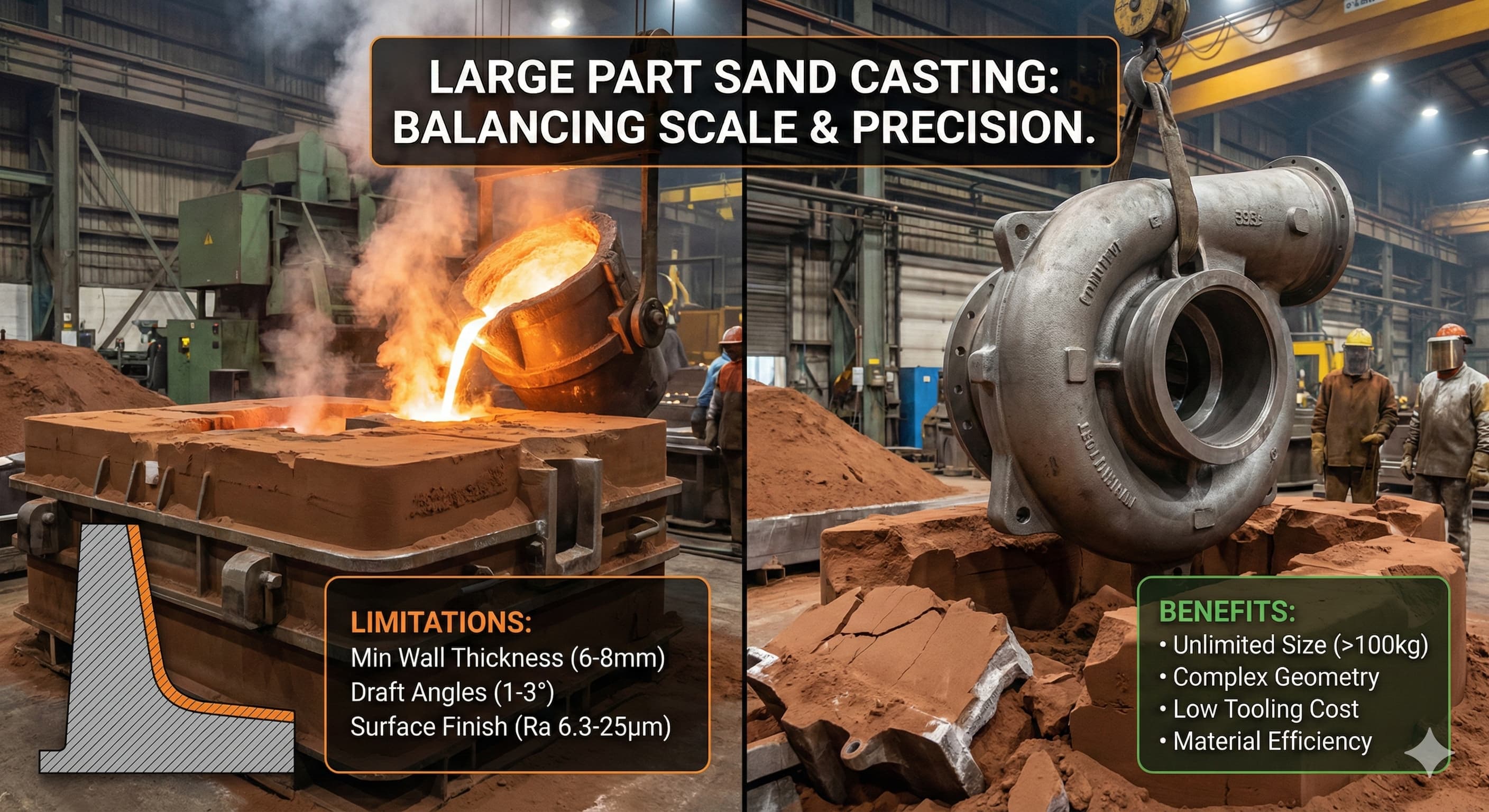
Large-scale casting operations demand engineering precision that balances material efficiency with dimensional accuracy. Sand casting emerges as the dominant manufacturing process for components exceeding 50 kg, where traditional machining becomes cost-prohibitive and alternative casting methods reach their physical limitations.
Key Takeaways:
- Sand casting accommodates virtually unlimited part sizes with complex geometries, making it ideal for components weighing 100+ kg
- Wall thickness limitations (minimum 6-8 mm) and draft angle requirements (1-3°) significantly impact design flexibility
- Material costs represent only 15-25% of total production expense, with tooling and labor driving economics
- Surface finish quality ranges from Ra 6.3-25 μm depending on sand grain size and molding technique
Understanding Sand Casting Fundamentals for Large Components
Sand casting's scalability advantage becomes pronounced when manufacturing parts exceeding 500 mm in any dimension. Unlike die casting, which faces pressure limitations around 2,000-4,000 kg components, sand casting theoretically has no upper size constraint. The process relies on packed sand molds that can accommodate engine blocks, turbine housings, and structural castings weighing several tonnes.
The fundamental principle involves creating a negative cavity in compacted sand, then filling this void with molten metal. For large parts, this seemingly simple process introduces complex thermal management challenges. A 200 kg aluminum casting contains approximately 37 MJ of thermal energy at pouring temperature (750°C), requiring controlled cooling to prevent internal stresses and dimensional distortion.
Green sand molding remains the most economical approach for large castings, utilizing clay-bonded sand with 6-8% moisture content. This mixture provides adequate mold strength while allowing gases to escape during metal solidification. Alternative binders like furan resins offer superior dimensional accuracy but increase material costs by 300-400%.
Critical Design Limitations in Large Sand Castings
Wall Thickness Constraints and Thermal Considerations
Minimum wall thickness requirements scale with part size due to thermal gradients during solidification. While small sand castings may achieve 4-5 mm walls, large components typically require minimum sections of 6-8 mm for aluminum alloys and 8-12 mm for cast iron grades.
The relationship between wall thickness and casting quality follows Chvorinov's rule, where solidification time equals K(V/A)², with V representing volume and A surface area. Large castings with thin sections create thermal hotspots that promote porosity formation and internal stress concentration.
| Material Grade | Minimum Wall (mm) | Maximum Wall (mm) | Recommended Range |
|---|---|---|---|
| Al A356-T6 | 6 | 75 | 10-40 |
| Al A319-T6 | 8 | 80 | 12-45 |
| Cast Iron GG20 | 10 | 150 | 15-60 |
| Cast Iron GG25 | 12 | 120 | 18-50 |
| Steel GS200 | 15 | 200 | 20-80 |
Draft Angle and Demolding Requirements
Large castings amplify demolding forces exponentially, requiring generous draft angles to prevent mold damage and surface defects. Standard practice calls for 1° minimum draft on external surfaces and 1.5-3° on internal features. Complex geometries may demand up to 5° draft angles, significantly impacting final part dimensions.
The demolding force calculation F = μ × N × A (where μ represents friction coefficient, N normal force, and A contact area) demonstrates why large castings require increased draft. A 1,000 cm² vertical surface generates substantial resistance during pattern extraction, potentially damaging the sand mold cavity.
Dimensional Tolerance Limitations
Sand casting tolerances follow CT (Casting Tolerance) grades according to ISO 8062-3, with large parts typically achieving CT10-CT13 grades. This translates to ±1.5-3.0 mm tolerance ranges for dimensions exceeding 500 mm length.
Shrinkage compensation varies by material: aluminum alloys shrink 1.0-1.3%, while cast iron exhibits 0.8-1.1% linear shrinkage. Large castings experience differential cooling rates that create non-uniform shrinkage patterns, making precise tolerance prediction challenging without finite element thermal analysis.
For high-precision results, Request a free quote and get pricing in 24 hours from Microns Hub.
Material Selection Strategies for Large Sand Castings
Material selection for large sand castings prioritizes castability characteristics over ultimate mechanical properties. Aluminum A356 dominates large casting applications due to excellent fluidity, moderate shrinkage (1.2%), and favorable strength-to-weight ratio of 180 MPa tensile strength at 2.68 g/cm³ density.
Cast iron grades GG20 and GG25 serve structural applications where weight considerations are secondary to cost optimization. These materials offer superior machinability and dimensional stability, with thermal expansion coefficients (10-12 × 10⁻⁶/K) that minimize distortion during service temperature fluctuations.
| Property | A356-T6 | A319-T6 | GG20 | GG25 |
|---|---|---|---|---|
| Tensile Strength (MPa) | 280 | 250 | 200 | 250 |
| Yield Strength (MPa) | 205 | 165 | - | - |
| Elongation (%) | 8-10 | 2-3 | 0.8 | 0.4 |
| Density (g/cm³) | 2.68 | 2.79 | 7.1 | 7.2 |
| Relative Cost | 1.0 | 0.9 | 0.4 | 0.45 |
Alloy Chemistry Impact on Large Casting Quality
Silicon content critically affects fluidity in aluminum casting alloys. A356's 7% silicon content provides excellent mold filling capability for complex geometries, while maintaining adequate mechanical properties through T6 heat treatment. Higher silicon content (A413 with 11-13% Si) improves castability but reduces mechanical strength and machinability.
Magnesium additions (0.3-0.45% in A356) enable precipitation hardening but increase oxidation tendencies during melting and pouring operations. Large castings require extended pour times, making oxidation control crucial for achieving sound metallurgy.
Manufacturing Process Optimization
Gating and Riser System Design
Large castings demand sophisticated gating systems to ensure complete mold filling while minimizing turbulence and oxide inclusion formation. The gating ratio (sprue:runner:ingate) typically follows 1:2:1 proportions for aluminum, modified to 1:1.5:1 for cast iron to account for reduced fluidity.
Riser design becomes critical for large sections, following the modulus method where riser modulus exceeds casting modulus by 1.2-1.4 times. A riser feeding a 50 mm thick casting section requires minimum 65-70 mm diameter to ensure adequate feeding during solidification.
Bottom gating systems minimize turbulence for large castings but require increased metal volume (10-15% additional material) compared to top gating approaches. The economic trade-off between material usage and casting quality often favors bottom gating for high-value components.
Thermal Management and Cooling Control
Controlled cooling rates prevent thermal stress development in large castings. Aluminum castings benefit from cooling rates of 1-3°C/minute through the solidification range (660-550°C), while cast iron requires slower cooling (0.5-1°C/minute) to prevent white iron formation.
Ceramic insulating sleeves around risers extend solidification time, improving feeding effectiveness. These sleeves maintain riser temperature 50-80°C above casting temperature during critical feeding periods, preventing premature solidification that causes shrinkage defects.
Quality Control and Inspection Challenges
Large casting inspection requires specialized equipment and techniques due to size constraints and access limitations. Radiographic testing typically employs Co-60 sources for steel castings exceeding 100 mm thickness, while ultrasonic testing provides more practical solutions for routine quality assessment.
Tolerance verification in large castings demands coordinate measuring machines (CMM) with working envelopes exceeding part dimensions. Bridge-type CMMs accommodate parts up to 4,000 mm length but cost €200,000-500,000, making measurement services economically attractive for many manufacturers.
Pressure testing validates internal passage integrity in large castings like pump housings and valve bodies. Test pressures typically range from 1.5-2.0 times working pressure, requiring substantial containment systems and safety protocols for large components.
Surface Finish Expectations and Improvement Methods
As-cast surface finish quality depends primarily on sand grain size and binder type. Standard green sand molding produces Ra 12.5-25 μm surface roughness, while resin-bonded sands achieve Ra 6.3-12.5 μm finishes. Large casting economics often preclude premium molding materials unless functional requirements demand superior surface quality.
Post-casting surface treatments include shot blasting, machining, and chemical etching to achieve required specifications. Shot blasting with S330 steel shot (0.85 mm diameter) effectively removes scale and improves surface uniformity on large castings.
Economic Advantages of Sand Casting for Large Parts
Sand casting's economic superiority for large parts stems from minimal tooling investment and material efficiency. Pattern costs range from €2,000-8,000 for large aluminum patterns, compared to €50,000-200,000 for equivalent die casting tooling with size limitations.
Material utilization efficiency varies with part complexity but typically achieves 60-75% for large castings when including gating and riser systems. This compares favorably to machining from solid stock, where large parts may achieve only 20-30% material utilization.
| Manufacturing Method | Tooling Cost (€) | Material Efficiency (%) | Size Limitation | Min Qty (pieces) |
|---|---|---|---|---|
| Sand Casting | 2,000-8,000 | 60-75 | Unlimited | 1 |
| Die Casting | 50,000-200,000 | 85-95 | 50 kg max | 500 |
| CNC Machining | 500-2,000 | 20-30 | Machine envelope | 1 |
| Forging | 15,000-80,000 | 90-95 | 100 kg typical | 100 |
Labor and Production Scaling
Labor requirements for large sand castings scale sublinearly with part size. A 10 kg casting may require 2-3 hours total labor, while a 100 kg casting needs only 6-8 hours due to proportionally reduced handling and finishing operations per unit weight.
Production lead times for large sand castings typically span 4-8 weeks, including pattern fabrication, mold preparation, casting, and basic finishing. This compares favorably to forging operations requiring 8-12 weeks for similar components.
Integration with Secondary Operations
Large sand castings often require extensive machining to achieve final dimensional and surface finish requirements. Machining allowances typically range from 3-6 mm on critical surfaces, with larger allowances (8-12 mm) on highly stressed areas requiring full material property development.
When considering comprehensive manufacturing solutions,our manufacturing services extend beyond casting to include precision machining and assembly operations. This integration becomes particularly valuable for large castings requiring multiple secondary processes.
Heat treatment scheduling affects large castings differently due to thermal mass considerations. T6 heat treatment for large aluminum castings may require 8-12 hours at solution temperature (540°C) compared to 2-4 hours for smaller parts, increasing processing costs proportionally.
For complex assemblies requiring both cast components and fabricated elements,sheet metal fabrication services can provide complementary manufacturing capabilities that integrate seamlessly with large casting operations.
Design Optimization Strategies
Geometry Modifications for Improved Castability
Rib and boss design significantly impacts large casting success rates. Rib thickness should not exceed 0.6 times adjacent wall thickness to prevent hot spot formation, while maintaining minimum 4-6 mm thickness for adequate strength contribution.
Internal passages and cooling channels require minimum 12-15 mm diameter for reliable core support during molding operations. Smaller passages often collapse or shift during metal pouring, creating dimensional variations and potential leakage paths.
Corner radii should exceed wall thickness by 1.5-2.0 times to minimize stress concentration and improve material flow during mold filling. Sharp internal corners create shrinkage stresses that propagate into crack formation during service loading.
Modular Design Approaches
Large casting economics often favor modular design strategies that divide complex geometries into manageable casting sizes. This approach enables standard tooling utilization while maintaining assembly flexibility for various product configurations.
Joint design between cast modules requires careful attention to load transfer and sealing requirements. Bolted flanges with O-ring grooves provide reliable sealing while accommodating thermal expansion differences between components.
Microns Hub Advantage in Large Casting Production
When ordering from Microns Hub, you benefit from direct manufacturer relationships that ensure superior quality control and competitive pricing compared to marketplace platforms. Our technical expertise in large casting optimization and personalized engineering support means every project receives the detailed analysis necessary for successful production outcomes, from initial design review through final quality verification.
Future Developments and Technology Integration
Digital sand printing technologies are revolutionizing large casting production by eliminating pattern requirements and enabling complex internal geometries previously impossible with traditional molding methods. Current systems accommodate parts up to 2,000 × 1,000 × 1,000 mm with dimensional accuracy approaching ±0.3 mm.
Simulation software integration enables thermal analysis and shrinkage prediction with accuracy levels exceeding 95% for large castings. This computational capability reduces development iterations and improves first-piece success rates from traditional 60-70% to 85-90% levels.
Automated finishing systems utilizing robotic shot blasting and machining centers reduce labor content while improving consistency for large casting production. These systems require substantial capital investment (€300,000-800,000) but become economically viable for production volumes exceeding 100 pieces annually.
Frequently Asked Questions
What is the maximum size limitation for sand casting large parts?
Sand casting has virtually no theoretical size limit. Components weighing several tonnes and measuring multiple meters in dimension are regularly produced. The practical limitations involve handling equipment, facility size, and economic considerations rather than the casting process itself. The largest sand castings include ship propellers, turbine housings, and structural components exceeding 10,000 kg.
How do tolerances compare between sand casting and machining for large parts?
Sand casting typically achieves CT10-CT13 tolerances (±1.5-3.0 mm for dimensions over 500 mm) according to ISO 8062-3, while CNC machining can achieve ±0.1-0.2 mm tolerances. However, machining large parts from solid stock becomes prohibitively expensive due to material waste and machine time. Most large castings use hybrid approaches with cast near-net shape plus selective machining of critical features.
What minimum wall thickness is required for large aluminum sand castings?
Minimum wall thickness for large aluminum sand castings ranges from 6-8 mm depending on alloy grade and part geometry. A356 aluminum can achieve 6 mm minimum walls due to excellent fluidity, while A319 requires 8 mm minimum thickness. Walls thinner than these minimums risk incomplete filling, cold shuts, and porosity formation that compromise structural integrity.
How does cooling rate affect large casting quality?
Controlled cooling rates are critical for large castings to prevent thermal stress and distortion. Aluminum castings benefit from 1-3°C/minute cooling through solidification range, while cast iron requires 0.5-1°C/minute. Rapid cooling causes surface tensile stresses and potential cracking, while excessive slow cooling reduces mechanical properties and increases cycle time.
What are typical lead times for large sand casting projects?
Lead times for large sand castings typically range from 4-8 weeks, including pattern fabrication (1-3 weeks), molding and casting operations (1-2 weeks), and basic finishing processes (1-2 weeks). Complex geometries requiring multiple cores or specialized alloys may extend lead times to 10-12 weeks. Rush orders can sometimes achieve 3-4 week delivery with premium pricing.
How do material costs compare between sand casting and alternative manufacturing methods?
Material costs represent 15-25% of total sand casting expenses, with aluminum A356 costing approximately €1.80-2.20 per kg. While sand casting material efficiency (60-75%) is lower than die casting (85-95%), the elimination of expensive tooling makes sand casting economically superior for large parts. CNC machining from solid stock achieves only 20-30% material efficiency, making it cost-prohibitive for large components.
What secondary operations are typically required for large sand castings?
Most large sand castings require machining of critical surfaces with 3-6 mm stock removal allowance. Heat treatment (T6 for aluminum) develops full mechanical properties but requires extended cycle times due to thermal mass. Surface treatments include shot blasting for scale removal and dimensional verification using coordinate measuring machines. Assembly operations may include welding, drilling, and testing depending on application requirements.
MICRONS HUB DV Ε.Ε. · VAT: EL803129638 · GEMI: 190254227000 · Industrial Area, Street B, Number 4, 71601 Heraklion, Crete, Greece