Surface Finishes for Cast Parts: From Shot Peening to Powder Coat
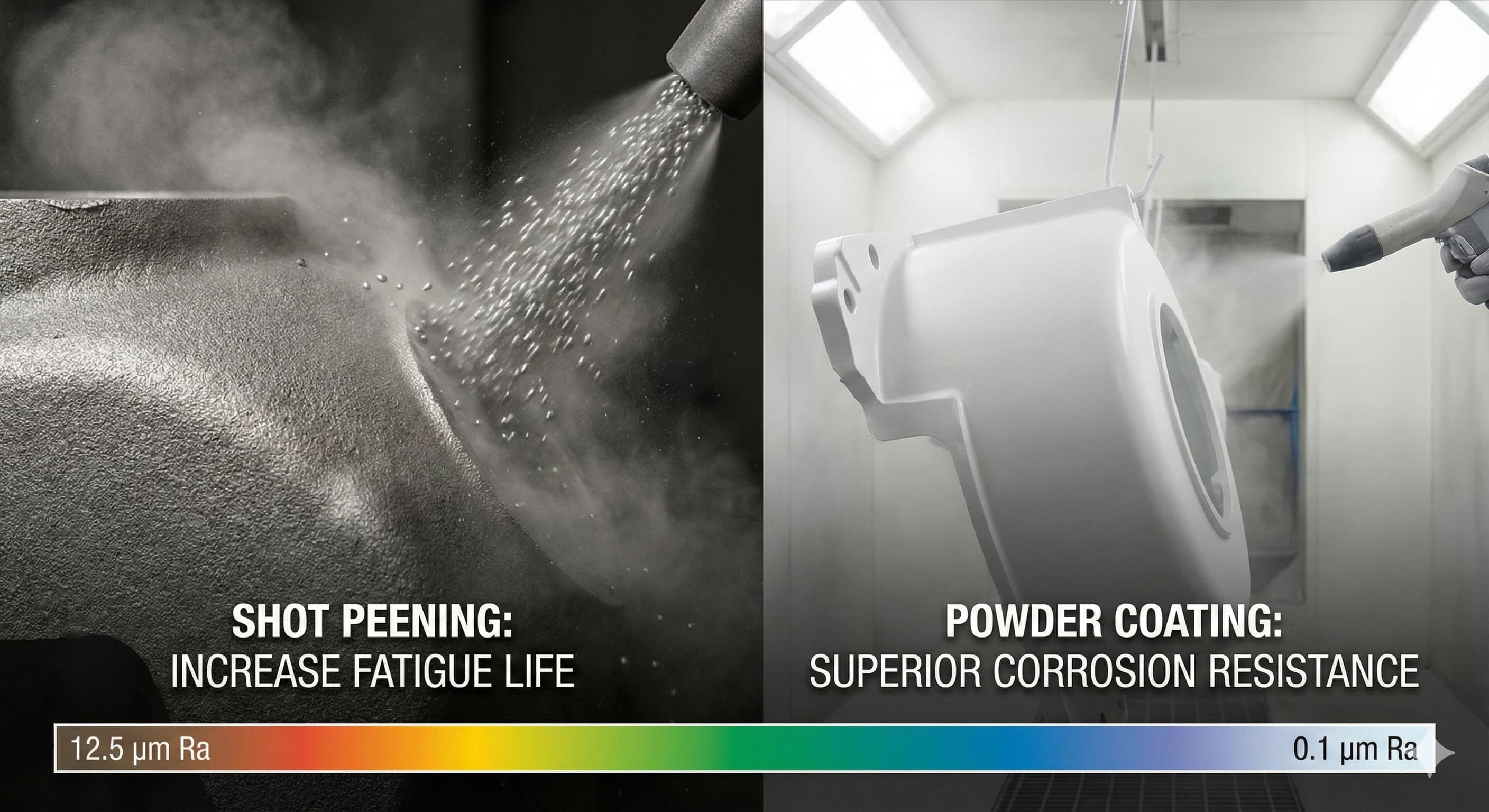
Cast parts emerge from the foundry with surface conditions that rarely meet final application requirements. Surface roughness values typically range from 12.5 to 50 μm Ra for sand casting and 3.2 to 6.3 μm Ra for die casting, necessitating secondary finishing operations to achieve functional and aesthetic specifications.
Key Takeaways:
- Shot peening increases fatigue life by 200-400% through compressive stress introduction at depths of 0.1-0.5 mm
- Powder coating provides superior corrosion resistance with thickness control of 50-150 μm compared to liquid paint systems
- Surface preparation accounts for 60-70% of total finishing cost and directly impacts coating adhesion performance
- Proper finishing selection can reduce manufacturing tolerances from ±0.5 mm to ±0.1 mm for critical surfaces
Understanding Cast Surface Characteristics
Cast surfaces inherit characteristics from their production method, mold material, and cooling conditions. Sand casting produces surfaces with embedded silica particles and oxidation layers, while die casting generates smoother surfaces with potential flash lines and ejector pin marks. These initial conditions determine the finishing strategy required.
Surface defects in cast parts include porosity, inclusions, cold shuts, and dimensional variations. Porosity particularly affects coating adhesion, as trapped air can cause coating failure through outgassing during curing cycles.Minimizing porosity during the casting process significantly reduces subsequent finishing requirements and costs.
The microstructure near the surface differs from the bulk material due to rapid cooling rates. This "skin effect" creates a harder, more brittle surface layer that requires specific preparation techniques. Understanding these metallurgical aspects enables optimal finishing process selection.
Mechanical Surface Preparation Methods
Mechanical preparation removes casting skin, scale, and contaminants while establishing the surface profile necessary for coating adhesion. Shot blasting represents the most common method, using steel shot, ceramic beads, or aluminum oxide media depending on material compatibility and desired surface roughness.
Shot peening differs fundamentally from shot blasting through controlled impact energy and coverage patterns. Peening induces compressive stresses 0.1-0.5 mm below the surface, dramatically improving fatigue resistance. Typical peening intensities range from 6-16 Almen "A" scale, with coverage requirements of 98% minimum for aerospace applications per AMS 2430.
| Media Type | Hardness (HRC) | Surface Finish (μm Ra) | Applications |
|---|---|---|---|
| Steel Shot | 45-55 | 6.3-12.5 | Heavy scale removal, peening |
| Glass Beads | N/A | 1.6-3.2 | Delicate cleaning, satin finish |
| Aluminum Oxide | N/A | 3.2-6.3 | Non-ferrous metals, precise control |
| Plastic Media | N/A | 0.8-1.6 | Paint removal, soft substrates |
Tumbling operations use ceramic media mixed with compounds to achieve uniform surface conditioning on complex geometries. Cycle times typically range from 2-8 hours depending on material removal requirements and desired surface quality. This method excels for deburring and edge radiusing while maintaining dimensional accuracy within ±0.05 mm.
Chemical Surface Treatments
Chemical treatments modify surface chemistry to enhance adhesion, corrosion resistance, or appearance. Phosphating creates a crystalline conversion coating that provides excellent paint adhesion and mild corrosion protection. Zinc phosphate coatings typically measure 5-25 μm thickness with crystal sizes of 1-10 μm.
Chromating treatments, while being phased out due to environmental concerns, still see use in aerospace applications where superior corrosion protection justifies the regulatory burden. Trivalent chromium alternatives provide similar performance with reduced environmental impact, achieving corrosion resistance equivalent to 240-480 hours salt spray exposure per ASTM B117.
Anodizing applies specifically to aluminum castings, creating an aluminum oxide layer 5-25 μm thick for decorative applications or up to 75 μm for hard anodizing. The porous structure accepts dyes and sealers, enabling color matching and enhanced corrosion protection. Surface preparation prior to anodizing requires caustic cleaning followed by acid etching to remove casting skin and achieve uniform oxide formation.
Powder Coating Systems and Application
Powder coating offers superior performance compared to liquid paint systems through complete film formation without volatile organic compounds. Electrostatic application charges powder particles oppositely to the grounded workpiece, achieving transfer efficiencies of 95-98% with proper booth design and powder reclaim systems.
Coating thickness control within 50-150 μm ensures optimal performance while minimizing material costs. Thickness uniformity depends on part geometry, with recessed areas typically receiving 70-80% of nominal thickness. Complex geometries may require Faraday cage guns or fluidized bed application to achieve uniform coverage.
| Powder Type | Cure Temperature (°C) | Film Thickness (μm) | Salt Spray Hours |
|---|---|---|---|
| Polyester TGIC | 180-200 | 60-80 | 1000+ |
| Polyester HAA | 160-180 | 50-70 | 500-750 |
| Polyester Urethane | 160-180 | 40-60 | 750-1000 |
| Epoxy | 160-200 | 75-125 | 500-1000 |
Curing parameters directly affect coating properties, with under-cure resulting in poor chemical resistance and over-cure causing brittleness and color shift. Differential thermal analysis and gel time testing establish optimal cure schedules for each powder formulation and substrate combination.
For high-precision results,Get a quote in 24 hours from Microns Hub.
Specialized Finishing Techniques
Vibratory finishing provides controlled surface modification through media action in oscillating containers. Media selection determines material removal rates and final surface texture, with ceramic triangles removing 0.025-0.075 mm per hour while plastic media achieves polishing action with minimal stock removal.
Electropolishing removes material electrochemically while simultaneously smoothing surface irregularities. Current density of 2-20 A/dm² in temperature-controlled electrolyte removes 5-50 μm of surface material, reducing surface roughness by 50-75%. This process excels for stainless steel components requiring sanitary finishes or enhanced corrosion resistance.
Thermal spray coatings apply materials impossible to achieve through conventional coating methods. Plasma spray deposits ceramic, metallic, or composite coatings with bond strengths exceeding 70 MPa. Coating thickness ranges from 0.1-5.0 mm enable restoration of worn surfaces or application of specialized surface properties like thermal barrier or wear resistance.
Quality Control and Testing Methods
Surface roughness measurement using contact profilometry or optical interferometry quantifies finish quality against specifications. Ra values provide average roughness while Rz measurements capture peak-to-valley variations more relevant for coating adhesion. Typical measurement lengths of 4.8 mm with 0.8 mm sampling intervals ensure statistical relevance per ISO 4287.
Coating thickness measurement employs magnetic induction for ferrous substrates or eddy current methods for non-ferrous materials. Calibration standards traceable to national metrology institutes ensure accuracy within ±2% of reading. Destructive testing through cross-sectional microscopy provides definitive thickness and adhesion evaluation.
Adhesion testing using pull-off dollies per ASTM D4541 or cross-hatch methods per ASTM D3359 validates coating adhesion strength. Pull-off values should exceed 5 MPa for structural applications, while cross-hatch results of 4B or 5B indicate excellent adhesion for most service environments.
| Test Method | Standard | Acceptance Criteria | Frequency |
|---|---|---|---|
| Surface Roughness | ISO 4287 | Ra 1.6-6.3 μm | Per batch |
| Coating Thickness | ISO 2178 | ±10% of nominal | 5 points/m² |
| Adhesion Pull-off | ASTM D4541 | >5 MPa | 1 per 10 m² |
| Salt Spray | ASTM B117 | 500-1000 hours | Per specification |
Cost Optimization Strategies
Finishing costs typically represent 20-40% of total casting cost, making optimization crucial for competitive pricing. Batch processing reduces handling costs and improves quality consistency through standardized processing parameters. Optimal batch sizes balance equipment utilization with inventory carrying costs.
Media consumption in abrasive processes follows predictable patterns, with steel shot lasting 200-500 cycles while ceramic media degrades more rapidly but produces superior surface quality. Media recycling and contamination control extend service life while maintaining consistent results.
When ordering from Microns Hub, you benefit from direct manufacturer relationships that ensure superior quality control and competitive pricing compared to marketplace platforms. Our technical expertise and integrated manufacturing services approach means every project receives the attention to detail it deserves, eliminating the communication gaps common with broker-based solutions.
Energy costs for curing ovens represent 30-50% of powder coating operating expenses. Infrared heating systems reduce cure times by 40-60% compared to convection ovens while improving temperature uniformity. Heat recovery systems capture exhaust energy to preheat incoming air, reducing energy consumption by 20-30%.
Integration with Manufacturing Processes
Surface finishing integration with upstream processes minimizes handling damage and improves workflow efficiency. Parts designed with finishing requirements in mind incorporate features like masking surfaces, drainage holes, and accessible geometries that reduce processing time and improve quality.
Our injection molding services often complement cast components in assemblies, requiring compatible surface finishes for aesthetic consistency and functional performance. Understanding these integration requirements during initial design prevents costly modifications later in the production cycle.
Fixtures and tooling design significantly impact finishing quality and throughput. Custom fixtures ensure consistent part orientation and masking while minimizing manual handling. Automated systems increase throughput while reducing labor costs and improving safety in hazardous finishing environments.
Environmental and Regulatory Considerations
Volatile organic compound emissions from solvent-based systems face increasingly stringent regulations across Europe. Powder coating systems eliminate VOC emissions while providing superior performance, making them preferred for new installations despite higher capital costs.
Waste stream management requires careful segregation of different media types and contaminated materials. Metal recovery from spent blast media and powder reclaim systems reduce raw material costs while minimizing environmental impact. Proper waste characterization ensures compliant disposal and may reveal opportunities for material recovery.
Worker safety considerations include respiratory protection from dust exposure, hearing conservation in high-noise environments, and ergonomic design of material handling systems. Automated systems reduce worker exposure while improving consistency and throughput.
Frequently Asked Questions
What surface roughness should I specify for powder coating adhesion?
Optimal surface roughness for powder coating ranges from 2.5-6.3 μm Ra. This profile provides sufficient mechanical anchoring for coating adhesion while avoiding excessive texture that could cause coating irregularities. Surfaces smoother than 1.6 μm Ra may experience adhesion failures, while roughness exceeding 12.5 μm Ra creates coating thickness variations and potential defects.
How does shot peening affect dimensional tolerance in cast parts?
Shot peening typically causes 0.025-0.1 mm growth in treated dimensions due to compressive stress-induced expansion. This effect is predictable and should be incorporated into casting tolerances. Critical dimensions may require post-peening machining to achieve final specifications. The dimensional change varies with material properties, peening intensity, and part geometry.
Can powder coating be applied directly to as-cast aluminum surfaces?
Direct powder coating application to as-cast aluminum surfaces generally produces poor results due to oxide layers, casting release agents, and surface contamination. Proper preparation including alkaline cleaning, acid etching, or conversion coating ensures adequate adhesion. Chromate or chromate-free conversion coatings provide optimal adhesion promotion and corrosion protection.
What are the temperature limitations for different powder coating types?
Standard polyester powder coatings maintain properties up to 120°C continuous service temperature. High-temperature formulations using polyimide or fluoropolymer chemistries withstand temperatures up to 260°C. Epoxy-based powders offer excellent chemical resistance but limited UV stability, making them suitable for interior applications or primer layers under topcoats.
How do I prevent powder coating thickness variations on complex geometries?
Thickness variations on complex geometries result from Faraday cage effects and recessed area accessibility. Solutions include specialized spray guns designed for interior surfaces, part rotation during application, and multiple spray passes from different angles. Some geometries may require fluidized bed application or electrostatic fluidized bed techniques for uniform coverage.
What surface preparation is required after welding cast assemblies?
Welded assemblies require removal of heat tint, spatter, and flux residues before finishing. Stainless steel welds need pickling with nitric-hydrofluoric acid solutions or mechanical cleaning to restore corrosion resistance. Carbon steel welds require complete scale removal and profile preparation equivalent to surrounding surfaces. Weld profile grinding may be necessary for aesthetic applications.
How do finishing processes affect casting porosity and leak tightness?
Abrasive finishing processes can expose sub-surface porosity, potentially compromising pressure tightness. Impregnation with anaerobic sealers before finishing preserves leak tightness while allowing surface preparation to proceed. Vacuum impregnation provides superior sealing performance compared to atmospheric pressure methods, achieving leak rates below 10⁻⁶ mbar·l/s for critical applications.
MICRONS HUB DV Ε.Ε. · VAT: EL803129638 · GEMI: 190254227000 · Industrial Area, Street B, Number 4, 71601 Heraklion, Crete, Greece