Rigidity in CNC Parts: How Wall Thickness Affects Machining Vibration
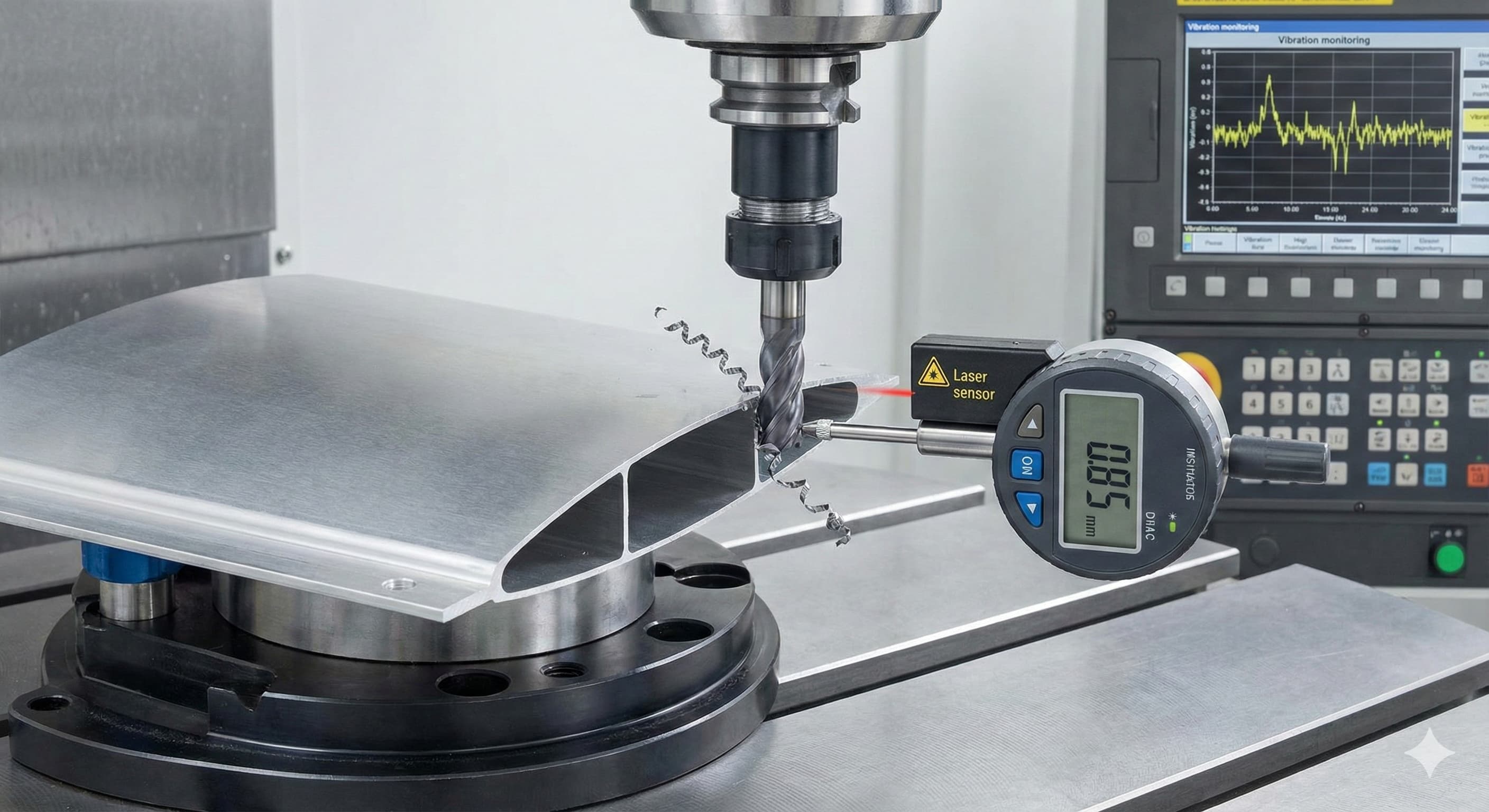
Machining vibration represents one of the most critical factors limiting dimensional accuracy and surface quality in modern CNC manufacturing. Wall thickness directly correlates with part rigidity, making it a fundamental design parameter that determines whether a component can be machined within specified tolerances or becomes a source of costly rework and production delays.
Key Takeaways:
- Wall thickness below 1.5 mm significantly increases vibration amplitude, requiring specialized fixturing and reduced cutting parameters
- Optimal wall-to-span ratios of 1:8 to 1:12 provide the best balance between material efficiency and machining stability
- Dynamic rigidity analysis can predict vibration-prone geometries before machining, preventing quality issues
- Strategic ribbing patterns can increase effective rigidity by 300-400% while adding minimal material cost
Understanding the Rigidity-Vibration Relationship
The fundamental physics governing CNC machining vibration stems from the dynamic interaction between cutting forces and workpiece stiffness. When a cutting tool engages material, it generates periodic forces that vary with spindle speed, feed rate, and depth of cut. These forces create deflections in both the tool and workpiece, with the magnitude of deflection inversely proportional to the system's rigidity.
For thin-walled components, the workpiece becomes the limiting factor in overall system rigidity. The relationship follows basic beam theory, where deflection increases proportionally to the cube of the unsupported length and inversely to the cube of the wall thickness. This cubic relationship explains why seemingly small reductions in wall thickness can dramatically increase vibration problems.
Material properties play a crucial role in this dynamic. Aluminum 6061-T6, with its modulus of elasticity of 68.9 GPa, exhibits different vibration characteristics compared to steel grades like AISI 4140 (200 GPa modulus). The higher modulus materials provide inherently better vibration resistance, but design optimization remains critical regardless of material selection.
| Wall Thickness (mm) | Relative Rigidity | Vibration Risk | Recommended Strategy |
|---|---|---|---|
| 0.5-1.0 | Very Low | High | Specialized fixturing, climb milling only |
| 1.0-1.5 | Low | Medium-High | Reduced cutting parameters, shorter tools |
| 1.5-3.0 | Medium | Medium | Standard machining with optimization |
| 3.0-6.0 | High | Low | Conventional parameters acceptable |
| >6.0 | Very High | Very Low | Material removal optimization focus |
Critical Wall Thickness Thresholds
Through extensive production experience at Microns Hub, we've identified specific wall thickness thresholds where machining behavior changes dramatically. These thresholds vary by material but follow predictable patterns that enable proactive manufacturing planning.
For aluminum alloys, the critical threshold occurs at approximately 1.2 mm wall thickness. Below this point, vibration amplitude increases exponentially, particularly in features with unsupported lengths exceeding 15 mm. The vibration frequency typically matches the tool's passing frequency, creating resonant conditions that amplify surface roughness and dimensional variation.
Steel components exhibit different behavior due to their higher density and modulus. The critical threshold for carbon steels occurs around 0.8 mm, while stainless grades like 316L can maintain reasonable stability down to 0.6 mm due to their work-hardening characteristics that provide additional damping.
Titanium alloys present unique challenges, with critical thresholds around 1.5 mm due to their combination of low thermal conductivity and high strength. The heat generation from machining titanium thin walls can cause thermal distortion that compounds vibration problems, creating a particularly challenging manufacturing scenario.
Geometric Design Strategies for Vibration Control
Effective vibration control begins in the design phase, where geometric modifications can dramatically improve machining stability without significantly increasing material costs. The key principle involves maximizing the second moment of area while maintaining functional requirements.
Ribbing represents the most effective strategy for improving thin-wall rigidity. Longitudinal ribs with a height equal to 2-3 times the wall thickness can increase effective rigidity by 300-400%. The optimal rib spacing ranges from 20-40 mm, depending on the overall feature dimensions and machining access requirements.
Cross-sectional shape optimization provides another powerful approach. Converting rectangular thin walls to T-sections or L-sections can double the rigidity while adding minimal material. This approach works particularly well for sheet metal fabrication services where formed features can be integrated into the manufacturing process.
Curved geometries inherently provide better vibration resistance than straight walls due to their shell-like behavior. A slight curvature with radius equal to 10-15 times the wall thickness can improve rigidity significantly while maintaining design intent. This principle applies particularly well to aerospace and automotive components where weight optimization drives thin-wall designs.
For high-precision results,Get your custom quote delivered in 24 hours from Microns Hub.
Machining Parameter Optimization
Once geometric optimization reaches its limits, machining parameter adjustment becomes critical for successful thin-wall production. The relationship between cutting parameters and vibration is complex, requiring a systems approach that considers tool selection, cutting conditions, and workholding strategies simultaneously.
Spindle speed selection requires careful consideration of both tool dynamics and workpiece natural frequency. For thin-wall features, the workpiece natural frequency often becomes the limiting factor. A general guideline involves maintaining spindle speeds at least 20% above or below the calculated workpiece natural frequency to avoid resonance conditions.
Feed rate optimization follows different rules for thin-wall machining. Higher feed rates can actually improve stability by reducing the time spent in unstable cutting zones, but this must be balanced against increased cutting forces that can deflect thin sections. The optimal approach often involves variable feed rates that reduce as the tool approaches critical thin-wall areas.
Axial depth of cut becomes particularly critical for thin walls. Shallow passes of 0.1-0.3 mm are often necessary, even though this significantly increases machining time. The trade-off between productivity and quality requires careful economic analysis, but the cost of rework typically justifies conservative approaches.
| Wall Thickness (mm) | Max Axial DOC (mm) | Recommended Feed (mm/min) | Speed Adjustment |
|---|---|---|---|
| 0.5-1.0 | 0.05-0.1 | 100-300 | -30% from standard |
| 1.0-1.5 | 0.1-0.2 | 300-600 | -20% from standard |
| 1.5-2.5 | 0.2-0.4 | 600-1200 | -10% from standard |
| 2.5-4.0 | 0.4-0.8 | 1200-2000 | Standard parameters |
Advanced Fixturing and Support Systems
Workholding strategy becomes paramount when machining thin-wall components, often requiring custom fixtures that provide support without interfering with cutting operations. The fundamental challenge involves providing adequate clamping force while avoiding distortion of the thin-wall geometry.
Vacuum fixturing systems work exceptionally well for thin-wall components, providing distributed support that minimizes distortion. Modern vacuum systems can generate holding forces of 0.1 MPa across the entire part surface, providing excellent stability without point loading that could cause local deformation.
Magnetic chucks offer advantages for ferrous thin-wall parts, particularly when combined with pole extensions that distribute magnetic force. The key involves using fine-pole magnetic chucks with pole spacing of 3-5 mm to provide uniform support across thin sections.
Custom soft-jaw designs represent the most versatile approach for thin-wall fixturing. Aluminum or plastic soft jaws can be machined to match part contours exactly, providing support precisely where needed. The soft jaw material prevents marking while distributing clamping forces over larger areas.
Expendable support structures, machined from the same material as the part, provide internal support during machining operations. These supports are designed with break-away features that allow removal after machining completion. While this approach increases material costs, it enables machining of otherwise impossible geometries.
Material Selection and Heat Treatment Considerations
Material selection significantly impacts thin-wall machining success, with some alloys providing inherently better vibration resistance and machinability characteristics. Understanding these differences enables design optimization from the material specification stage.
Aluminum 6061-T6 represents an excellent balance of machinability and strength for thin-wall applications. Its relatively low strength (yield strength 276 MPa) reduces cutting forces while providing adequate structural performance for many applications. The T6 temper provides good dimensional stability during machining.
For higher strength requirements, aluminum 7075-T6 offers superior mechanical properties but presents machining challenges. Its higher strength (yield strength 503 MPa) increases cutting forces, while its tendency toward work hardening requires careful parameter selection. The material works well for thin walls when proper techniques are employed.
Steel selection for thin walls often favors lower carbon grades for machinability. AISI 1018 provides excellent machinability with minimal work hardening, making it ideal for thin-wall prototypes. For production applications requiring higher strength, AISI 4140 pre-hardened to 28-32 HRC offers good machinability while providing substantial strength improvements.
Stainless steel thin walls benefit from grades like 303 or 416 that include sulfur additions for improved machinability. These grades machine more readily than 316L while providing corrosion resistance adequate for many applications. The improved chip breaking characteristics reduce the risk of chip wrapping that can damage thin walls.
Tool Selection and Geometry Optimization
Tool selection for thin-wall machining requires balancing cutting performance with dynamic stability. Shorter, more rigid tools generally provide better results, but access requirements often limit tool geometry options. Understanding the trade-offs enables optimal tool selection within geometric constraints.
End mill geometry plays a crucial role in thin-wall success. Variable helix angles help break up harmonic vibrations, while unequal spacing reduces chatter tendency. Three-flute designs often work better than four-flute for thin walls, providing good surface finish while reducing cutting forces per tooth.
Cutting edge preparation becomes critical for thin-wall applications. Sharp edges minimize cutting forces but may provide inadequate tool life. A slight edge radius of 2-5 micrometers often provides the optimal balance between cutting force and tool longevity. This preparation works particularly well with high-speed machining approaches that minimize thermal effects.
Tool length-to-diameter ratios should remain below 4:1 whenever possible for thin-wall applications. Longer tools amplify vibration problems through their reduced stiffness. When longer tools are unavoidable, reduced cutting parameters and specialized tool holders with vibration damping become necessary.
Coating selection impacts both tool life and cutting performance. TiAlN coatings work well for steel thin walls, providing both wear resistance and thermal barrier properties. For aluminum, uncoated or diamond-like carbon (DLC) coated tools often provide better performance by reducing built-up edge formation.
Quality Control and Measurement Strategies
Measuring thin-wall components presents unique challenges due to their flexibility and sensitivity to measurement forces. Traditional contact measurement can deflect thin walls, leading to false readings that don't represent actual part dimensions under operating conditions.
Non-contact measurement systems provide ideal solutions for thin-wall inspection. Laser scanning and optical coordinate measuring machines (CMMs) can capture complete part geometry without applying measurement forces. These systems enable full inspection of complex thin-wall geometries that would be impossible to measure with traditional methods.
When contact measurement becomes necessary, careful consideration of measurement force is essential. Modern CMMs allow measurement force adjustment down to 0.1 N, which minimizes deflection while maintaining measurement accuracy. Support tooling may be required to prevent deflection during measurement.
Surface roughness measurement on thin walls requires specialized techniques due to the stylus force sensitivity. Non-contact optical profilometers provide excellent surface finish measurement without mechanical contact. These systems can measure surface roughness values down to Ra 0.01 micrometers while providing complete surface topography information.
When ordering from Microns Hub, you benefit from direct manufacturer relationships that ensure superior quality control and competitive pricing compared to marketplace platforms. Our advanced metrology capabilities and technical expertise mean every thin-wall component receives the precision measurement and quality verification it demands for critical applications.
Economic Considerations and Cost Optimization
Thin-wall machining typically increases manufacturing costs due to reduced cutting parameters, specialized tooling, and increased setup complexity. Understanding these cost drivers enables better design decisions and accurate project budgeting from the initial design phase.
Machining time increases substantially for thin-wall features, often requiring 2-3 times longer than equivalent thick-wall components. This increase stems from reduced cutting parameters, additional setup requirements, and more frequent tool changes due to the demanding cutting conditions.
Tooling costs also increase for thin-wall applications. Specialized end mills with optimized geometry command premium pricing, while shorter tool life in demanding applications increases per-part tooling costs. Custom fixturing requirements add additional tooling expenses that must be amortized across production quantities.
Quality costs present significant considerations for thin-wall manufacturing. The increased risk of dimensional variation and surface finish problems can drive scrap rates higher without proper process control. Investment in proper equipment, tooling, and process development typically provides positive returns through reduced scrap and rework costs.
| Cost Factor | Standard Wall (>3mm) | Thin Wall (1-3mm) | Very Thin (<1mm) |
|---|---|---|---|
| Machining Time Multiplier | 1.0x | 1.5-2.0x | 2.5-4.0x |
| Tooling Cost Increase | Baseline | +25-50% | +75-150% |
| Setup Complexity | Standard | +50% time | +100-200% time |
| Scrap Risk Factor | Low (1-2%) | Medium (3-5%) | High (5-10%) |
Integration with Manufacturing Processes
Thin-wall components often require integration with other manufacturing processes to achieve optimal results. Understanding how CNC machining interfaces with complementary processes enables comprehensive manufacturing solutions that optimize both performance and cost.
Additive manufacturing provides excellent opportunities for thin-wall component production, particularly for complex geometries that would be difficult to fixture for machining.Our manufacturing services include hybrid approaches where 3D printing creates near-net shapes that are finish-machined for critical surfaces and features.
Chemical etching offers precision thin-wall capabilities for specific applications, particularly in electronics and aerospace. The process can achieve wall thickness down to 0.025 mm with excellent dimensional control, though material options are limited compared to machining.
Investment casting provides another route for thin-wall production, particularly for complex geometries in high-temperature alloys. Cast thin walls can be finish-machined for critical features while maintaining the geometric complexity that would be challenging to achieve through machining alone.
Electroforming represents a specialized process for producing extremely thin-wall components, particularly in precious metals or specialized alloys. While not directly related to machining, understanding these alternative processes helps determine the most cost-effective manufacturing approach for specific applications.
Future Technologies and Advanced Techniques
Emerging technologies continue to expand the possibilities for thin-wall machining, with several developments showing particular promise for improving both capability and economics. These advances represent the future direction of precision manufacturing for challenging geometries.
Ultrasonic-assisted machining shows significant promise for thin-wall applications. The high-frequency vibration applied to the cutting tool reduces cutting forces while improving surface finish. Early results indicate force reductions of 30-50% for thin-wall aluminum machining, enabling thinner walls and better surface quality.
Cryogenic cooling systems provide another avenue for thin-wall improvement. By reducing cutting temperatures, these systems minimize thermal distortion while extending tool life. The approach works particularly well for titanium and stainless steel thin walls where thermal effects present significant challenges.
Adaptive control systems represent the future of thin-wall machining optimization. These systems monitor cutting forces, vibration, and spindle power in real-time, automatically adjusting cutting parameters to maintain optimal conditions. Such systems can prevent the onset of chatter while maximizing material removal rates within stability limits.
Machine learning applications are beginning to impact thin-wall manufacturing through predictive modeling of vibration behavior. These systems can analyze part geometry and predict optimal cutting parameters before machining begins, reducing setup time and improving first-part quality.
Case Studies and Practical Applications
Real-world applications of thin-wall machining demonstrate the practical implementation of the principles discussed throughout this guide. These examples provide insight into successful strategies and common pitfalls encountered in production environments.
Aerospace structural components frequently require thin walls for weight optimization while maintaining structural integrity. A recent project involved machining aluminum 7075-T6 ribs with 0.8 mm wall thickness and 150 mm unsupported length. Success required custom vacuum fixturing, specialized 3-flute end mills with 15-degree helix angles, and cutting parameters reduced to 40% of standard values.
Medical device manufacturing presents particularly demanding thin-wall requirements due to biocompatibility and precision demands. Titanium Ti-6Al-4V components with 0.5 mm walls require specialized approaches including flood coolant, extremely sharp tools, and climb milling techniques. The combination of material properties and geometric requirements makes these among the most challenging thin-wall applications.
Electronics enclosures represent high-volume thin-wall applications where cost optimization becomes critical. Aluminum 6061-T6 enclosures with 1.2 mm walls benefit from optimized toolpaths that minimize air cutting while maintaining consistent engagement angles. The key to economic success involves balancing cycle time with tool life through careful parameter optimization.
Automotive applications often involve thin-wall features integrated into larger components. Engine components with thin-wall cooling passages require specialized approaches that support thin sections during machining while providing access for cutting tools. Success requires close collaboration between design and manufacturing teams to optimize both functionality and manufacturability.
Frequently Asked Questions
What is the minimum wall thickness achievable through CNC machining?
The minimum achievable wall thickness depends on material, geometry, and quality requirements. Generally, aluminum walls down to 0.3 mm are possible with specialized techniques, while steel can be machined to 0.2 mm minimum thickness. However, practical considerations usually limit production parts to 0.8-1.0 mm minimum thickness for consistent quality and reasonable economics.
How does wall thickness affect machining time and costs?
Reducing wall thickness below 2 mm typically increases machining time by 50-200% due to reduced cutting parameters and additional setup requirements. Costs increase proportionally, with very thin walls (<1 mm) often costing 3-4 times more to machine than standard thick walls. Custom fixturing and specialized tooling add additional cost factors.
What cutting parameters should be used for thin-wall aluminum machining?
For aluminum walls below 1.5 mm thickness, reduce spindle speeds by 20-30% from standard parameters, limit axial depth of cut to 0.1-0.2 mm, and use feed rates of 300-800 mm/min depending on wall thickness. Three-flute end mills with sharp edges and positive rake angles typically provide optimal results. Climb milling is strongly preferred to minimize deflection forces.
How can I prevent vibration when machining thin walls?
Vibration prevention requires a systematic approach: optimize part design with ribs or curved sections where possible, use shorter and more rigid cutting tools, employ proper workholding with distributed support, reduce cutting parameters to maintain stability, and avoid spindle speeds near workpiece natural frequencies. Vacuum or magnetic fixturing often provides superior results compared to mechanical clamping.
What measurement techniques work best for thin-wall inspection?
Non-contact measurement systems like laser scanners or optical CMMs provide ideal inspection solutions for thin walls, eliminating measurement force that can deflect parts. When contact measurement is necessary, reduce probe force to 0.1 N minimum and use support tooling to prevent deflection. Surface finish measurement requires non-contact optical methods to avoid stylus-induced deflection.
Which materials machine best for thin-wall applications?
Aluminum 6061-T6 provides excellent thin-wall machinability due to its good strength-to-weight ratio and favorable cutting characteristics. For higher strength requirements, 7075-T6 works well with proper techniques. Among steels, low-carbon grades like 1018 offer superior machinability, while 303 stainless provides good results for corrosion resistance applications. Avoid materials prone to work hardening for very thin walls.
Is it more economical to machine thin walls or use alternative manufacturing processes?
The economic decision depends on part complexity, production volume, and precision requirements. For simple geometries and high volumes, processes like chemical etching or forming may be more economical. For complex 3D geometries requiring tight tolerances, CNC machining often provides the best solution despite higher costs.Micromachining approaches can optimize both capability and economics for specific applications.
MICRONS HUB DV Ε.Ε. · VAT: EL803129638 · GEMI: 190254227000 · Industrial Area, Street B, Number 4, 71601 Heraklion, Crete, Greece