High-Speed Machining (HSM): Surface Finish Benefits for Aluminum Molds
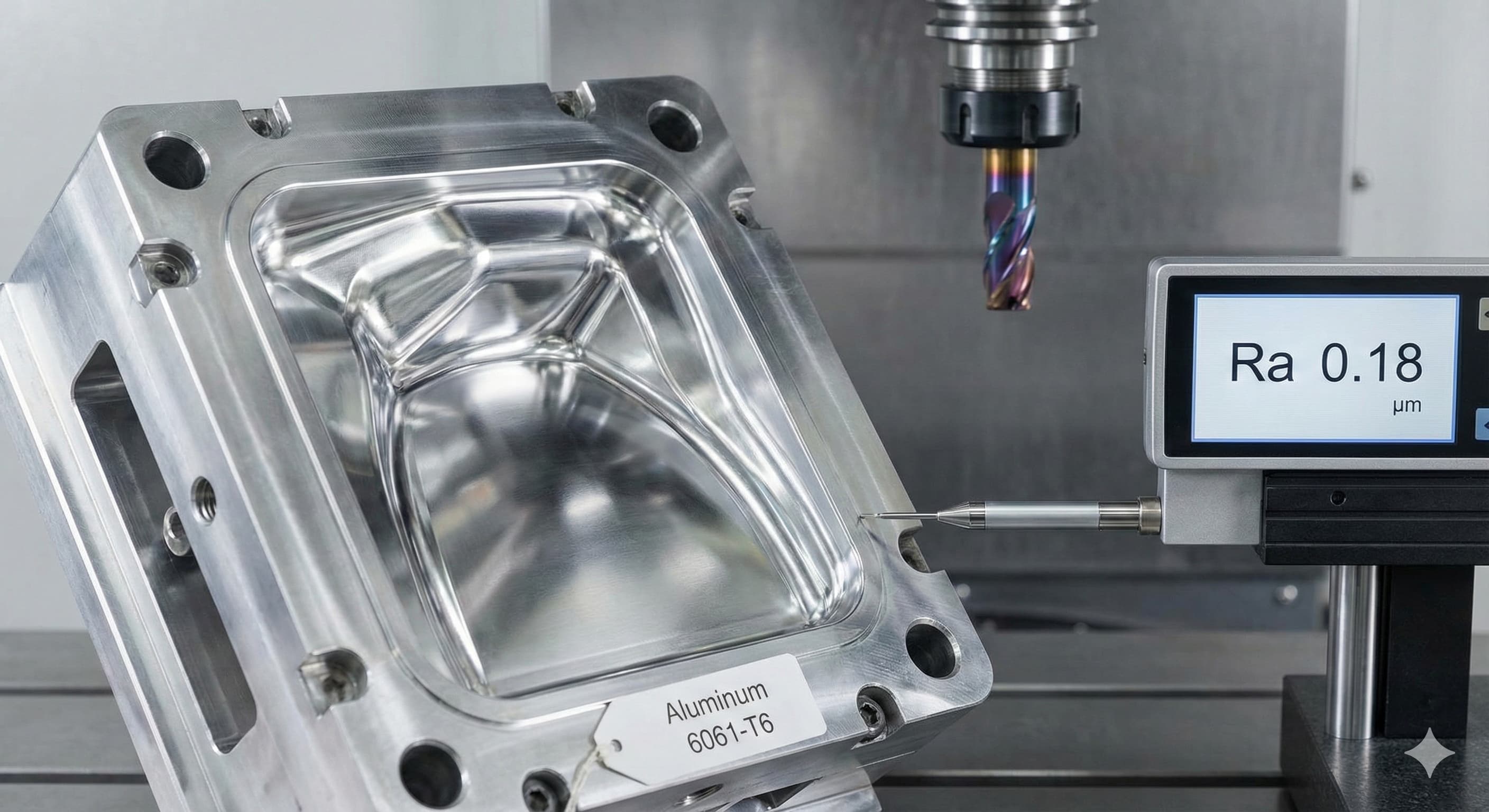
Aluminum mold surface quality directly determines product success in injection molding applications. High-speed machining (HSM) parameters fundamentally alter surface topography through controlled tool-workpiece interactions at elevated cutting speeds, delivering Ra values below 0.2 μm without secondary finishing operations.
Key Takeaways:
- HSM reduces aluminum mold surface roughness by 60-80% compared to conventional machining through optimized chip formation mechanisms
- Spindle speeds exceeding 15,000 RPM with feed rates above 5,000 mm/min eliminate built-up edge formation on aluminum alloys
- Direct correlation exists between cutting velocity and surface finish quality for Al 6061-T6 and Al 7075-T6 mold applications
- Tool path strategies in HSM minimize thermal cycling effects that degrade aluminum surface integrity
Understanding High-Speed Machining Physics for Aluminum Surface Quality
High-speed machining fundamentally alters the material removal mechanism in aluminum through increased cutting velocities that exceed the thermal conductivity limitations of the workpiece material. When machining aluminum alloys at conventional speeds below 300 m/min, heat generation creates localized thermal zones that promote built-up edge formation and work hardening effects. These phenomena directly compromise surface finish quality by creating micro-welding between tool and workpiece materials.
The transition to HSM operating parameters—typically 800-2,000 m/min cutting speeds for aluminum—shifts the heat generation zone into the chip rather than the finished surface. This thermal redistribution occurs because the shortened contact time between cutting tool and workpiece prevents heat transfer into the aluminum substrate. The result manifests as dramatically improved surface finish characteristics with Ra values consistently achieving 0.1-0.3 μm range without secondary operations.
Material property considerations become critical when implementing HSM for aluminum mold applications. Al 6061-T6 exhibits optimal HSM response due to its balanced silicon content (0.4-0.8%) that provides adequate hardness without excessive abrasiveness. The T6 temper condition ensures dimensional stability during high-speed operations by maintaining consistent grain structure throughout the machining process.
Tool geometry optimization specifically for aluminum HSM requires consideration of rake angles between 15-25° positive to minimize cutting forces while maintaining edge strength. Relief angles of 8-12° prevent rubbing contact that generates surface defects. Coating selection focuses on titanium aluminum nitride (TiAlN) or diamond-like carbon (DLC) formulations that resist aluminum adhesion at elevated temperatures.
Spindle Speed and Feed Rate Optimization for Surface Quality
Spindle speed selection directly influences surface finish quality through its effect on chip formation consistency and thermal management. Research data from aluminum mold machining operations demonstrates optimal surface finish occurs when spindle speeds exceed the critical velocity threshold where built-up edge formation transitions to stable shear zone cutting.
For Al 6061-T6 mold applications, this critical threshold typically occurs at spindle speeds above 12,000 RPM when using 10-12 mm diameter end mills. At these speeds, the cutting velocity approaches 400-500 m/min, effectively eliminating the stick-slip cutting action that creates surface irregularities. Feed rate coordination becomes essential to maintain optimal chip load per tooth while achieving maximum surface quality benefits.
| Aluminum Alloy | Optimal Spindle Speed (RPM) | Feed Rate (mm/min) | Achievable Ra (μm) | Typical Applications |
|---|---|---|---|---|
| Al 6061-T6 | 15,000-20,000 | 4,000-6,000 | 0.1-0.2 | Injection molds, tooling |
| Al 7075-T6 | 12,000-18,000 | 3,000-5,000 | 0.15-0.25 | Aerospace molds, fixtures |
| Al 2024-T4 | 10,000-15,000 | 2,500-4,000 | 0.2-0.35 | Prototype molds, soft tooling |
| Al 5083-H111 | 8,000-12,000 | 2,000-3,500 | 0.25-0.4 | Marine applications, forming dies |
The relationship between feed rate and surface quality in aluminum HSM follows predictable patterns based on chip thickness effects. Optimal chip thickness for aluminum typically ranges from 0.05-0.15 mm per tooth, calculated by dividing feed rate by the product of spindle speed and number of cutting edges. Exceeding this range creates excessive cutting forces that deflect the workpiece and compromise surface quality, particularly in thin-walled mold sections.
Advanced HSM strategies employ variable feed rate programming that adjusts cutting parameters based on local geometry complexity. In mold cavity regions with tight radii or deep pockets, feed rates automatically reduce by 20-30% to maintain surface quality while preventing tool breakage. This adaptive approach ensures consistent surface finish across complex mold geometries without manual intervention.
Tool Path Strategy Impact on Aluminum Surface Characteristics
Tool path programming directly influences aluminum surface quality through its control of cutting engagement conditions and thermal cycling effects. Conventional tool paths that employ full radial engagement create excessive heat buildup and tool deflection that manifests as visible machining marks on the finished surface. HSM tool path strategies specifically address these limitations through optimized engagement angles and constant chip load maintenance.
Trochoidal milling represents the most effective tool path approach for aluminum mold cavities, maintaining constant radial engagement between 5-15% of tool diameter while achieving high material removal rates. This strategy prevents the intermittent cutting action that creates surface irregularities while ensuring adequate chip evacuation. The continuous cutting motion eliminates the start-stop marks common in conventional rectangular tool paths.
For high-precision results,Request a free quote and get pricing in 24 hours from Microns Hub.
Climb milling orientation becomes mandatory for aluminum HSM applications due to its superior surface finish characteristics compared to conventional milling. The cutting action in climb milling begins with maximum chip thickness and reduces to zero, creating a shearing action that produces clean surface generation. Conventional milling's opposite chip thickness progression creates rubbing action that work-hardens the aluminum surface and degrades finish quality.
Depth of cut selection requires balance between productivity and surface quality objectives. For aluminum molds requiring Ra values below 0.2 μm, axial depth of cuts should not exceed 0.5-1.0 mm to prevent excessive cutting forces that cause tool deflection. Final finishing passes utilize 0.1-0.2 mm depth of cut with increased feed rates to maintain optimal cutting conditions while achieving superior surface quality.
Material-Specific Considerations for Aluminum Mold Applications
Aluminum alloy selection significantly impacts HSM surface finish outcomes due to inherent material property differences that affect machinability characteristics. Silicon content particularly influences cutting behavior, with alloys containing 0.4-1.2% silicon exhibiting optimal HSM response through improved chip breaking and reduced tool adhesion tendencies.
Al 6061-T6 represents the benchmark aluminum alloy for mold applications due to its balanced composition that promotes excellent surface finish capability. The magnesium-silicon precipitation hardening system provides adequate strength (yield strength 276 MPa) while maintaining machinability characteristics that respond well to HSM parameters. The relatively low copper content (0.15-0.4%) minimizes work hardening tendencies that complicate surface finish achievement.
Temper condition selection critically affects HSM surface quality outcomes. T6 temper provides optimal dimensional stability during high-speed operations through its fully aged microstructure that resists cutting-induced stress effects. T4 temper aluminum exhibits greater tendency toward work hardening during cutting operations, requiring modified HSM parameters to achieve equivalent surface quality results.
| Property | Al 6061-T6 | Al 7075-T6 | Al 2024-T4 | Impact on HSM Surface Finish |
|---|---|---|---|---|
| Yield Strength (MPa) | 276 | 503 | 324 | Higher strength requires lower feed rates |
| Tensile Strength (MPa) | 310 | 572 | 469 | Affects cutting force and tool deflection |
| Hardness (HB) | 95 | 150 | 120 | Harder materials require sharper tools |
| Silicon Content (%) | 0.4-0.8 | 0.4 max | 0.5 max | Higher Si improves chip breaking |
| Surface Finish Ra (μm) | 0.1-0.2 | 0.15-0.25 | 0.2-0.35 | Direct correlation with alloy composition |
Thermal treatment history affects aluminum response to HSM operations through its influence on grain structure and internal stress distribution. Solution heat-treated and artificially aged materials (T6 condition) exhibit superior dimensional stability during HSM compared to naturally aged conditions (T4) that may experience stress relief during cutting operations.
Coolant and Lubrication Strategies for Optimal Surface Quality
Coolant selection and delivery methods critically influence aluminum surface quality achievement in HSM applications through their effects on heat management and chip evacuation efficiency. Traditional flood cooling often proves inadequate for HSM operations due to insufficient heat removal capacity at elevated cutting speeds and the tendency to create chip recutting that degrades surface quality.
Minimum quantity lubrication (MQL) systems deliver superior results for aluminum HSM by providing precise lubricant placement while maintaining the dry cutting benefits that prevent chip adhesion. MQL flow rates of 50-100 ml/hour using synthetic esters or vegetable-based cutting fluids create the optimal balance between lubrication and heat management without compromising chip evacuation.
High-pressure coolant systems operating at 70-150 bar pressure provide exceptional chip evacuation capability essential for maintaining surface quality in deep mold cavities. The coolant jet velocity must exceed chip velocity to ensure effective removal while preventing recutting damage. Proper nozzle positioning becomes critical, with coolant directed both at the cutting zone and chip evacuation path.
Air blast systems complement liquid coolant strategies by ensuring complete chip removal from machined surfaces before subsequent tool passes. Compressed air at 6-8 bar pressure effectively removes aluminum chips that might otherwise create surface scratching or built-up edge formation on cutting tools.
Quality Control and Surface Measurement Techniques
Surface quality verification in aluminum mold applications requires sophisticated measurement techniques that accurately characterize the microscale surface features critical for molding performance. Contact profilometry using stylus instruments provides the most reliable Ra measurement capability, with stylus radius limitations of 2 μm ensuring accurate reproduction of surface texture characteristics.
Non-contact optical measurement systems offer advantages for complex mold geometry evaluation where stylus access becomes problematic. White light interferometry achieves measurement resolution below 0.1 nm, enabling detailed analysis of surface features that influence mold release characteristics and part quality. These systems particularly excel at measuring surface features in tight radius areas and deep cavities where contact methods prove impractical.
When ordering from Microns Hub, you benefit from direct manufacturer relationships that ensure superior quality control and competitive pricing compared to marketplace platforms. Our technical expertise and personalized service approach means every project receives the attention to detail it deserves, with comprehensive surface quality documentation provided for every aluminum mold component.
Statistical process control implementation for aluminum HSM operations requires continuous monitoring of surface quality parameters to identify process drift before it affects part quality. Control charts tracking Ra values across multiple measurement locations enable early detection of tool wear or process parameter deviation that compromises surface quality. Our precision CNC machining services incorporate advanced quality control protocols specifically designed for aluminum mold applications.
Advanced HSM Techniques for Complex Mold Geometries
Complex aluminum mold geometries present unique challenges for HSM surface quality achievement due to varying cutting conditions across different feature types. Deep pocket machining requires specialized strategies that maintain surface quality while ensuring adequate tool rigidity and chip evacuation capability throughout the cutting process.
Multi-axis HSM programming becomes essential for complex mold surfaces where maintaining optimal tool orientation relative to the workpiece surface ensures consistent cutting conditions. Five-axis simultaneous machining enables continuous tool engagement without the gouging and poor surface quality associated with three-axis approximation of curved surfaces. Tool axis vector control maintains constant lead and tilt angles that optimize surface generation across complex geometries.
Adaptive clearing strategies automatically adjust cutting parameters based on local material engagement conditions, ensuring consistent surface quality across varying wall thicknesses and pocket depths. These intelligent tool path algorithms prevent the tool deflection and chatter that commonly degrade surface quality in thin-walled mold sections.
Precision feature machining in aluminum molds often requires specialized micro-HSM techniques that extend traditional HSM principles to extremely small cutting tools and features. Spindle speeds may exceed 40,000 RPM for end mills smaller than 1 mm diameter, requiring specialized consideration of tool dynamics and vibration control.
Cost-Benefit Analysis of HSM for Aluminum Mold Production
Economic justification for HSM implementation in aluminum mold production requires comprehensive analysis of both direct machining costs and downstream quality benefits. Initial equipment investment typically ranges from €150,000-500,000 for HSM-capable machining centers with appropriate spindle specifications and control systems. However, the productivity and quality improvements often justify investment within 12-24 months for moderate to high-volume mold production.
Cycle time reduction represents the most immediate economic benefit, with aluminum mold roughing operations achieving 3-5x productivity improvements compared to conventional machining. Finishing operation benefits prove even more dramatic, with HSM often eliminating secondary polishing operations entirely through direct achievement of required surface quality specifications.
Tool life considerations present complex economic relationships in aluminum HSM applications. While cutting speeds increase dramatically, the improved cutting mechanics and reduced built-up edge formation often extend tool life compared to conventional machining. Carbide end mill costs typically range from €50-200 per tool, with HSM applications achieving 50-150% longer tool life through reduced adhesive wear mechanisms.
Quality-related cost benefits include elimination of secondary finishing operations, reduced rework rates, and improved part quality consistency. Aluminum molds achieving Ra 0.15 μm directly from HSM operations eliminate polishing costs of €200-800 per square meter while reducing lead times by 2-5 days per mold.
| Cost Factor | Conventional Machining | HSM Implementation | Savings Potential | Payback Period |
|---|---|---|---|---|
| Cycle Time (hours/mold) | 40-60 | 12-20 | 60-70% | 6-12 months |
| Secondary Finishing (€/m²) | 400-800 | 0-100 | €300-700/m² | 3-6 months |
| Tool Costs (€/part) | 25-45 | 15-30 | €10-15/part | 12-18 months |
| Quality Control (€/mold) | 200-350 | 100-200 | €100-150/mold | 8-15 months |
| Overall Production Cost | 100% baseline | 60-75% | 25-40% reduction | 12-24 months |
Through our manufacturing services, clients regularly achieve 30-50% cost reductions in aluminum mold production through optimized HSM implementation. The combination of reduced cycle times, eliminated secondary operations, and improved quality consistency creates compelling economic advantages that extend well beyond initial machining cost considerations.
Implementation Guidelines and Best Practices
Successful HSM implementation for aluminum mold applications requires systematic approach to equipment selection, process development, and operator training. Machine tool specifications must include adequate spindle power (typically 15-40 kW), high-speed capability (15,000-40,000 RPM), and precise feed drive systems capable of acceleration rates exceeding 1G for optimal surface quality achievement.
Process development should begin with material characterization testing to establish optimal cutting parameters for specific aluminum alloys and temper conditions. Test cuts using various spindle speed and feed rate combinations enable identification of the optimal parameter window for each application. Surface quality measurement throughout this development process ensures parameter selection based on actual finish requirements rather than theoretical calculations.
Operator training requirements increase significantly for HSM operations due to the critical nature of parameter selection and the reduced margin for error at elevated cutting speeds. Training programs should emphasize understanding of cutting physics, tool path optimization, and quality control procedures specific to aluminum mold applications.
Preventive maintenance programs become critical for HSM equipment due to the demanding operating conditions and precision requirements. Spindle condition monitoring, tool measurement systems, and machine geometry verification require more frequent attention compared to conventional machining operations. Maintenance intervals typically decrease by 30-50% to ensure consistent performance and surface quality capability.
Future Developments in Aluminum HSM Technology
Emerging technologies continue to advance aluminum HSM capabilities through improvements in cutting tool materials, machine tool design, and process monitoring systems. Ultra-fine grain carbide substrates with advanced coating systems enable even higher cutting speeds while maintaining tool life and surface quality benefits.
Artificial intelligence integration in HSM systems promises adaptive parameter optimization that responds to real-time cutting conditions. These systems monitor vibration, acoustic emissions, and power consumption to automatically adjust cutting parameters for optimal surface quality maintenance throughout the machining process.
Additive manufacturing integration with HSM creates hybrid production strategies where complex mold geometries receive near-net-shape printing followed by HSM finishing operations. This approach optimizes both productivity and surface quality while enabling geometric complexity previously impossible through conventional manufacturing methods.
Advanced simulation capabilities enable virtual optimization of HSM processes before physical implementation, reducing development time and ensuring optimal results from initial production runs. These systems accurately predict surface quality outcomes based on material properties, cutting parameters, and tool path strategies.
Frequently Asked Questions
What spindle speeds are required for optimal aluminum mold surface finish in HSM?
Optimal aluminum mold surface finish typically requires spindle speeds exceeding 15,000 RPM for most applications, with specific requirements varying based on tool diameter and aluminum alloy. For Al 6061-T6 using 10-12 mm end mills, speeds of 15,000-20,000 RPM consistently achieve Ra values below 0.2 μm. Higher speeds up to 40,000 RPM benefit smaller diameter tools and more demanding surface quality requirements.
How does HSM eliminate the need for secondary finishing operations on aluminum molds?
HSM eliminates secondary finishing by achieving required surface quality directly through optimized cutting mechanics that prevent built-up edge formation and minimize work hardening effects. The high cutting velocities shift heat generation into the chip rather than the workpiece, enabling direct achievement of Ra values in the 0.1-0.3 μm range that meet injection molding requirements without polishing or EDM finishing.
Which aluminum alloys respond best to HSM for mold applications?
Al 6061-T6 provides the optimal combination of machinability and surface finish capability for HSM mold applications, consistently achieving Ra values of 0.1-0.2 μm. Al 7075-T6 offers higher strength but requires more careful parameter selection to achieve equivalent surface quality. Al 2024-T4 presents challenges due to work hardening tendencies but remains viable for less demanding applications.
What cutting parameters provide the best balance between productivity and surface quality?
Optimal cutting parameters typically combine spindle speeds of 15,000-20,000 RPM with feed rates of 4,000-6,000 mm/min for aluminum molds. Axial depth of cut should remain below 1.0 mm for finishing operations, with radial engagement limited to 5-15% of tool diameter using trochoidal tool paths. These parameters maintain optimal chip load while preventing tool deflection that compromises surface quality.
How does coolant strategy affect aluminum HSM surface quality?
Coolant strategy critically affects surface quality through heat management and chip evacuation control. Minimum quantity lubrication (MQL) at 50-100 ml/hour provides optimal lubrication without chip recutting issues, while high-pressure coolant at 70-150 bar ensures complete chip evacuation. Proper coolant delivery prevents built-up edge formation and maintains consistent cutting conditions essential for superior surface finish.
What quality control methods best verify aluminum mold surface finish from HSM?
Contact profilometry using 2 μm radius stylus provides the most reliable Ra measurement for aluminum mold surfaces, with multiple measurement locations ensuring statistical validity. Non-contact white light interferometry offers advantages for complex geometries and achieves sub-nanometer resolution for detailed surface characterization. Both methods require calibrated equipment and trained operators for accurate results.
What economic benefits justify HSM investment for aluminum mold production?
HSM investment typically achieves payback within 12-24 months through cycle time reductions of 60-70%, elimination of secondary finishing operations costing €300-700/m², and overall production cost reductions of 25-40%. Additional benefits include improved quality consistency, reduced rework rates, and faster delivery times that enhance competitive positioning in the mold manufacturing market.
MICRONS HUB DV Ε.Ε. · VAT: EL803129638 · GEMI: 190254227000 · Industrial Area, Street B, Number 4, 71601 Heraklion, Crete, Greece