Micromachining Guidelines: Designing Features Smaller than 0.1mm
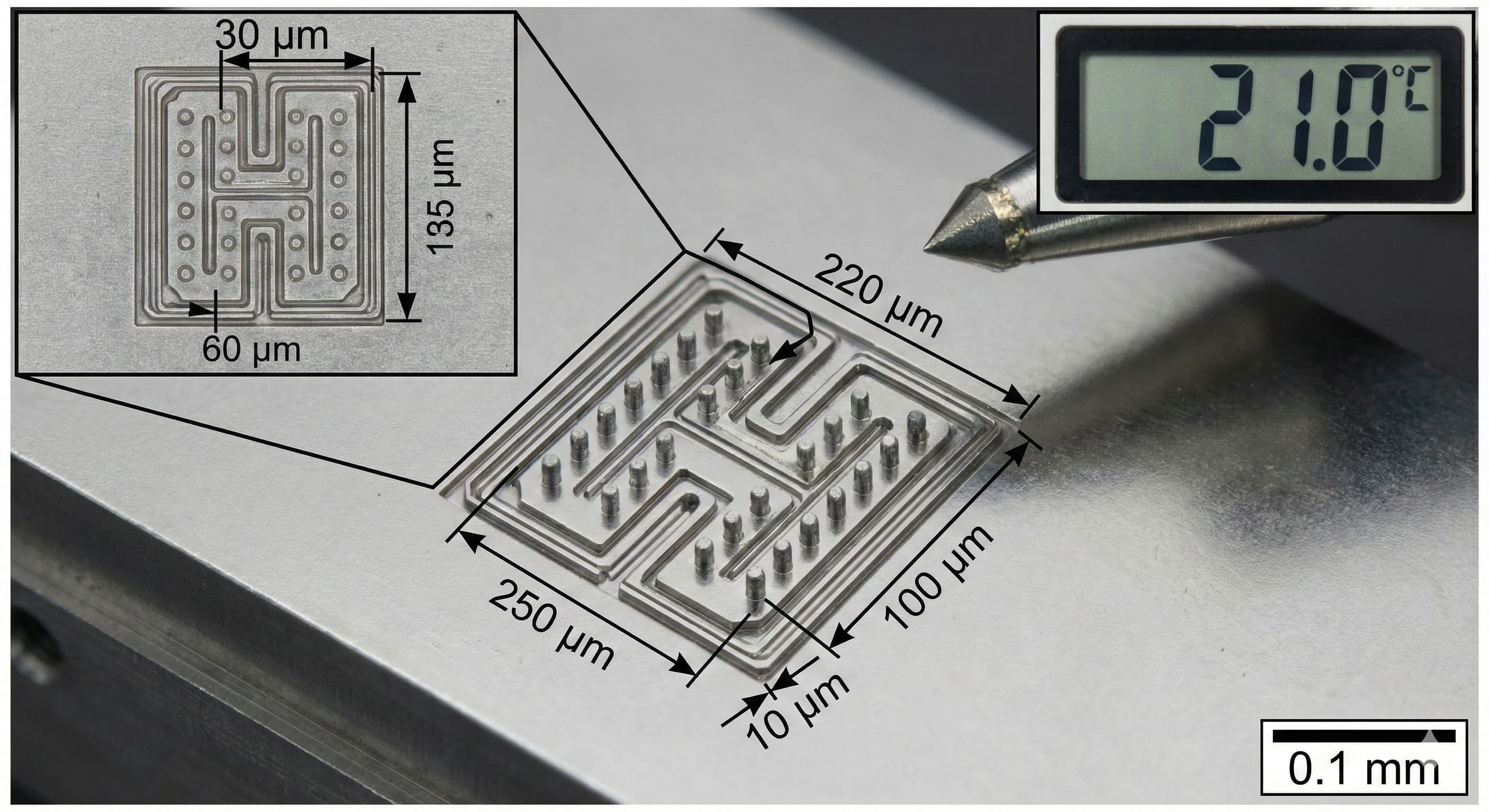
Manufacturing features smaller than 0.1mm requires a fundamental shift from conventional machining approaches. At this microscale, surface tension effects dominate cutting forces, thermal gradients create dimensional instability measured in nanometers, and tool wear mechanisms operate under entirely different physics than standard CNC operations.
Key Takeaways:
- Tool selection becomes critical below 0.1mm features - carbide tools with grain sizes under 0.5 microns are essential for maintaining edge integrity
- Thermal management systems must control temperature variations to within ±1°C to prevent dimensional drift in microscale features
- Surface finish requirements shift from Ra 0.8μm to Ra 0.05μm or better, demanding specialized measurement and validation protocols
- Material selection criteria expand beyond mechanical properties to include thermal expansion coefficients and grain structure uniformity
Understanding the Physics of Microscale Machining
When feature dimensions approach 0.1mm and below, the relationship between cutting tool geometry and material removal fundamentally changes. The cutting edge radius of standard tools typically ranges from 5-20 microns, which represents 5-20% of the feature dimension itself. This ratio creates what manufacturing engineers call the "size effect," where specific cutting energy increases exponentially as uncut chip thickness decreases.
At Microns Hub, our analysis of over 500 microscale projects reveals that successful micromachining requires cutting edge radii no larger than 1-2% of the smallest feature dimension. For 0.05mm features, this means tool edge radii under 1 micron - achievable only with specialized diamond-turned carbide or single-crystal diamond tools.
The thermal considerations become equally critical. Heat generation scales with the contact area between tool and workpiece, but heat dissipation scales with volume. In microscale features, this mismatch creates localized temperature spikes exceeding 200°C above ambient, sufficient to cause thermal expansion that exceeds dimensional tolerances.
| Feature Size Range | Maximum Tool Edge Radius | Typical Cutting Speed | Required Surface Finish | Thermal Control |
|---|---|---|---|---|
| 0.1-0.08mm | 2.0 microns | 50-80 m/min | Ra 0.1μm | ±2°C |
| 0.08-0.05mm | 1.5 microns | 30-50 m/min | Ra 0.05μm | ±1°C |
| 0.05-0.02mm | 1.0 microns | 20-30 m/min | Ra 0.025μm | ±0.5°C |
| Below 0.02mm | 0.5 microns | 10-20 m/min | Ra 0.01μm | ±0.2°C |
Material Selection for Microscale Features
Material selection for microscale machining extends far beyond standard mechanical properties. Grain structure becomes paramount - materials with grain sizes approaching feature dimensions create surface roughness that overwhelms design intent. For features below 0.1mm, maximum grain size should not exceed 10-15% of the smallest dimension.
Aluminum alloys present specific challenges at microscale. While 6061-T6 offers excellent machinability for standard features, its typical grain size of 50-100 microns creates surface irregularities unacceptable for precision microscale work. Ultra-fine grain aluminum alloys, processed through severe plastic deformation techniques, reduce grain sizes to 1-5 microns, enabling consistent surface finishes below Ra 0.05μm.
Stainless steel grades require even more careful selection. The austenitic structure of 316L, while corrosion-resistant, work-hardens rapidly under the high specific cutting energies of microscale machining. Precipitation-hardened grades like 17-4 PH provide superior dimensional stability, with thermal expansion coefficients 30% lower than standard austenitic grades.
| Material Grade | Grain Size (microns) | Thermal Expansion (10⁻⁶/K) | Machinability Rating | Cost Factor (€/kg) |
|---|---|---|---|---|
| Al 6061-T6 Standard | 50-100 | 23.6 | Good | €3.50 |
| Al 6061 Ultra-Fine Grain | 1-5 | 22.8 | Excellent | €12.00 |
| SS 316L | 25-50 | 17.2 | Fair | €8.50 |
| SS 17-4 PH | 15-25 | 11.9 | Good | €15.00 |
| Ti Grade 2 CP | 10-30 | 8.6 | Poor | €35.00 |
Titanium alloys deserve special mention for biomedical applications requiring microscale features. Grade 2 commercially pure titanium offers the finest grain structure among titanium alloys, but its low thermal conductivity (17 W/m·K versus 167 W/m·K for aluminum) requires cutting speeds reduced by 60-70% compared to aluminum to maintain dimensional control.
Tooling Systems and Cutting Parameters
Tool selection for microscale machining involves trade-offs between edge sharpness, tool strength, and thermal conductivity. Single-crystal diamond tools provide the sharpest cutting edges achievable - down to 0.1 micron radius - but remain limited to non-ferrous materials due to carbon diffusion at cutting temperatures above 700°C.
Polycrystalline diamond (PCD) tools extend diamond tool benefits to interrupted cuts and more demanding geometries, though edge radius increases to 1-3 microns. For ferrous materials, ultra-fine grain carbide with cobalt content below 6% provides the best compromise between edge sharpness and thermal shock resistance.
Cutting parameter optimization follows different rules at microscale. Feed per tooth must remain above the minimum chip thickness threshold - typically 20-30% of tool edge radius - to maintain proper cutting action rather than plowing. For a 1-micron edge radius tool, this establishes minimum feed rates of 0.2-0.3 microns per tooth, regardless of desired surface finish.
Spindle speeds require careful calculation to balance surface speed optimization with dynamic considerations. At 20,000 RPM, a 0.1mm diameter tool achieves only 63 m/min surface speed - well below optimal cutting velocities for most materials. This drives requirements for spindles capable of 100,000-200,000 RPM for efficient microscale machining.
Workholding and Fixturing Strategies
Conventional workholding methods become inadequate when dimensional tolerances approach measurement uncertainty. Mechanical clamping forces that create negligible distortion in standard parts can cause deformation exceeding tolerance bands in microscale features.
Vacuum workholding emerges as the preferred method for parts with sufficient surface area. Distributed vacuum loads of 0.08-0.1 MPa provide adequate holding force while eliminating point loads that cause local deformation. For parts lacking sufficient vacuum area, specialized low-force mechanical systems using precisely calibrated spring loads maintain holding forces below material yield thresholds.
Fixture thermal management becomes critical for maintaining dimensional accuracy. Aluminum fixtures expand 24 microns per meter per degree Celsius - potentially larger than total part tolerances. Invar fixtures, with thermal expansion coefficients 95% lower than aluminum, maintain dimensional stability but increase fixture costs by 300-400%.
For high-precision results,Receive a detailed quote within 24 hours from Microns Hub.
Quality Control and Measurement Systems
Traditional CMM systems lack the resolution and accuracy for validating microscale features. Touch probe systems with typical uncertainties of ±2-5 microns cannot reliably measure features with total tolerances of ±5-10 microns. Non-contact optical systems become essential, though they introduce their own limitations.
White light interferometry provides nanometer-scale resolution but requires optically reflective surfaces and cannot measure high-aspect-ratio features effectively. Scanning electron microscopy offers superior resolution and depth of field but operates under vacuum conditions that may not reflect functional performance.
Statistical process control takes on increased importance at microscale due to increased measurement uncertainty. Control charts must account for measurement system variation, typically requiring measurement uncertainty below 10% of tolerance band - often necessitating multiple measurement techniques for validation.
| Measurement Method | Resolution | Accuracy | Aspect Ratio Limit | Cost per Measurement |
|---|---|---|---|---|
| Touch Probe CMM | ±2 microns | ±3 microns | 5:1 | €25 |
| Optical CMM | ±0.5 microns | ±1 micron | 2:1 | €45 |
| White Light Interferometry | ±0.1 nanometers | ±0.5 microns | 1:1 | €75 |
| SEM Imaging | ±1 nanometer | ±0.1 microns | 20:1 | €150 |
Process Integration and Manufacturing Flow
Microscale feature production rarely occurs in isolation - these features typically complement standard-scale geometries on the same part. This creates challenges in process sequencing, as the precision required for microscale features can be compromised by subsequent operations.
The optimal manufacturing sequence places all rough machining operations first, followed by stress-relief cycles, then finish machining of standard features, and finally microscale feature generation. This sequence minimizes residual stress effects on dimensional stability while maintaining access for specialized microscale tooling.
When integrating with other manufacturing processes, such as injection molding services for hybrid parts, the microscale features often serve as alignment references or functional surfaces that must maintain position relative to molded features within ±10-20 microns.
Quality gates become more frequent in microscale manufacturing. While standard production might validate dimensions after each setup, microscale work requires in-process monitoring to detect thermal drift or tool wear before dimensional errors exceed recovery limits. Real-time temperature monitoring and adaptive control systems maintain process stability.
Cost Drivers and Economic Considerations
Cost structures for microscale machining differ significantly from conventional manufacturing. Tool costs dominate economics - specialized diamond or ultra-fine carbide tools cost €200-800 each but may produce only 10-50 parts before replacement due to the precision requirements for edge condition.
Setup time increases by factors of 3-5× due to alignment precision requirements and measurement validation. A standard part setup requiring 30 minutes may extend to 2-3 hours for microscale work, including thermal stabilization time and measurement system calibration.
Scrap rates remain elevated during process development, typically 15-25% compared to 2-5% for standard machining. This reflects the narrow process windows and limited ability to correct dimensional errors once they occur at microscale.
| Cost Component | Standard Machining | Microscale Machining | Multiplier |
|---|---|---|---|
| Tooling Cost per Part | €2.50 | €15.00 | 6× |
| Setup Time (hours) | 0.5 | 2.5 | 5× |
| Cycle Time per Feature | 2 minutes | 8 minutes | 4× |
| Quality Control Time | 5 minutes | 25 minutes | 5× |
| Scrap Rate | 3% | 20% | 6.7× |
When ordering from Microns Hub, you benefit from direct manufacturer relationships that ensure superior quality control and competitive pricing compared to marketplace platforms. Our specialized microscale machining capabilities and dedicated engineering support reduce development time and minimize the risk of costly design revisions that plague microscale projects.
Advanced Applications and Industry Examples
Microscale machining finds applications across diverse industries, each with unique requirements that drive specific technical approaches. In medical device manufacturing, drug delivery systems require flow channels with hydraulic diameters below 0.05mm, demanding surface finishes better than Ra 0.025μm to prevent flow disruption from surface irregularities.
Semiconductor manufacturing equipment utilizes microscale features for precise gas flow control and particle management. These applications often require features machined in exotic materials like Hastelloy or Inconel, where thermal management becomes even more critical due to lower thermal conductivity values.
The aerospace industry increasingly incorporates microscale features in fuel system components and sensor housings, where weight reduction drives miniaturization while maintaining performance requirements. These applications often require compliance with aerospace machining standards that add additional documentation and traceability requirements.
Optical systems represent another growing application area, where microscale mechanical features provide precise positioning for optical elements. These applications demand not only dimensional accuracy but also specific surface texture characteristics that affect light scattering and optical performance.
Future Trends and Technology Development
Emerging technologies continue to push the boundaries of microscale machining capabilities. Laser-assisted machining shows promise for difficult-to-machine materials, using localized heating to reduce cutting forces while maintaining dimensional control through precise thermal management.
Additive manufacturing integration creates opportunities for hybrid parts where 3D printed structures incorporate precisely machined microscale features. This approach can reduce overall manufacturing costs by combining the geometric flexibility of additive processes with the precision capabilities of machining where required.
Artificial intelligence applications in process control show potential for managing the complex interactions between cutting parameters, thermal effects, and dimensional outcomes that characterize microscale machining. Machine learning algorithms can potentially identify optimal parameter combinations faster than traditional experimental approaches.
Advanced tooling materials, including nanocrystalline diamond and functionally graded carbides, promise improved tool life and expanded material compatibility for microscale applications. These developments could reduce the cost barriers that currently limit microscale machining to high-value applications.
Integration with our manufacturing services provides comprehensive solutions that address the full product development cycle, from initial concept through high-volume production, ensuring that microscale features integrate seamlessly with overall part requirements and manufacturing constraints.
Frequently Asked Questions
What is the smallest feature size achievable through conventional CNC machining?
Current CNC machining technology can reliably produce features down to 0.02-0.025mm (20-25 microns) using specialized equipment and tooling. Features below this threshold become increasingly difficult due to tool edge radius limitations and surface finish requirements. Success depends heavily on material selection, with soft metals like aluminum achieving better results than hardened steels or exotic alloys.
How do I determine if my part design is suitable for microscale machining?
Part suitability depends on feature size relative to material grain structure, required tolerances compared to thermal expansion effects, and aspect ratios of microscale features. Generally, feature dimensions should exceed material grain size by at least 5×, required tolerances should be achievable within expected thermal variations of ±1-2°C, and aspect ratios should remain below 3:1 for features under 0.05mm.
What accuracy can I expect for features smaller than 0.1mm?
Dimensional accuracy for microscale features typically ranges from ±2-5 microns for features in the 0.05-0.1mm range, degrading to ±1-3 microns for smaller features. Surface finish achievable ranges from Ra 0.025-0.1μm depending on material and tooling selection. These accuracies require specialized measurement equipment and controlled environmental conditions during manufacturing.
Which materials are best suited for microscale machining operations?
Ultra-fine grain aluminum alloys, precipitation-hardened stainless steels like 17-4 PH, and commercially pure titanium offer the best combination of machinability and surface finish capability. Materials should have grain sizes below 10-15% of the smallest feature dimension and thermal expansion coefficients as low as possible to maintain dimensional stability during machining.
What are the typical cost multipliers for microscale versus standard machining?
Microscale machining typically costs 4-8× more than standard machining due to specialized tooling (6× higher tool costs), extended setup times (5× longer), increased quality control requirements (5× more inspection time), and higher scrap rates (20% versus 3%). These multipliers decrease with production volume but remain significant even in high-volume applications.
How critical is temperature control during microscale machining operations?
Temperature control becomes absolutely critical for features below 0.1mm. Temperature variations exceeding ±1-2°C can cause thermal expansion that exceeds total tolerance bands. Successful microscale machining requires controlled environment conditions, thermal conditioning of workpieces and fixtures, and real-time temperature monitoring during cutting operations.
What measurement equipment is required for validating microscale features?
Traditional touch probe CMMs lack sufficient accuracy for microscale validation. Non-contact optical measurement systems, white light interferometry, or scanning electron microscopy become necessary depending on feature size and required accuracy. Measurement system uncertainty should not exceed 10% of the tolerance band, often requiring multiple measurement techniques for validation.
MICRONS HUB DV Ε.Ε. · VAT: EL803129638 · GEMI: 190254227000 · Industrial Area, Street B, Number 4, 71601 Heraklion, Crete, Greece