Investment Casting (Lost Wax): Achieving Impossible Geometries in Steel
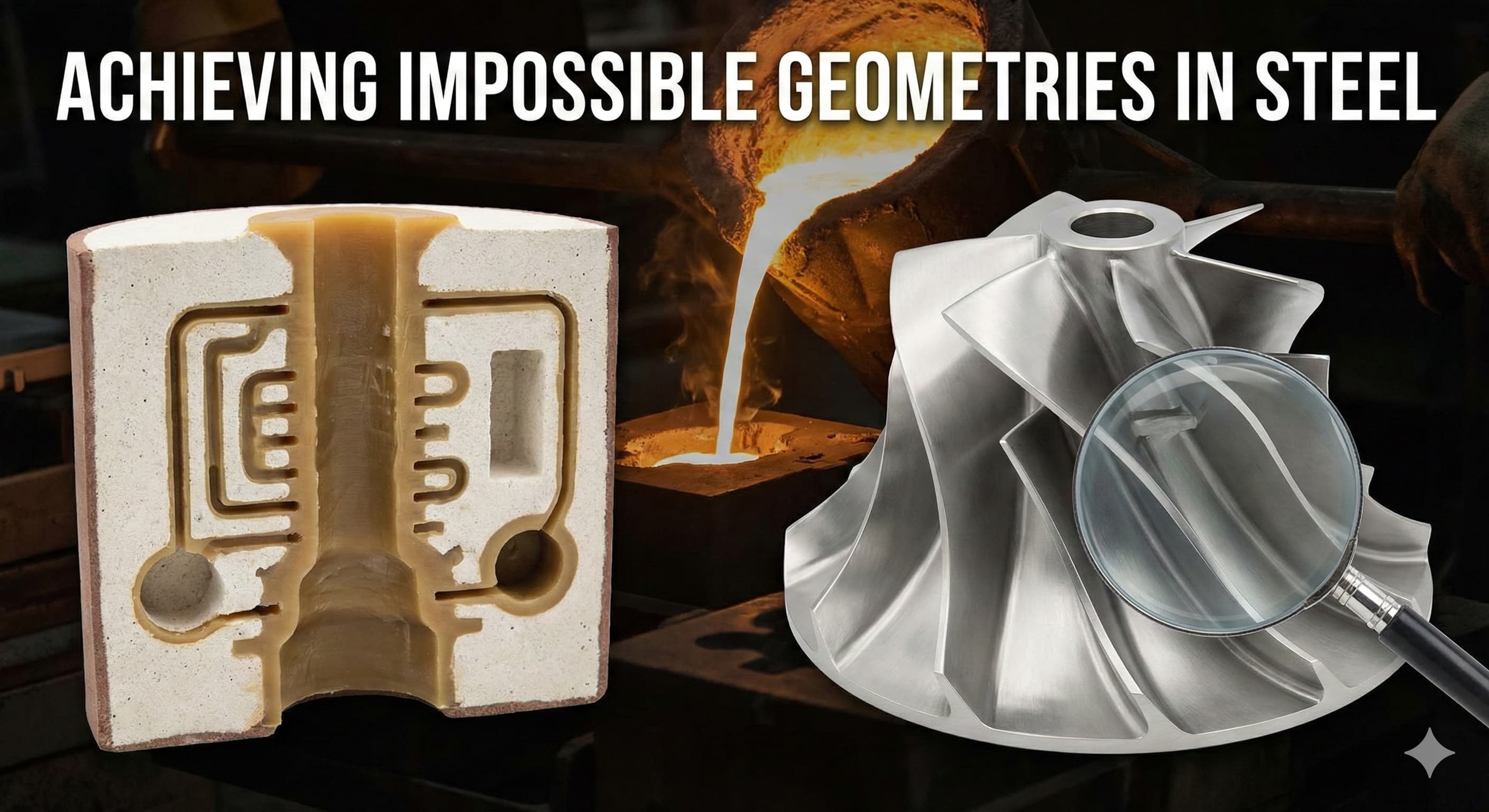
Steel components requiring impossible geometries—internal cooling channels, undercuts spanning multiple axes, and hollow cavities with no machining access—represent manufacturing's ultimate challenge. Investment casting transforms these engineering impossibilities into production realities through controlled metallurgy and precision mold dissolution.
Key Takeaways:
- Investment casting achieves steel geometries impossible through conventional machining, including complex internal channels and multi-directional undercuts
- Surface finishes reach Ra 1.6-3.2 μm directly from casting, eliminating secondary operations for many applications
- Wall thickness control maintains ±0.2 mm consistency across complex geometries while achieving dimensional tolerances of ±0.1 mm per 25 mm
- Material properties match or exceed wrought steel equivalents, with proper alloy selection and heat treatment protocols
The Physics of Impossible Geometries
Investment casting's fundamental advantage lies in its ability to create internal voids and complex external surfaces through expendable pattern dissolution. Unlike conventional manufacturing where tool access dictates design limitations, investment casting forms geometries by removing wax patterns that can be shaped without mechanical constraints.
The process begins with injection molding wax patterns that incorporate every detail of the final steel component. These patterns include internal passages, external undercuts, and surface textures that would require multiple setups or remain impossible through traditional machining. The wax's low melting point (60-70°C) enables complete removal from even the most intricate ceramic shell molds.
Ceramic shell construction uses progressive dipping cycles with increasingly coarse refractory materials. The initial prime coat, typically colloidal silica with 200-mesh silica flour, captures surface details down to 0.025 mm. Subsequent backup coats build structural integrity using aluminum oxide or zirconium silicate aggregates, creating shells capable of withstanding steel pouring temperatures exceeding 1600°C.
Steel solidification within these ceramic molds produces near-net-shape components requiring minimal finishing. The controlled cooling environment prevents the rapid thermal gradients that cause distortion in conventional casting methods. Internal geometries maintain dimensional accuracy because the ceramic shell provides uniform support throughout the solidification process.
Material Selection and Metallurgical Control
Steel alloy selection for investment casting requires balancing fluidity during pouring with final mechanical properties. Low-carbon steels (0.08-0.15% carbon) provide excellent castability and weldability but limited strength. Medium-carbon grades (0.30-0.50% carbon) offer superior mechanical properties while maintaining adequate fluidity for complex geometries.
Stainless steel alloys present specific advantages for investment casting applications. Austenitic grades like 316L demonstrate excellent fluidity and corrosion resistance, making them ideal for components with intricate internal cooling passages. Martensitic grades such as 17-4 PH provide high strength after precipitation hardening while maintaining good casting characteristics.
| Steel Grade | Carbon Content (%) | Tensile Strength (MPa) | Casting Fluidity | Heat Treatment Required |
|---|---|---|---|---|
| 1010 Low Carbon | 0.08-0.13 | 365-400 | Excellent | Normalizing |
| 1045 Medium Carbon | 0.43-0.50 | 570-700 | Good | Quench & Temper |
| 316L Stainless | 0.03 max | 515-620 | Excellent | Solution Annealing |
| 17-4 PH Stainless | 0.07 max | 930-1100 | Good | Precipitation Hardening |
| 4140 Alloy | 0.38-0.43 | 655-850 | Fair | Quench & Temper |
Microstructural control through controlled solidification rates enables optimization of grain structure and mechanical properties. Directional solidification techniques, where applicable, align grain boundaries to enhance fatigue resistance in critical load directions. This becomes particularly important for components with stress concentrations around complex geometric features.
Degassing procedures remove hydrogen and other dissolved gases that could cause porosity in thin sections or complex geometries. Vacuum degassing during melting, combined with proper gating design, ensures sound castings even in challenging configurations where trapped gas could compromise integrity.
Dimensional Accuracy and Tolerance Achievement
Investment casting dimensional accuracy depends on controlling shrinkage through multiple process stages. Wax pattern dimensions must compensate for both wax shrinkage during cooling and steel shrinkage during solidification. Steel alloys typically shrink 1.5-2.1% linearly during cooling from pouring temperature to room temperature.
Pattern tooling incorporates these shrinkage factors plus additional allowances for machining critical surfaces. CNC-machined aluminum tools maintain dimensional stability across production runs while enabling rapid design iterations. Tool surface finishes of Ra 0.4 μm transfer directly to wax patterns and subsequently to cast steel surfaces.
Geometric complexity affects achievable tolerances through its impact on heat extraction and solidification patterns. Simple geometries readily achieve ±0.08 mm per 25 mm, while complex configurations with varying section thickness may require ±0.13 mm per 25 mm tolerances. Critical dimensions often receive machining allowances of 0.4-0.8 mm to guarantee final accuracy through finish operations.
Wall thickness consistency presents unique challenges in complex geometries where multiple flow paths converge. Minimum wall thickness typically ranges from 1.5 mm for small components to 3.0 mm for larger castings. Maximum thickness should not exceed 25 mm without incorporating design features to control solidification shrinkage.
When comparing manufacturing approaches,die casting vs. CNC machining economics often favor investment casting for complex steel geometries despite higher initial tooling costs. The ability to eliminate multiple secondary operations frequently provides substantial cost advantages for production volumes exceeding 100 pieces annually.
Surface Quality and Finish Control
As-cast surface finishes in investment casting rival many secondary finishing operations. The ceramic shell's fine prime coat reproduces pattern surface textures with minimal degradation. Typical as-cast finishes range from Ra 1.6 μm on simple surfaces to Ra 3.2 μm in complex areas with multiple draft angles.
Surface finish optimization begins with pattern preparation and ceramic shell composition. Wax pattern surfaces polished to Ra 0.4 μm consistently produce cast surfaces below Ra 2.0 μm when combined with appropriate shell materials. Colloidal silica binders create denser shell surfaces compared to ethyl silicate systems, resulting in superior finish transfer.
Pattern removal techniques significantly impact final surface quality. Steam dewaxing provides controlled wax elimination while preserving shell surface integrity. Flash firing at 900-1000°C removes residual wax while developing shell strength necessary for steel pouring temperatures.
Critical surfaces requiring superior finishes benefit from specialized techniques during casting or post-processing. Controlled atmosphere melting prevents oxide formation that could degrade surface appearance. Shot peening using glass bead media removes minor surface imperfections while imparting beneficial compressive stresses.
| Surface Treatment | Achievable Ra (μm) | Process Time | Cost Impact | Applications |
|---|---|---|---|---|
| As-Cast Standard | 1.6-3.2 | None | Baseline | General Components |
| Shot Peening | 1.0-2.0 | 15-30 min | +15% | Fatigue Critical Parts |
| Electropolishing | 0.2-0.8 | 2-4 hours | +40% | Medical/Food Service |
| Machined Critical Surfaces | 0.4-1.6 | Variable | +25% | Sealing Surfaces |
Design Optimization for Complex Geometries
Successful investment casting design requires understanding how molten steel flows through complex passages and solidifies within intricate geometries. Flow analysis software predicts filling patterns and identifies potential defect locations before tooling fabrication begins.
Internal passages present specific design challenges requiring careful attention to minimum dimensions and accessibility. Circular cross-sections provide optimal flow characteristics, with minimum diameters of 2.0 mm for reliable casting. Square or rectangular passages should maintain minimum dimensions of 2.5 mm with generous corner radii to prevent flow restriction.
Draft angles facilitate pattern removal while minimizing impact on final geometry. External surfaces typically require 1-3 degrees of draft depending on depth and complexity. Internal passages may eliminate draft angles entirely since pattern removal occurs through melting rather than mechanical extraction.
Undercuts and reverse tapers, impossible in conventional casting, become routine features in investment casting. Multi-directional undercuts require careful pattern design to ensure complete wax removal during dewaxing cycles. Core supports within hollow sections must be engineered to maintain position during shell building and pattern removal.
For high-precision results,receive a detailed quote within 24 hours from Microns Hub.
Gating and risering system design directly impacts casting quality in complex geometries. Multiple gate locations prevent cold shuts in components with extensive thin sections or complex flow paths. Riser placement must ensure directional solidification while avoiding interference with critical geometric features.
Cost Analysis and Economic Considerations
Investment casting economics for complex steel geometries reflect the interplay between tooling costs, material utilization, and eliminated secondary operations. Pattern tooling represents the primary cost driver, typically ranging from €2,000 for simple geometries to €15,000 for complex multi-cavity configurations.
Material costs in investment casting include not only the steel alloy but also ceramic shell materials, wax patterns, and energy for multiple heating cycles. Steel utilization rates of 60-75% compare favorably with subtractive manufacturing where complex geometries may waste 80% or more of the starting material.
Volume considerations significantly impact per-piece economics. Setup costs for shell building, pattern preparation, and melting operations spread across production quantities to determine unit costs. Break-even analysis typically shows advantages over machining for quantities exceeding 50-100 pieces annually, depending on geometric complexity.
| Production Volume | Tooling Amortization | Per-Piece Cost (€) | Break-Even vs Machining | Lead Time |
|---|---|---|---|---|
| 25-50 pieces | €40-80 | €85-120 | Marginal | 4-6 weeks |
| 100-250 pieces | €15-30 | €45-75 | Favorable | 3-4 weeks |
| 500-1000 pieces | €5-12 | €25-45 | Strong Advantage | 2-3 weeks |
| 2000+ pieces | €2-6 | €18-35 | Significant Savings | 2-3 weeks |
Secondary operation elimination provides substantial cost benefits for complex geometries. Components requiring multiple machining setups, EDM operations, or assembly of multiple parts often justify investment casting even at lower volumes. The ability to incorporate mounting bosses, cooling channels, and cosmetic details directly in the casting eliminates numerous manufacturing steps.
Quality Control and Inspection Protocols
Quality assurance for investment cast steel components with complex geometries requires specialized inspection techniques capable of evaluating internal features and intricate external surfaces. Dimensional inspection using coordinate measuring machines (CMM) provides comprehensive geometric verification but may require specialized fixtures for complex shapes.
Non-destructive testing becomes critical for components with internal passages or hollow sections where visual inspection cannot detect potential defects. Radiographic testing reveals internal porosity, inclusions, or incomplete fill conditions that could compromise performance. Penetrant testing on external surfaces identifies surface-breaking defects that might affect cosmetic or functional requirements.
Computed tomography (CT) scanning provides three-dimensional analysis of internal geometries, enabling verification of passage dimensions, wall thickness consistency, and detection of internal defects. This technology proves particularly valuable for complex components where traditional inspection methods cannot access critical areas.
Metallurgical testing ensures proper microstructure and mechanical properties in cast steel components. Tensile testing, hardness verification, and microstructural analysis confirm that heat treatment procedures achieved desired properties throughout the casting cross-section.
Advanced Applications and Case Studies
Aerospace components demonstrate investment casting's capability to produce impossible geometries in high-performance steel alloys. Turbine engine components with internal cooling passages, multiple airfoil sections, and integrated mounting features exemplify the process's geometric capabilities. These components often incorporate cooling channels with hydraulic diameters below 1.0 mm while maintaining structural integrity under extreme operating conditions.
Medical device applications leverage investment casting's ability to produce complex geometries with superior surface finishes. Surgical instruments with integral hinges, internal mechanisms, and ergonomic handles demonstrate the process's precision and surface quality capabilities. Biocompatible steel alloys like 316LVM achieve medical-grade surface finishes directly from casting.
Industrial tooling represents another significant application area where complex geometries provide functional advantages. Injection molding tools with integral cooling circuits, complex surface textures, and multiple cavity configurations benefit from investment casting's geometric freedom. When comparing with other manufacturing methods, our specialized injection molding services often complement investment cast tooling for optimal production efficiency.
Automotive applications increasingly utilize investment casting for components requiring weight reduction through complex internal geometries. Turbocharger housings with optimized flow passages, brake components with integral cooling features, and suspension elements with hollow construction demonstrate the automotive industry's adoption of investment casting for performance-critical applications.
When ordering from Microns Hub, you benefit from direct manufacturer relationships that ensure superior quality control and competitive pricing compared to marketplace platforms. Our technical expertise and personalized service approach means every project receives the attention to detail it deserves, particularly for complex investment casting applications requiring precise geometric control.
The integration of investment casting with other manufacturing processes creates hybrid approaches that optimize both cost and performance. Components may incorporate cast complex geometries with machined critical surfaces, combining the geometric freedom of casting with the precision of conventional machining where required. This approach through our manufacturing services often provides optimal solutions for challenging applications.
Future Developments and Emerging Technologies
Advanced simulation software continues improving investment casting design optimization for complex geometries. Computational fluid dynamics (CFD) modeling predicts metal flow patterns through intricate passages, enabling design refinement before tooling fabrication. Solidification modeling identifies potential defect locations and optimizes cooling rates throughout complex cross-sections.
Additive manufacturing integration offers new possibilities for pattern production and complex geometry achievement. 3D printed wax patterns enable rapid prototyping of complex geometries while maintaining the dimensional accuracy required for investment casting. This technology particularly benefits low-volume applications where conventional pattern tooling costs become prohibitive.
Ceramic shell technology development focuses on improved surface finish transfer and dimensional stability. Advanced refractory materials and binder systems enable finer surface reproduction while maintaining the high-temperature strength required for steel casting applications.
Automation advances in shell building, pattern handling, and finishing operations reduce labor costs while improving consistency. Robotic systems handle complex geometries more reliably than manual operations, particularly for components with delicate features that could be damaged during processing.
Frequently Asked Questions
What minimum wall thickness can investment casting achieve in steel components?
Investment casting typically achieves minimum wall thickness of 1.5 mm for small steel components and 3.0 mm for larger castings. Thinner sections may be possible in specific geometries but require careful evaluation of filling characteristics and structural integrity. Local thin sections can often achieve 1.0 mm thickness when supported by heavier adjacent sections.
How does investment casting compare to CNC machining for complex internal geometries?
Investment casting excels for internal geometries that machining cannot access, such as cooling channels, hollow chambers, and complex internal passages. While machining achieves superior dimensional accuracy on accessible surfaces, investment casting produces near-net-shape internal features that would require EDM or other specialized processes. Cost advantages typically favor investment casting for volumes above 100 pieces annually.
What dimensional tolerances are achievable on complex investment cast steel parts?
Standard dimensional tolerances range from ±0.08 mm per 25 mm for simple geometries to ±0.13 mm per 25 mm for complex configurations. Critical dimensions often receive ±0.05 mm tolerances through selective machining of cast surfaces. Geometric complexity, section thickness variations, and alloy selection all influence achievable tolerances.
Can investment casting produce steel components with multiple undercuts and reverse drafts?
Yes, investment casting excels at producing multiple undercuts and reverse drafts that would be impossible in conventional casting or machining. The expendable wax pattern allows unlimited geometric complexity since pattern removal occurs through melting rather than mechanical extraction. Design considerations focus on ensuring complete wax removal during dewaxing cycles.
What surface finishes can be achieved directly from investment casting in steel?
As-cast surface finishes typically range from Ra 1.6 μm to Ra 3.2 μm depending on geometry complexity and ceramic shell preparation. Superior finishes down to Ra 1.0 μm are achievable on simple surfaces with optimized shell systems. Many applications use as-cast surfaces without secondary finishing, particularly where cosmetic surface requirements can accommodate typical casting textures.
How long does the investment casting process take for complex steel geometries?
Lead times typically range from 2-6 weeks depending on pattern tooling complexity, shell building cycles, and finishing requirements. Simple geometries with existing tooling may complete in 2-3 weeks, while complex configurations requiring new pattern development may require 4-6 weeks for first articles. Production quantities generally ship within 2-3 weeks after pattern approval.
What steel alloys work best for investment casting of complex geometries?
Low-carbon steels (1010, 1020) provide excellent castability and work well for complex geometries requiring good flow characteristics. Stainless steel grades like 316L and 17-4 PH combine good casting properties with corrosion resistance. Medium-carbon alloys (1045, 4140) offer higher strength but require more careful gating design for complex geometries. Alloy selection should balance casting fluidity with required mechanical properties.
MICRONS HUB DV Ε.Ε. · VAT: EL803129638 · GEMI: 190254227000 · Industrial Area, Street B, Number 4, 71601 Heraklion, Crete, Greece