Heat Treating Cast Aluminum: T6 Temper Explained for Structural Parts
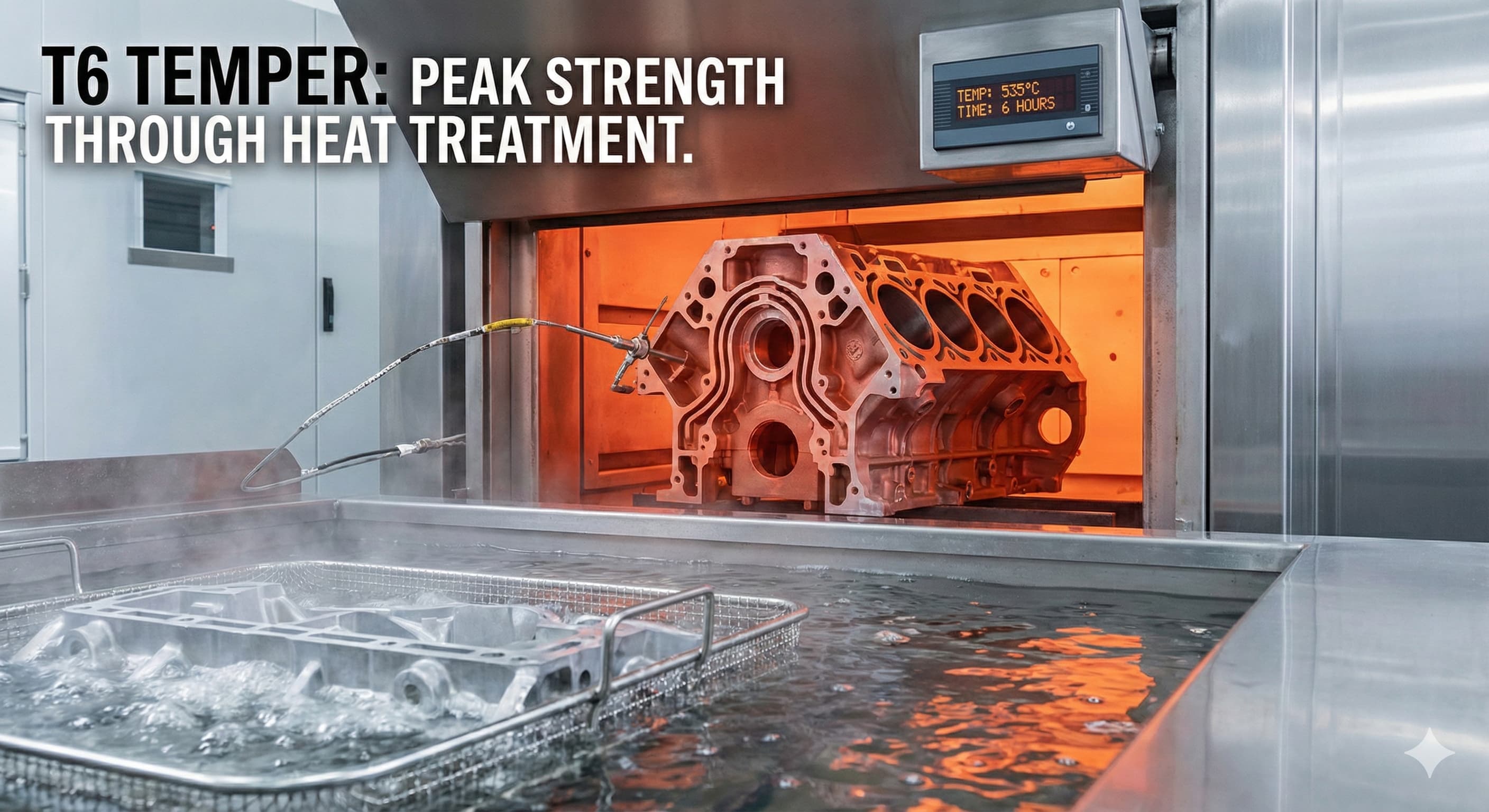
Cast aluminum components demand precise heat treatment to achieve optimal structural performance. T6 temper represents the pinnacle of precipitation hardening for aluminum castings, delivering maximum strength through controlled solution heat treatment and artificial aging. For engineers designing critical structural parts, understanding the metallurgical transformations and processing parameters becomes essential for achieving consistent mechanical properties and dimensional stability.
Key Takeaways
- T6 temper achieves peak strength through solution treatment at 515-540°C followed by artificial aging at 160-175°C
- Proper quenching rates and aging parameters directly impact final tensile strength, which can reach 310 MPa in A356-T6 alloys
- Dimensional stability requires careful control of thermal gradients during solution treatment to prevent warping in complex geometries
- Cost optimization balances energy consumption, cycle time, and quality requirements across different furnace configurations
The T6 temper designation represents a specific sequence of thermal treatments that transforms cast aluminum from its as-cast condition into a precipitation-hardened structure. This process involves dissolving alloying elements at elevated temperatures, rapidly cooling to create a supersaturated solid solution, and then aging at controlled temperatures to precipitate strengthening phases.
Metallurgical Principles of T6 Heat Treatment
The foundation of T6 temper lies in precipitation hardening, where dissolved alloying elements form fine precipitates that obstruct dislocation movement. In aluminum-silicon casting alloys like A356, magnesium and silicon combine to form Mg2Si precipitates during the aging process. The solution treatment phase dissolves these elements into the aluminum matrix at temperatures between 515-540°C, depending on the specific alloy composition.
Silicon content significantly influences the solution treatment temperature. A356 alloy, containing 6.5-7.5% silicon, requires solution temperatures of 535-540°C to achieve complete dissolution of magnesium silicide phases. Lower silicon alloys like A319 operate effectively at 515-525°C, while high-silicon alloys may require temperatures approaching 545°C.
The supersaturated solid solution created during quenching remains metastable at room temperature. Artificial aging at 160-175°C for 4-12 hours triggers controlled precipitation of Mg2Si phases. The precipitate size and distribution directly determine final mechanical properties, with peak strength occurring when precipitates reach optimal size for maximum dislocation interaction.
Solution Heat Treatment Process Parameters
Solution treatment requires precise temperature control and uniform heating throughout the casting cross-section. Furnace atmosphere becomes critical, as excessive oxidation can create surface defects and alter heat transfer characteristics. Protective atmospheres using nitrogen or controlled air circulation maintain surface integrity while ensuring even temperature distribution.
Soaking time calculations depend on section thickness and alloy composition. Thin sections under 6 mm typically require 2-4 hours at solution temperature, while thick sections exceeding 25 mm may need 8-12 hours for complete homogenization.Large cast components present particular challenges in achieving uniform solution treatment due to thermal mass variations and section thickness differences.
Temperature uniformity within ±5°C across the entire casting ensures consistent precipitate dissolution. Thermocouples positioned at critical locations monitor temperature gradients, particularly in complex geometries with varying section thickness. Advanced furnace control systems maintain temperature profiles that accommodate different heating rates for thin and thick sections.
| Alloy Grade | Solution Temperature (°C) | Soaking Time (hours) | Quench Temperature (°C) |
|---|---|---|---|
| A356-T6 | 535-540 | 4-8 | 65-80 |
| A319-T6 | 515-525 | 6-10 | 65-80 |
| A380-T6 | 515-520 | 2-4 | 65-80 |
| AlSi7Mg0.3-T6 | 535-540 | 4-6 | 65-80 |
Quenching Requirements and Critical Cooling Rates
The quenching phase determines the effectiveness of subsequent aging by controlling the retention of dissolved alloying elements. Water quenching provides the most rapid cooling rates, typically 50-200°C per second, essential for maintaining supersaturation in most aluminum casting alloys. Quench water temperature affects cooling rates significantly, with optimal temperatures ranging from 65-80°C.
Polymer quenchants offer controlled cooling rates that reduce distortion risk while maintaining adequate supersaturation. These solutions, typically 8-15% polyalkylene glycol concentration, provide cooling rates of 20-80°C per second. The polymer concentration adjusts cooling characteristics, with higher concentrations reducing cooling rates and associated thermal stresses.
Critical cooling rates vary by alloy composition and section thickness. A356 alloy requires minimum cooling rates of 30°C per second through the critical temperature range of 400-250°C to prevent premature precipitation during quenching. Thicker sections may require more aggressive quenching or modified alloy compositions to achieve adequate cooling rates at the center.
Quench delay time between solution treatment and quenching must remain under 10 seconds to prevent precipitation at elevated temperatures. Automated transfer systems minimize this delay while ensuring proper part orientation during quenching. Parts with complex geometries require careful positioning to prevent air entrapment and ensure uniform cooling.
Artificial Aging Process Control
Artificial aging transforms the supersaturated solid solution into a precipitation-hardened structure through controlled heating. The aging temperature of 160-175°C provides sufficient thermal energy for precipitate nucleation and growth while maintaining fine precipitate size for maximum strengthening effect. Higher temperatures accelerate aging but may result in overaging and reduced strength.
Time-temperature relationships during aging follow predictable curves, with peak strength typically occurring after 4-8 hours at 175°C or 8-12 hours at 160°C. Extended aging beyond peak strength conditions results in precipitate coarsening and strength reduction. This overaging phenomenon becomes critical in production scheduling, as parts held at temperature beyond optimal times exhibit reduced mechanical properties.
Aging furnace design requires excellent temperature uniformity and air circulation to ensure consistent aging across all parts in a load. Temperature variations exceeding ±3°C can create property variations that affect structural performance. Forced air circulation systems maintain uniform heating while preventing hot spots that could cause localized overaging.
For high-precision results,Get your custom quote delivered in 24 hours from Microns Hub.
| Aging Temperature (°C) | Time to Peak (hours) | Tensile Strength (MPa) | Yield Strength (MPa) |
|---|---|---|---|
| 160 | 8-12 | 280-310 | 215-240 |
| 165 | 6-8 | 285-315 | 220-245 |
| 170 | 4-6 | 290-320 | 225-250 |
| 175 | 3-5 | 295-325 | 230-255 |
Quality Control and Property Verification
Mechanical property testing validates the effectiveness of T6 heat treatment through standardized test methods. Tensile testing per ASTM B557 provides primary verification of strength and ductility characteristics. Test specimens must represent the same thermal history as production parts, requiring careful specimen location selection in castings with varying section thickness.
Hardness testing using Brinell or Rockwell scales offers rapid property assessment for production control. Brinell hardness values for A356-T6 typically range from 70-90 HB, correlating with tensile strength values. Hardness mapping across casting cross-sections reveals heat treatment uniformity and identifies areas of incomplete processing.
Microstructural analysis through metallography confirms proper precipitate formation and distribution. Optical microscopy at 500-1000X magnification reveals precipitate morphology and size distribution. Scanning electron microscopy provides detailed precipitate characterization for process optimization and failure analysis investigations.
Dimensional stability verification measures part geometry changes during heat treatment. Critical dimensions require measurement before and after T6 processing to quantify distortion effects. Statistical process control tracks dimensional changes over time, identifying furnace or fixture issues that affect part geometry.
Common Defects and Prevention Strategies
Distortion represents the most common T6 heat treatment defect, resulting from non-uniform heating, cooling, or residual stress relief. Complex casting geometries with varying section thickness experience differential thermal expansion and contraction during processing. Proper fixture design supports critical surfaces while allowing controlled movement during thermal cycling.
Quench cracking occurs when thermal stresses exceed material strength during rapid cooling. Crack initiation typically occurs at stress concentrations like sharp corners, section transitions, or surface defects. Design modifications to reduce stress concentrations and optimized quenchant selection minimize cracking risk while maintaining required cooling rates.
Surface oxidation during solution treatment creates scale formation that affects subsequent machining and coating operations. Protective atmosphere furnaces or salt bath heat treatment eliminate oxidation while providing excellent temperature uniformity. When air furnaces are used, controlled atmosphere generators maintain low oxygen levels to minimize oxidation.
Incomplete solution treatment results from inadequate temperature, time, or temperature uniformity during the solution phase. This defect manifests as reduced strength and poor aging response due to incomplete dissolution of strengthening elements. Proper furnace calibration and loading procedures ensure adequate heat treatment throughout the casting volume.
Process Integration with Manufacturing Operations
T6 heat treatment integration with casting and machining operations requires careful scheduling and handling procedures. Post-casting cooling rates influence the as-cast microstructure and subsequent heat treatment response. Rapid cooling from casting temperature may create beneficial fine grain structures, while slow cooling can produce coarse precipitates that resist dissolution during solution treatment.
Machining operations before heat treatment offer advantages in dimensional control but require material removal allowances for subsequent distortion. Semi-finished machining leaves material for final machining after T6 processing, accommodating thermal distortion while minimizing material waste. This approach works particularly well with our manufacturing services that integrate casting, heat treatment, and precision machining.
Surface preparation before heat treatment affects process uniformity and final surface quality. Shot blasting removes casting skin and oxide layers that can inhibit heat transfer and create non-uniform heating. Chemical cleaning eliminates oils and contaminants that could cause surface defects during high-temperature processing.
Post-heat treatment operations must accommodate the fully hardened condition of T6 material. Machining parameters require adjustment for increased cutting forces and tool wear associated with harder material. Similarly, forming operations become limited due to reduced ductility in the peak-aged condition.
When ordering from Microns Hub, you benefit from direct manufacturer relationships that ensure superior quality control and competitive pricing compared to marketplace platforms. Our technical expertise in heat treatment optimization and personalized service approach means every structural casting receives the precise thermal processing required for optimal performance.
Cost Analysis and Economic Considerations
T6 heat treatment costs encompass energy consumption, labor, equipment depreciation, and quality control expenses. Energy costs typically represent 40-60% of total heat treatment expenses, with solution treatment consuming significantly more energy than aging due to higher temperatures and longer cycle times. Natural gas furnaces offer lower operating costs compared to electric furnaces in most European markets, with typical energy costs ranging from €15-25 per tonne processed.
Batch size optimization balances energy efficiency with production scheduling requirements. Large batch processing reduces energy cost per part but may increase inventory carrying costs and reduce scheduling flexibility. Small batch processing offers greater flexibility but increases energy consumption per unit due to furnace thermal mass effects.
Equipment selection impacts both capital and operating costs significantly. Continuous furnaces provide excellent energy efficiency for high-volume production but require substantial capital investment, typically €500,000-2,000,000 depending on capacity. Batch furnaces offer lower capital costs, starting from €150,000-400,000, with greater operational flexibility for varying part sizes and production volumes.
Quality control costs include testing equipment, specimens, labor, and potential rework expenses. Automated testing systems reduce labor costs while providing consistent test conditions. Statistical process control implementation minimizes testing requirements while maintaining quality assurance, typically reducing testing costs by 30-50%.
| Cost Component | Percentage of Total | Typical Range (€/tonne) | Optimization Strategy |
|---|---|---|---|
| Energy | 45-55% | 18-28 | Batch optimization, waste heat recovery |
| Labor | 20-30% | 8-15 | Automation, process optimization |
| Equipment | 15-25% | 6-12 | Preventive maintenance, efficiency upgrades |
| Quality Control | 5-10% | 2-5 | Statistical process control, automated testing |
Advanced Techniques and Process Improvements
Modified T6 treatments adapt standard parameters for specific applications or alloy compositions. T6I treatments incorporate interrupted aging cycles that improve fatigue resistance through precipitate morphology control. These processes typically involve initial aging at 175°C for 2-4 hours, followed by cooling to room temperature, then final aging at 160°C for additional strengthening.
Vacuum heat treatment eliminates oxidation concerns while providing excellent temperature uniformity through enhanced heat transfer. Vacuum furnaces operate at pressures below 1×10⁻² mbar, preventing oxidation while allowing precise atmosphere control. This approach particularly benefits thin-section castings where surface oxidation significantly affects dimensional accuracy.
Infrared heating systems provide rapid, uniform heating for solution treatment applications. These systems offer precise temperature control and reduced energy consumption compared to conventional convection furnaces. Infrared heating particularly benefits complex geometries where conventional heating creates temperature gradients.
Predictive modeling using finite element analysis optimizes heat treatment parameters for specific part geometries. These models predict temperature distributions, cooling rates, and distortion patterns, enabling process optimization before production implementation. Advanced modeling capabilities include precipitation kinetics and property prediction throughout the casting volume.
Alloy-Specific Considerations
A356 alloy represents the most common aluminum casting alloy for T6 treatment, offering excellent castability and strength characteristics. The 0.25-0.45% magnesium content provides optimal precipitation hardening response, while 6.5-7.5% silicon ensures good fluidity and feeding characteristics during casting. Solution treatment at 535-540°C for 6-8 hours followed by aging at 170°C for 4-6 hours typically achieves tensile strengths of 290-320 MPa.
A319 alloy contains higher copper content (3.0-4.0%) compared to A356, requiring modified heat treatment parameters to accommodate copper-containing precipitates. Solution treatment temperatures of 515-525°C prevent incipient melting of copper-rich phases while ensuring adequate dissolution. The aging response differs from A356, with peak strength occurring after 6-8 hours at 175°C.
European EN AC-AlSi7Mg0.3 alloy closely matches A356 composition but includes tighter impurity limits and modified silicon content ranges. Heat treatment parameters remain similar to A356, but the reduced iron and copper content often results in slightly higher ductility values. This alloy responds well to precision casting processes that maintain tight dimensional tolerances.
High-strength alloys like A201 (Al-Cu-Ag-Mg) require specialized heat treatment approaches due to their complex precipitation sequences. Multiple aging stages may be necessary to achieve optimal strength and toughness combinations. These alloys typically require solution treatment at 515-525°C followed by dual aging treatments to develop both θ' (Al₂Cu) and Ω (Al₂Cu-Ag) precipitates.
Industry Applications and Performance Requirements
Automotive structural components represent a major application area for T6-treated aluminum castings. Engine blocks, transmission cases, and suspension components require consistent mechanical properties throughout complex geometries. The combination of strength, weight savings, and dimensional stability makes T6 aluminum castings ideal for these demanding applications.
Aerospace applications demand exceptional quality control and property consistency in T6-treated components. Critical components like aircraft engine mounts, landing gear components, and structural brackets require 100% property verification through mechanical testing. Traceability requirements mandate complete documentation of heat treatment parameters for each production lot.
Marine applications benefit from the corrosion resistance and strength characteristics of T6-treated aluminum castings. Propeller brackets, engine mounts, and hull fittings experience complex loading conditions that require optimal mechanical properties. The T6 temper provides excellent fatigue resistance in the corrosive marine environment when properly protected with appropriate coatings.
Industrial machinery components utilize T6 aluminum castings for their excellent strength-to-weight ratio and machinability characteristics. Pump housings, valve bodies, and gear cases benefit from the dimensional stability and consistent properties achieved through proper T6 processing. These applications often involve injection molding services for integrated plastic components that interface with the aluminum castings.
Frequently Asked Questions
What is the difference between T6 and other aluminum tempers for cast parts?
T6 temper involves solution heat treatment followed by artificial aging to peak strength, while T4 uses solution treatment and natural aging, and T7 involves overaging for improved stress corrosion resistance. T6 provides the highest strength but lower ductility compared to T4, making it ideal for structural applications requiring maximum load-bearing capability.
How long does the complete T6 heat treatment process take?
Complete T6 processing typically requires 12-20 hours including heating, solution treatment (6-8 hours), quenching (minutes), and aging (4-8 hours). Actual cycle times depend on part size, furnace capacity, and specific alloy requirements. Large, thick sections may require extended solution treatment times up to 12 hours.
Can T6 heat treatment be performed on all aluminum casting alloys?
T6 treatment works effectively on precipitation-hardenable aluminum alloys containing magnesium, copper, or zinc as primary alloying elements. Pure aluminum and non-heat-treatable alloys like Al-Si alloys without magnesium cannot achieve significant strengthening through T6 processing. Alloys like A356, A319, and A201 respond excellently to T6 treatment.
What causes distortion during T6 heat treatment and how can it be minimized?
Distortion results from non-uniform heating, differential thermal expansion, and residual stress relief during processing. Minimization strategies include proper fixture design, controlled heating and cooling rates, symmetric furnace loading, and stress-relieving treatments before T6 processing. Complex geometries may require specialized fixturing to maintain dimensional accuracy.
How do you verify that T6 heat treatment was performed correctly?
Verification involves mechanical property testing (tensile and hardness), microstructural analysis, and dimensional inspection. Hardness testing provides rapid assessment, while tensile testing confirms strength requirements. Microstructural examination reveals proper precipitate formation and distribution throughout the casting structure.
What are the typical mechanical properties achieved with T6 treatment?
A356-T6 typically achieves 280-320 MPa tensile strength, 215-250 MPa yield strength, and 3-8% elongation. Properties vary with alloy composition, casting quality, and processing parameters. Thicker sections may show reduced properties due to slower cooling rates during quenching and solution treatment limitations.
Is T6 heat treatment cost-effective for low-volume production?
T6 treatment remains cost-effective for low volumes when strength requirements justify the processing costs. Batch processing with other parts reduces per-unit costs, while the performance benefits often outweigh processing expenses. Alternative treatments like T4 may be more economical when ultimate strength is not required.
MICRONS HUB DV Ε.Ε. · VAT: EL803129638 · GEMI: 190254227000 · Industrial Area, Street B, Number 4, 71601 Heraklion, Crete, Greece