Galvanized vs. Stainless Steel: Corrosion Resistance in Outdoor Enclosures
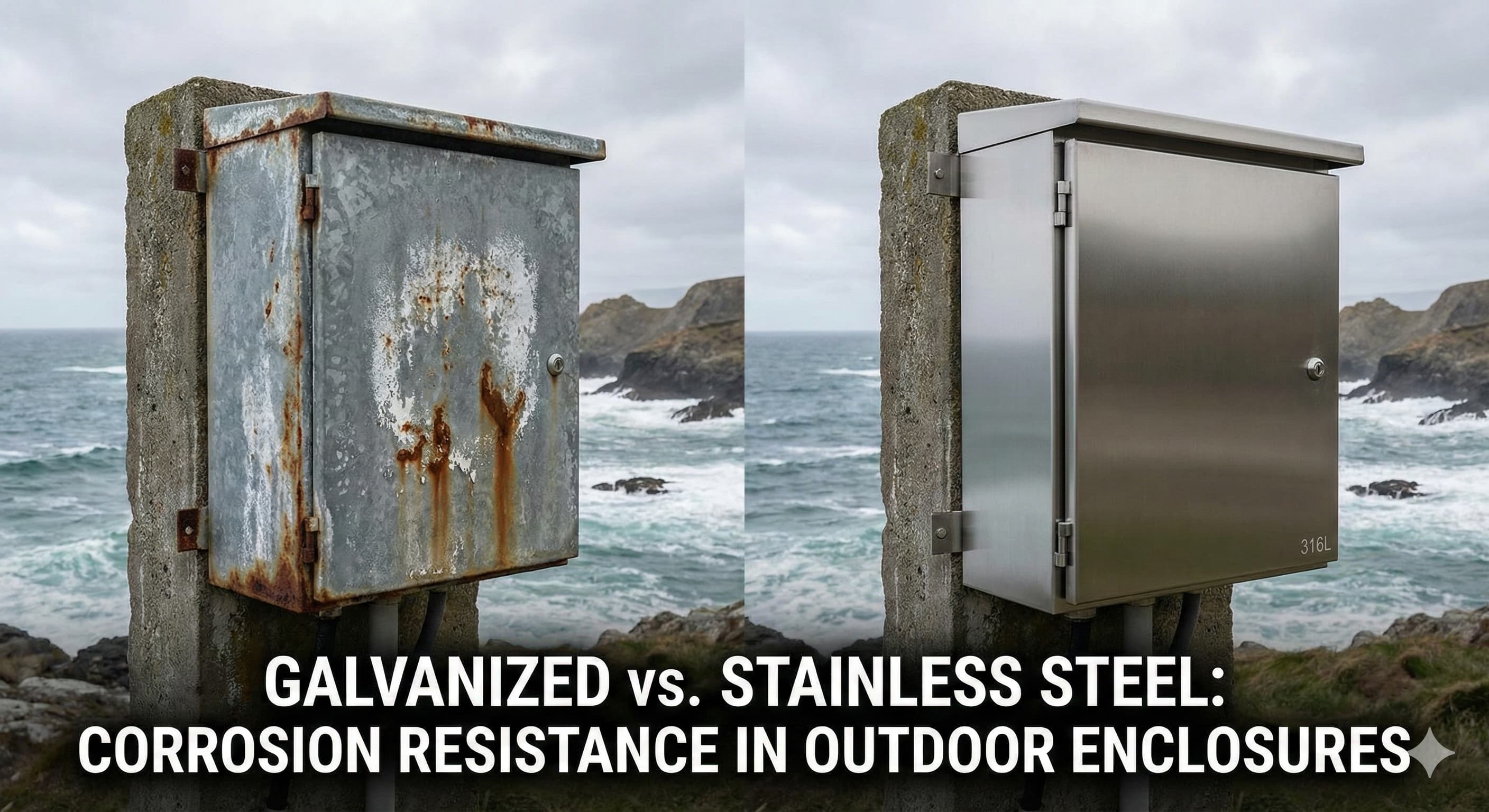
Corrosion-induced enclosure failures cost European manufacturers an estimated €15.6 billion annually, with 73% of these failures occurring within the first five years of deployment. The choice between galvanized and stainless steel for outdoor enclosures represents one of the most critical material decisions in industrial design, directly impacting both operational costs and system reliability.
Key Takeaways:
- Galvanized steel offers initial cost savings of 40-60% but may require replacement every 5-15 years in aggressive environments
- Stainless steel grades 316L and 2205 provide superior long-term corrosion resistance with lifecycle costs often 30% lower than galvanized alternatives
- Environmental factors such as chloride exposure, humidity levels, and temperature cycling determine optimal material selection
- Proper surface preparation and coating systems can extend galvanized steel performance by 200-300% in moderate environments
Understanding Corrosion Mechanisms in Outdoor Environments
Corrosion in outdoor enclosures follows predictable electrochemical pathways that vary significantly based on material composition and environmental exposure. Galvanized steel relies on sacrificial zinc coating protection, where zinc preferentially corrodes to protect the underlying steel substrate. This cathodic protection mechanism functions effectively until zinc depletion occurs, typically measured at coating thicknesses below 25 micrometers.
Stainless steel achieves corrosion resistance through chromium oxide passivation, forming a self-healing protective layer when chromium content exceeds 10.5%. This passive film rebuilds automatically in oxygen-rich environments, providing sustained protection without material consumption. However, chloride-induced pitting can compromise this protection when critical pitting temperatures are exceeded.
Environmental aggression levels directly influence corrosion rates according to ISO 9223 atmospheric corrosivity categories. C1 (very low) environments exhibit corrosion rates below 1.3 micrometers annually for carbon steel, while C5-M (very high marine) conditions can exceed 200 micrometers per year. These classifications determine appropriate material selection and expected service life calculations.
| Corrosivity Category | Environment Type | Galvanized Steel Rate (μm/year) | 316L SS Rate (μm/year) |
|---|---|---|---|
| C1 - Very Low | Heated buildings, dry rural | 0.1-0.7 | Negligible |
| C2 - Low | Unheated buildings, rural | 0.7-2.1 | Negligible |
| C3 - Medium | Urban, coastal (>10km) | 2.1-4.2 | 0.01-0.05 |
| C4 - High | Industrial, coastal (1-10km) | 4.2-8.4 | 0.05-0.1 |
| C5-M - Very High | Marine, <1km coast | 8.4-25 | 0.1-0.3 |
Galvanized Steel Performance Characteristics
Hot-dip galvanizing creates zinc-iron intermetallic layers totaling 45-85 micrometers thickness on typical structural steel components. The coating consists of distinct phases: gamma (Fe₃Zn₁₀), delta (FeZn₇), zeta (FeZn₁₃), and eta (pure zinc) layers, each contributing specific protective properties. Gamma and delta phases provide excellent adhesion and barrier protection, while the outer eta layer offers sacrificial protection through galvanic action.
Coating consumption follows linear kinetics in most atmospheric environments, with zinc loss rates predictable through established models. Typical consumption rates range from 0.5-2.0 micrometers annually in moderate climates, extending to 5-15 micrometers in aggressive marine environments. This predictability enables accurate lifecycle cost calculations and maintenance scheduling.
Temperature cycling significantly impacts galvanized coating performance through differential expansion coefficients between zinc (39.7 × 10⁻⁶/°C) and steel (11.7 × 10⁻⁶/°C). Thermal stress accumulation can lead to coating fracture and accelerated corrosion initiation, particularly problematic in enclosures experiencing temperature ranges exceeding 50°C daily variation.
Duplex systems combining galvanizing with organic topcoats achieve enhanced performance through barrier and sacrificial protection mechanisms. Properly applied duplex systems can achieve 1.5-2.5 times galvanizing-only performance, making them cost-effective for extended service life requirements. When integrated with precision sheet metal fabrication techniques, these protective systems ensure dimensional accuracy while maintaining corrosion resistance.
Stainless Steel Grades and Selection Criteria
Austenitic stainless steels dominate outdoor enclosure applications due to superior corrosion resistance and fabrication characteristics. Grade 304 (1.4301) contains 18-20% chromium and 8-10.5% nickel, providing excellent general corrosion resistance but limited chloride tolerance. Grade 316L (1.4404) incorporates 2-3% molybdenum, significantly enhancing pitting and crevice corrosion resistance in chloride environments.
Duplex stainless steels such as 2205 (1.4462) offer enhanced strength and chloride resistance through balanced austenite-ferrite microstructures. With 22% chromium, 5% nickel, and 3% molybdenum, duplex grades achieve twice the yield strength of austenitic grades while maintaining superior corrosion performance. This combination enables weight reduction and cost savings in structural applications.
| Grade | Chromium (%) | Nickel (%) | Molybdenum (%) | PREN* | Typical Cost (€/kg) |
|---|---|---|---|---|---|
| 304 (1.4301) | 18-20 | 8-10.5 | - | 18-20 | 4.2-4.8 |
| 316L (1.4404) | 16.5-18.5 | 10-13 | 2-2.5 | 24-26 | 5.8-6.4 |
| 2205 (1.4462) | 21-23 | 4.5-6.5 | 2.5-3.5 | 32-35 | 6.2-6.8 |
| 254SMO (1.4547) | 19.5-20.5 | 17.5-18.5 | 6-6.5 | 42-45 | 12.5-14.2 |
*PREN = Pitting Resistance Equivalent Number = %Cr + 3.3(%Mo) + 16(%N)
Critical pitting temperature (CPT) measurements provide quantitative chloride resistance assessment. Grade 316L exhibits CPT values of 15-25°C in 1M NaCl solution, while duplex 2205 achieves 50-60°C under identical conditions. This temperature threshold determines safe operating limits in chloride-contaminated environments.
Surface finish significantly influences corrosion initiation and propagation rates. Mill finish (2B) surfaces contain microscopic inclusions and residual stresses that promote localized attack. Electropolished or mechanically polished surfaces (Ra< 0.4 micrometers) reduce crevice corrosion susceptibility by eliminating surface irregularities and enhancing passive film uniformity.
Environmental Factor Analysis
Chloride concentration represents the primary environmental variable affecting material selection decisions. Atmospheric chloride levels vary from <10 mg/m²/day in inland locations to >1500 mg/m²/day within 100 meters of coastlines. Galvanized steel performance degrades rapidly when chloride deposition exceeds 60 mg/m²/day, while 316L stainless steel maintains acceptable performance up to 300 mg/m²/day.
Relative humidity control significantly impacts corrosion kinetics for both material systems. Critical relative humidity thresholds of 60-70% trigger accelerated corrosion in the presence of hygroscopic contaminants. Enclosure design must incorporate ventilation and drainage systems to maintain internal humidity below these critical levels, particularly important when housing sensitive electronic components that may benefit from injection molding services for protective housings.
Temperature cycling effects extend beyond simple thermal expansion considerations. Phase transformation in austenitic stainless steels can occur during repeated heating cycles above 400°C, potentially reducing corrosion resistance through carbide precipitation and chromium depletion. Galvanized coatings experience accelerated interdiffusion at elevated temperatures, consuming the protective zinc layer more rapidly.
Atmospheric pollutants including sulfur dioxide, nitrogen oxides, and industrial chemicals create synergistic corrosion acceleration effects. Acid rain conditions (pH< 5.6) increase galvanized coating consumption rates by 20-50% compared to neutral environments. Stainless steel grades generally maintain performance in acidic conditions, though specific grades may be required for severe industrial atmospheres.
Cost-Benefit Analysis and Lifecycle Economics
Initial material costs favor galvanized steel by substantial margins, typically 40-60% lower than equivalent stainless steel components. However, lifecycle cost analysis reveals more complex economic relationships when maintenance, replacement, and downtime costs are considered. Galvanized enclosures in C4-C5 environments may require replacement every 5-8 years, while stainless steel installations can achieve 25-30 year service life with minimal maintenance.
Fabrication costs vary significantly between materials due to different processing requirements. Galvanized steel utilizes standard carbon steel fabrication techniques with post-galvanizing processes, while stainless steel requires specialized welding procedures, heat treatment considerations, and surface finishing operations. These factors can increase stainless steel fabrication costs by 15-25% beyond raw material premiums.
| Cost Component | Galvanized Steel | 316L Stainless | 2205 Duplex |
|---|---|---|---|
| Material Cost (€/kg) | 1.8-2.2 | 5.8-6.4 | 6.2-6.8 |
| Fabrication Premium | Baseline | +15-25% | +20-30% |
| Surface Treatment | Included | +5-10% | +8-12% |
| Maintenance (€/year/m²) | 8-15 | 2-4 | 1-3 |
| Expected Service Life | 5-15 years | 25-35 years | 30-40 years |
Net present value calculations demonstrate crossover points where stainless steel becomes economically advantageous. Using 3% discount rates and C4 environmental conditions, stainless steel achieves cost parity within 8-12 years for most enclosure configurations. Higher discount rates favor galvanized steel, while aggressive environments accelerate stainless steel economic advantages.
For high-precision results,Submit your project for a 24-hour quote from Microns Hub.
Downtime costs often dominate lifecycle economics in critical applications. Planned maintenance windows for galvanized enclosure replacement may cost €2000-8000 in lost production, while unplanned failures can exceed €50000 in industrial settings. These indirect costs typically favor higher-reliability stainless steel solutions despite initial cost premiums.
Design Considerations and Best Practices
Enclosure geometry significantly influences corrosion performance through moisture retention and crevice formation. Sharp corners and horizontal surfaces promote water accumulation, accelerating localized attack. Design optimization incorporating rounded corners and drainage provisions can extend service life by 30-50% regardless of material selection. Advanced corner relief designs help minimize stress concentration and improve corrosion resistance at critical bend locations.
Dissimilar metal contact creates galvanic corrosion cells when different materials are electrically connected in corrosive environments. Galvanized steel coupled with stainless steel hardware accelerates zinc coating consumption near contact points. Proper isolation using non-conductive gaskets and coatings prevents galvanic acceleration while maintaining mechanical integrity.
Ventilation design balances environmental protection with corrosion mitigation. Sealed enclosures trap moisture and create aggressive internal conditions, while excessive ventilation permits contaminant ingress. Optimal designs incorporate filtered ventilation with moisture control systems, maintaining internal relative humidity below 50% while preventing particle contamination.
Fastener selection requires careful material compatibility consideration. Stainless steel fasteners in galvanized enclosures create minimal galvanic effects due to small surface area ratios. However, carbon steel fasteners in stainless enclosures experience rapid corrosion and potential structural failure. All fastening systems should utilize materials with equivalent or superior corrosion resistance to base materials.
Quality Control and Specification Standards
Coating quality verification follows established international standards ensuring performance predictability. ISO 1461 specifies minimum galvanizing thickness requirements: 45 micrometers for steel thickness <1 mm, scaling to 85 micrometers for thickness >6 mm. Coating thickness measurement using magnetic induction or eddy current techniques provides non-destructive quality verification.
Stainless steel quality control emphasizes chemical composition verification and surface condition assessment. Positive material identification (PMI) using X-ray fluorescence confirms grade specification compliance, while ferrite measurement ensures proper microstructure in duplex grades. Surface roughness measurement and visual inspection detect fabrication-induced defects that compromise corrosion performance.
Accelerated testing protocols provide performance validation without extended exposure periods. Salt spray testing per ASTM B117 offers comparative performance assessment, though results may not correlate directly with atmospheric exposure. Cyclic corrosion tests such as GM9540P better simulate real-world conditions through temperature, humidity, and salt exposure cycling.
When ordering from Microns Hub, you benefit from direct manufacturer relationships that ensure superior quality control and competitive pricing compared to marketplace platforms. Our technical expertise in material selection and fabrication processes means every enclosure project receives the precise engineering attention required for optimal corrosion performance and cost-effectiveness.
Application-Specific Recommendations
Telecommunications infrastructure requires 15-25 year service life with minimal maintenance access. Grade 316L stainless steel provides optimal performance in coastal and urban environments, while galvanized steel with duplex coating systems offers cost-effective solutions for inland C2-C3 locations. Antenna mounting systems benefit from duplex stainless steel's enhanced strength-to-weight ratio.
Industrial control enclosures in chemical processing environments demand highest corrosion resistance levels. Super austenitic grades such as 254SMO (1.4547) or 6Mo alloys provide necessary chloride and acid resistance. Initial cost premiums are justified by elimination of unplanned maintenance and production interruptions.
Renewable energy applications present unique challenges combining marine environments with electrical isolation requirements. Solar panel mounting systems utilize aluminum alloys or duplex stainless steel for coastal installations, while galvanized steel remains viable for inland wind turbine structures with proper maintenance programs.
Transportation infrastructure balances cost constraints with safety requirements. Highway sign structures and bridge components utilize galvanized steel with 15-20 year replacement cycles, while critical safety systems may justify stainless steel for enhanced reliability. De-icing salt exposure significantly accelerates corrosion, requiring upgraded material selection or enhanced coating systems.
Our comprehensive manufacturing services enable optimal material selection and fabrication processes for each specific application, ensuring your outdoor enclosures achieve maximum performance and cost-effectiveness throughout their intended service life.
Maintenance Strategies and Performance Monitoring
Preventive maintenance programs extend service life and provide early failure detection for both material systems. Galvanized enclosures require annual visual inspection for coating breakdown, white rust formation, and red rust initiation. Touch-up coatings applied before substrate exposure can extend service life by 5-10 years at minimal cost.
Stainless steel maintenance focuses on surface contamination removal and passive film restoration. Chloride deposits and atmospheric soiling should be removed through periodic cleaning with mild detergents and fresh water rinse. Mechanical damage requires immediate attention to prevent crevice corrosion initiation at scratched or gouged locations.
Performance monitoring utilizes both visual assessment and quantitative measurement techniques. Coating thickness gauges track galvanized layer consumption rates, enabling predictive replacement scheduling. Corrosion potential measurements identify active corrosion cells and galvanic coupling effects in complex installations.
Condition-based replacement strategies optimize lifecycle costs through data-driven decision making. Linear coating consumption models predict remaining service life within ±2 years for galvanized systems in stable environments. Stainless steel performance monitoring focuses on localized attack detection rather than general corrosion assessment.
Future Developments and Emerging Technologies
Advanced coating systems continue evolving to bridge performance gaps between galvanized and stainless steel solutions. Zinc-aluminum-magnesium alloy coatings provide enhanced corrosion protection while maintaining cost advantages over stainless steel. These systems achieve 2-4 times conventional galvanizing performance in accelerated testing protocols.
Corrosion monitoring sensors enable real-time performance assessment and predictive maintenance optimization. Wireless sensor networks monitor temperature, humidity, chloride deposition, and electrochemical parameters, providing continuous condition assessment. Machine learning algorithms analyze sensor data to predict maintenance requirements and optimize replacement timing.
Additive manufacturing technologies may revolutionize enclosure design and material utilization. Selective laser melting enables complex geometries optimized for corrosion resistance while minimizing material consumption. Gradient materials combining different stainless steel compositions could provide location-specific performance optimization.
Sustainability considerations increasingly influence material selection decisions. Lifecycle assessment methodologies quantify environmental impacts including carbon emissions, recycling potential, and resource consumption. Stainless steel's infinite recyclability and reduced maintenance requirements often provide environmental advantages despite higher initial energy requirements.
Frequently Asked Questions
What is the typical service life difference between galvanized and stainless steel enclosures?
Galvanized steel enclosures typically achieve 5-15 years service life depending on environmental conditions, with C1-C2 environments supporting longer durations and C4-C5 coastal/industrial environments limiting life to 5-8 years. Stainless steel enclosures commonly achieve 25-35 years service life with grade 316L, while duplex grades can exceed 40 years in aggressive environments. The service life ratio generally ranges from 2:1 to 5:1 favoring stainless steel.
How do initial costs compare between galvanized steel and stainless steel enclosures?
Initial costs favor galvanized steel by 40-60% for equivalent enclosure designs. A typical 600mm × 400mm × 200mm enclosure costs approximately €180-220 in galvanized steel versus €320-420 in 316L stainless steel. However, lifecycle cost analysis often shows stainless steel achieving cost parity within 8-12 years when maintenance, replacement, and downtime costs are included.
Which material performs better in coastal marine environments?
Stainless steel significantly outperforms galvanized steel in coastal environments due to superior chloride resistance. Grade 316L maintains acceptable performance with chloride deposition up to 300 mg/m²/day, while galvanized steel experiences rapid deterioration above 60 mg/m²/day. Within 1 km of coastline, stainless steel typically provides 3-5 times longer service life than galvanized alternatives.
Can galvanized steel performance be enhanced through additional coatings?
Yes, duplex coating systems combining galvanizing with organic topcoats can achieve 1.5-2.5 times the performance of galvanizing alone. Properly applied duplex systems provide both barrier protection and sacrificial protection mechanisms. These systems are particularly effective in C3-C4 environments, potentially extending service life to 15-20 years while maintaining cost advantages over stainless steel.
What are the key design considerations for maximizing corrosion resistance?
Critical design factors include eliminating horizontal surfaces that retain water, incorporating drainage provisions, avoiding sharp corners that concentrate stress, and preventing dissimilar metal contact. Proper ventilation design maintains internal humidity below 50% while preventing contaminant ingress. Fastener selection must match or exceed base material corrosion resistance to prevent galvanic coupling effects.
How do temperature extremes affect material performance?
Temperature cycling creates thermal stress due to different expansion coefficients between coating and substrate materials. Galvanized steel experiences coating fracture when daily temperature variation exceeds 50°C, while stainless steel maintains integrity across wider temperature ranges. Elevated temperatures above 400°C can compromise stainless steel performance through carbide precipitation and chromium depletion.
What maintenance is required for each material type?
Galvanized steel requires annual visual inspection for coating breakdown and touch-up applications before substrate exposure occurs. Maintenance costs typically range from €8-15 per square meter annually. Stainless steel maintenance focuses on cleaning and contamination removal, with annual costs of €2-4 per square meter. Touch-up welding and surface restoration may be required for mechanical damage in both systems.
MICRONS HUB DV Ε.Ε. · VAT: EL803129638 · GEMI: 190254227000 · Industrial Area, Street B, Number 4, 71601 Heraklion, Crete, Greece