Copper Busbar Fabrication: Bending and Punching for Electrical Distribution
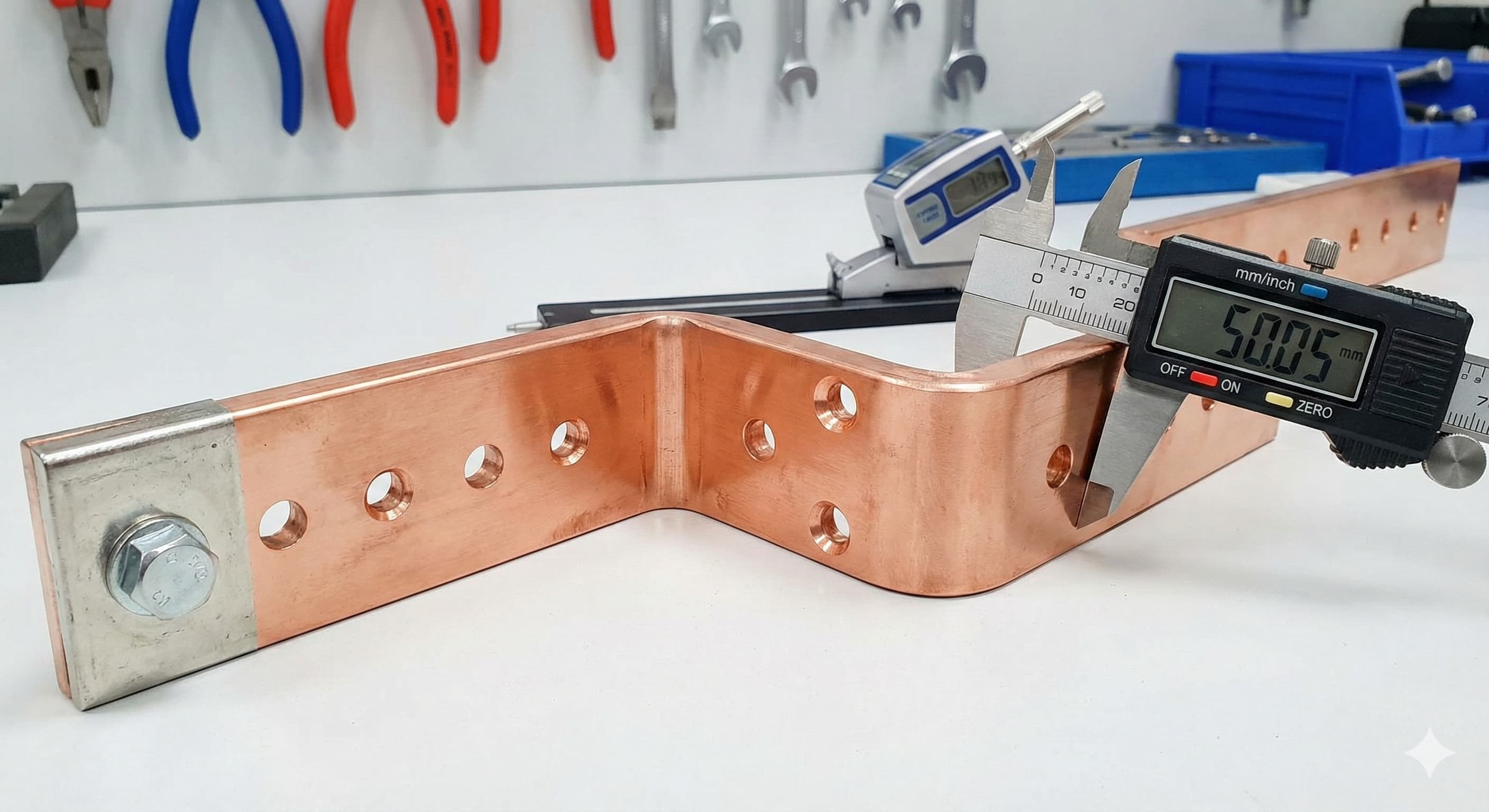
Copper busbar fabrication demands precision engineering to ensure optimal electrical conductivity and structural integrity in power distribution systems. Modern electrical infrastructure relies heavily on properly manufactured copper busbars, where even minor deviations in bending radius or punching tolerances can compromise performance and safety.
Key Takeaways
- Copper busbar bending requires minimum radius calculations based on material thickness to prevent cracking and maintain conductivity
- Punching operations must account for work hardening effects and tool wear to maintain dimensional accuracy within ±0.1 mm
- Material selection between ETP copper (C11000) and oxygen-free copper (C10100) significantly impacts fabrication parameters
- Proper annealing schedules restore ductility after cold working operations, ensuring long-term reliability
The fabrication of copper busbars involves sophisticated metalworking processes that combine traditional sheet metal techniques with specialized electrical considerations. Unlike standard sheet metal fabrication services, copper busbar manufacturing requires understanding of both mechanical properties and electrical performance criteria.
Material Specifications and Selection Criteria
Copper busbar fabrication begins with material selection, where the choice between different copper grades directly impacts both fabrication parameters and final performance. Electrolytic Tough Pitch (ETP) copper C11000 represents the most common grade for busbar applications, offering 99.90% minimum copper content with excellent conductivity of 101% IACS (International Annealed Copper Standard).
Oxygen-free copper C10100 provides superior performance for critical applications, with 99.99% copper content and reduced risk of hydrogen embrittlement during fabrication. The material exhibits enhanced ductility during bending operations, though at a cost premium of approximately 15-20% over ETP copper.
| Property | C11000 (ETP) | C10100 (OF) | C10200 (OF-E) |
|---|---|---|---|
| Copper Content (%) | 99.90 min | 99.99 min | 99.95 min |
| Conductivity (% IACS) | 101 | 101 | 101 |
| Tensile Strength (MPa) | 220-290 | 205-275 | 205-275 |
| Elongation (%) | 30-45 | 35-50 | 35-50 |
| Cost Factor | 1.0 | 1.15-1.20 | 1.10-1.15 |
Material thickness selection depends on current-carrying requirements and mechanical strength needs. Standard thicknesses range from 3 mm to 15 mm for most applications, with custom thicknesses available up to 25 mm. Thicker sections require modified bending parameters and may necessitate preheating to prevent cracking during forming operations.
Bending Process Engineering
Copper busbar bending operations require careful calculation of minimum bend radius to prevent material failure and maintain electrical properties. The minimum inside bend radius for copper typically equals 1.5 times the material thickness for 90-degree bends, though this varies with copper grade and temper condition.
For annealed copper (O temper), the minimum bend radius can be as tight as 1.0 times thickness, while work-hardened material (H02-H04 temper) may require radius values up to 3.0 times thickness. These calculations become critical when designing compact electrical enclosures where space constraints demand tight bending radii.
Springback compensation presents another crucial consideration in copper busbar bending. Copper exhibits springback angles typically ranging from 2-4 degrees for 90-degree bends, depending on material thickness and bending radius. Accurate compensation requires empirical testing with specific material lots, as copper properties can vary between suppliers and heat treatments.
| Material Thickness (mm) | Min. Bend Radius (Annealed) | Min. Bend Radius (Work Hardened) | Typical Springback (degrees) |
|---|---|---|---|
| 3.0 | 3.0 | 6.0 | 2.5 |
| 5.0 | 5.0 | 10.0 | 3.0 |
| 8.0 | 8.0 | 16.0 | 3.5 |
| 10.0 | 10.0 | 20.0 | 4.0 |
| 12.0 | 12.0 | 24.0 | 4.2 |
Press brake selection for copper bending requires consideration of tonnage requirements and tooling specifications. Copper's work hardening characteristics demand higher forming forces than steel of equivalent thickness, typically requiring 20-30% additional tonnage. V-die selection follows the 8-times-thickness rule for die opening width, ensuring proper material flow during bending.
Punching Operations and Tool Design
Punching operations in copper busbar fabrication demand specialized tooling and process parameters to achieve dimensional accuracy and edge quality requirements. Copper's tendency to work harden during punching operations affects both tool life and hole quality, making proper clearance calculations essential for consistent results.
Punch-to-die clearance for copper typically ranges from 8-12% of material thickness per side, compared to 5-8% for mild steel. Insufficient clearance leads to excessive work hardening and premature tool wear, while excessive clearance produces poor edge quality and dimensional variations exceeding ±0.1 mm tolerances.
Tool material selection significantly impacts production efficiency and hole quality. High-speed steel (HSS) punches provide adequate performance for prototype and low-volume production, while carbide tooling becomes essential for high-volume operations exceeding 10,000 hits per tool. Carbide tools maintain dimensional stability longer but require more careful handling and setup procedures.
For high-precision results,Receive a detailed quote within 24 hours from Microns Hub.
| Hole Diameter (mm) | Punch Clearance (% per side) | Expected Tool Life (HSS) | Expected Tool Life (Carbide) |
|---|---|---|---|
| 6.0 | 10% | 8,000 hits | 25,000 hits |
| 8.0 | 9% | 10,000 hits | 30,000 hits |
| 10.0 | 8% | 12,000 hits | 35,000 hits |
| 12.0 | 8% | 15,000 hits | 40,000 hits |
| 16.0 | 8% | 20,000 hits | 50,000 hits |
Burr formation during punching requires careful control through proper clearances and sharp tooling maintenance. Acceptable burr height for electrical applications typically does not exceed 0.05 mm, as larger burrs can create stress concentrations and potential failure points under electrical loading. Secondary deburring operations may be necessary for critical applications, adding approximately €0.15-€0.30 per linear meter to processing costs.
Heat Treatment and Annealing Processes
Heat treatment of copper busbars serves multiple purposes: stress relief after forming operations, restoration of ductility for subsequent fabrication steps, and optimization of electrical conductivity. Annealing temperatures for copper range from 200°C to 650°C, depending on the degree of prior cold working and desired final properties.
Full annealing requires heating to 500-650°C followed by controlled cooling to achieve maximum ductility and conductivity. This process completely recrystallizes the work-hardened structure, reducing yield strength to approximately 70 MPa while maximizing elongation values above 45%. The process adds €2.50-€4.00 per kilogram to fabrication costs but proves essential for complex forming operations.
Stress relief annealing at lower temperatures (200-300°C) provides a cost-effective alternative when full softening is not required. This process reduces residual stresses by 70-80% while maintaining higher strength levels suitable for structural applications. Processing time reduces to 1-2 hours compared to 4-6 hours for full annealing, lowering costs to €1.50-€2.50 per kilogram.
Atmosphere control during annealing prevents oxidation and maintains surface quality. Protective atmospheres using nitrogen or forming gas (95% N2, 5% H2) eliminate oxide formation that can compromise electrical connections. Vacuum annealing provides the highest quality results but increases processing costs by 40-50% over atmospheric treatments.
Dimensional Tolerances and Quality Control
Copper busbar fabrication tolerances must balance manufacturing practicality with electrical performance requirements. Standard fabrication tolerances for copper busbars follow ISO 2768-mK guidelines, with linear dimensions held to ±0.2 mm for lengths up to 150 mm, increasing to ±0.3 mm for lengths up to 600 mm.
Bend angle tolerances typically achieve ±1 degree accuracy with proper tooling and setup procedures. Tighter tolerances of ±0.5 degrees are achievable through secondary operations or precision forming techniques, though costs increase by 25-35% over standard tolerances. Critical electrical connections may require these tighter tolerances to ensure proper mating with switchgear components.
Hole position accuracy becomes critical for mounting and connection applications. Standard punching operations achieve position tolerances of ±0.15 mm, while CNC punching or machining can improve this to ±0.05 mm when required. The additional precision typically adds €0.50-€1.00 per hole to manufacturing costs.
| Feature Type | Standard Tolerance | Precision Tolerance | Cost Impact |
|---|---|---|---|
| Linear Dimension (≤150mm) | ±0.2 mm | ±0.1 mm | +15% |
| Linear Dimension (≤600mm) | ±0.3 mm | ±0.15 mm | +20% |
| Bend Angle | ±1.0° | ±0.5° | +30% |
| Hole Position | ±0.15 mm | ±0.05 mm | +50% |
| Hole Diameter | ±0.1 mm | ±0.05 mm | +25% |
Surface finish requirements vary with application, from standard mill finish for enclosed applications to bright annealed finish for visible installations. Electroplating with tin, silver, or nickel provides corrosion protection and improved electrical contact performance, similar to protective treatments used in outdoor enclosure applications where environmental protection is critical.
Cost Optimization Strategies
Material utilization optimization significantly impacts copper busbar fabrication costs due to high copper prices ranging from €7,500-€9,500 per metric ton. Nesting efficiency improvements from 75% to 85% can reduce material costs by €150-€200 per project for typical busbar assemblies. CAD-based nesting software becomes essential for high-volume production.
Batch processing of similar operations reduces setup costs and improves efficiency. Grouping all punching operations before bending reduces tool changes and setup time, typically improving productivity by 15-25%. Similarly, batching heat treatment operations reduces energy costs and cycle times.
When ordering from Microns Hub, you benefit from direct manufacturer relationships that ensure superior quality control and competitive pricing compared to marketplace platforms. Our technical expertise and personalized service approach means every copper busbar project receives the attention to detail it deserves, from initial design consultation through final quality inspection.
Tooling standardization across projects reduces overall tooling costs and inventory requirements. Standard punch sizes (6, 8, 10, 12, 16 mm diameter) cover 80% of typical applications, while custom tooling should be reserved for high-volume applications exceeding 1,000 pieces. Standard tooling reduces lead times and eliminates tooling charges for repeat orders.
Advanced Fabrication Techniques
Progressive die operations offer significant advantages for high-volume copper busbar production, combining punching, bending, and forming operations in a single tool setup. Initial tooling costs range from €15,000-€35,000 but provide piece costs 40-60% lower than conventional operations for quantities exceeding 5,000 pieces.
Hydroforming techniques enable complex three-dimensional shapes impossible with conventional press brake operations. The process uses pressurized fluid to form copper against a single-sided die, achieving uniform wall thickness and eliminating springback issues. Setup costs range from €3,000-€8,000 per tool, making it suitable for medium to high-volume applications.
Laser cutting provides excellent edge quality for complex geometries, though processing speeds are slower than punching for simple shapes. Laser cutting typically costs €0.25-€0.45 per linear meter for 5 mm copper, compared to €0.10-€0.15 per hole for standard punching operations. The technology excels for prototype development and low-volume custom shapes.
Roll forming enables continuous production of long busbars with consistent cross-sectional profiles. The process proves economical for lengths exceeding 3 meters and quantities above 500 pieces. Tool costs range from €8,000-€15,000 but enable production speeds up to 15 meters per minute once setup is complete.
Quality Assurance and Testing Protocols
Electrical conductivity testing ensures copper busbar performance meets specification requirements. Four-point resistance measurements provide accurate conductivity values, with acceptable readings typically exceeding 98% IACS for fabricated parts. Testing costs approximately €25-€35 per part but proves essential for critical electrical applications.
Dimensional inspection using coordinate measuring machines (CMM) provides comprehensive verification of complex busbar geometries. CMM inspection typically costs €45-€65 per part but ensures compliance with tight tolerance requirements. Statistical process control reduces inspection frequency for established processes while maintaining quality assurance.
Mechanical property verification through tensile testing confirms material properties after fabrication processes. Sample testing typically costs €125-€175 per test but provides valuable data for process optimization and quality documentation. Testing frequency depends on application criticality and customer requirements.
Non-destructive testing methods including dye penetrant inspection detect surface defects that could compromise performance. Inspection costs range from €15-€25 per part but identifies potential failure points before installation. Ultrasonic testing can detect internal defects in thick sections where required.
Integration with Manufacturing Services
Copper busbar fabrication often integrates with broader electrical enclosure manufacturing, requiring coordination with other metalworking processes. Panel fabrication may require structural reinforcement techniques to support heavy busbar assemblies and prevent deflection under electrical loads.
Assembly considerations include hardware specification, torque requirements, and joint preparation. Bolt torque specifications for copper connections typically range from 25-45 Nm for M10 fasteners, depending on busbar thickness and connection design. Proper torque ensures reliable electrical contact while preventing material deformation.
Surface preparation for connections may include chemical cleaning, abrasive finishing, or protective plating. Silver plating provides optimal electrical contact but adds €2.50-€4.50 per square decimeter to processing costs. Tin plating offers a cost-effective alternative at €1.20-€2.80 per square decimeter while providing adequate corrosion protection.
Packaging and shipping considerations for copper busbars include protection against handling damage and oxidation during transport. Protective films or interleaving papers prevent surface damage, while moisture barriers prevent oxidation in humid environments. Packaging costs typically add €0.50-€1.50 per part depending on protection level required.
Our comprehensive approach to copper busbar fabrication extends across our manufacturing services, ensuring seamless integration with related metalworking processes and maintaining consistent quality standards throughout complex electrical assembly projects.
Frequently Asked Questions
What is the minimum bend radius for copper busbars?
The minimum bend radius for copper busbars depends on material temper and thickness. For annealed copper, use 1.0-1.5 times material thickness, while work-hardened copper requires 2.0-3.0 times thickness. Tighter radii risk cracking and reduced electrical conductivity.
How does copper work hardening affect fabrication processes?
Copper work hardening during forming operations increases yield strength by 200-300% while reducing ductility. This requires higher forming forces, modified tooling clearances, and potential intermediate annealing for complex shapes. Plan for 20-30% higher press tonnage requirements.
What punch-to-die clearances are recommended for copper?
Use 8-12% material thickness per side for copper punching clearances, higher than steel requirements. Insufficient clearance causes excessive work hardening and tool wear, while excessive clearance produces poor edge quality. Optimize clearances based on hole size and material thickness.
When is annealing necessary during copper busbar fabrication?
Annealing becomes necessary when work hardening prevents further forming operations or when maximum conductivity is required. Full annealing at 500-650°C restores ductility completely, while stress relief at 200-300°C provides partial softening with lower processing costs.
What tolerances are achievable in copper busbar fabrication?
Standard tolerances follow ISO 2768-mK with ±0.2 mm for dimensions under 150 mm and ±1.0° for bend angles. Precision operations can achieve ±0.05 mm hole positioning and ±0.5° bend angles with 25-50% cost increases through secondary operations or specialized tooling.
How does copper grade selection affect fabrication parameters?
ETP copper C11000 provides standard fabricability and conductivity for most applications. Oxygen-free copper C10100 offers superior ductility and reduced hydrogen embrittlement risk but costs 15-20% more. Material selection impacts bending parameters, annealing schedules, and tool life.
What surface treatments are recommended for copper busbars?
Surface treatment depends on environmental conditions and electrical requirements. Bare copper provides maximum conductivity but oxidizes over time. Silver plating offers optimal electrical contact, tin plating provides cost-effective protection, and nickel plating delivers superior corrosion resistance in harsh environments.
MICRONS HUB DV Ε.Ε. · VAT: EL803129638 · GEMI: 190254227000 · Industrial Area, Street B, Number 4, 71601 Heraklion, Crete, Greece