CNC Machining of Magnesium: Safety Protocols and Design Benefits
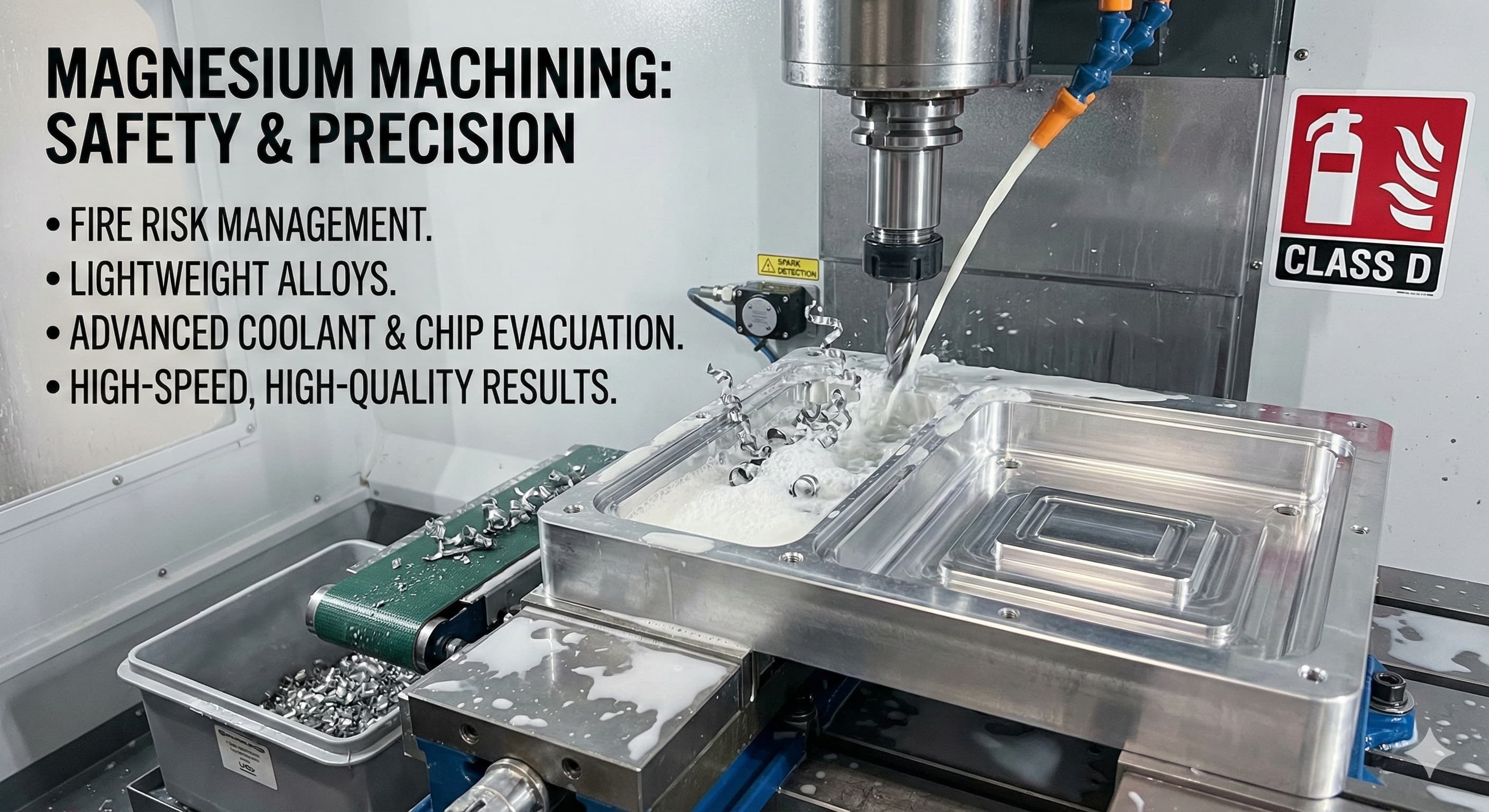
Magnesium presents unique challenges in CNC machining that demand specialized safety protocols and technical expertise. Despite being the lightest structural metal with exceptional strength-to-weight ratios, magnesium's reactive nature and specific machining requirements often deter manufacturers from leveraging its significant design benefits.
Key Takeaways:
- Magnesium alloys like AZ31B and AZ91D offer 35% weight reduction compared to aluminum 6061-T6 while maintaining comparable strength properties
- Fire prevention requires continuous coolant flow, chip evacuation systems, and inert atmosphere machining for complex geometries
- Proper tooling selection and cutting parameters can achieve surface finishes of Ra 0.8 μm with tolerances to ±0.025 mm
- Cost benefits emerge in high-volume production despite higher raw material costs due to excellent machinability and reduced cycle times
Understanding Magnesium Alloy Properties for CNC Applications
Magnesium alloys exhibit remarkable machinability characteristics that surpass most engineering materials when proper protocols are followed. The hexagonal close-packed crystal structure of magnesium allows for clean chip formation and reduced cutting forces compared to aluminum or steel alternatives.
AZ31B magnesium alloy, containing 3% aluminum and 1% zinc, provides tensile strength of 290 MPa with a density of only 1.78 g/cm³. This translates to a specific strength ratio that exceeds aluminum 6061-T6 by approximately 15%. For aerospace and automotive applications where weight reduction directly impacts performance and efficiency, this advantage becomes commercially significant.
| Property | Magnesium AZ31B | Aluminum 6061-T6 | Steel 1045 |
|---|---|---|---|
| Density (g/cm³) | 1.78 | 2.70 | 7.85 |
| Tensile Strength (MPa) | 290 | 310 | 625 |
| Yield Strength (MPa) | 220 | 275 | 530 |
| Elastic Modulus (GPa) | 45 | 69 | 200 |
| Specific Strength (kN⋅m/kg) | 163 | 115 | 80 |
| Machinability Rating | Excellent | Good | Fair |
The superior machinability of magnesium stems from its low cutting forces and excellent thermal conductivity. Cutting forces typically measure 30-40% lower than equivalent aluminum operations, reducing tool wear and enabling higher feed rates. This characteristic allows for aggressive machining parameters while maintaining dimensional accuracy.
Material Grade Selection for Specific Applications
AZ91D represents the most commonly machined magnesium alloy in die-cast form, offering improved corrosion resistance through higher aluminum content (9%). However, wrought alloys like AZ31B provide superior mechanical properties for structural applications requiring precise edge treatments and complex geometries.
ZK60A alloy, containing zinc and zirconium additions, achieves tensile strengths approaching 365 MPa in T5 condition. This high-strength variant suits applications where maximum weight reduction must be balanced against structural requirements. The zirconium addition refines grain structure, improving both strength and machinability characteristics.
Critical Safety Protocols for Magnesium Machining
Fire prevention remains the paramount safety concern when machining magnesium alloys. Magnesium chips ignite at approximately 650°C, creating intense fires that cannot be extinguished with water or standard CO₂ systems. Proper safety protocols must address chip management, coolant systems, and emergency response procedures.
Chip Management and Evacuation Systems
Continuous chip evacuation prevents accumulation of fine particles that present the highest fire risk. Chips should be removed immediately from the cutting zone using flood coolant or dedicated vacuum systems with appropriate filtration. Wet chip collection systems using water-miscible coolants maintain chip temperatures below ignition threshold while preventing static electricity buildup.
For high-volume production, automated chip conveyors with enclosed designs minimize operator exposure while ensuring consistent removal rates. These systems must incorporate spark detection and suppression capabilities, automatically stopping machining operations when abnormal conditions are detected.
Storage of magnesium chips requires sealed, moisture-controlled containers to prevent hydrogen gas generation. Chips should never exceed 48-hour storage periods without proper treatment or disposal through certified recycling channels.
Coolant Selection and Application
Synthetic coolants specifically formulated for magnesium machining provide optimal heat dissipation while maintaining chemical stability. These coolants typically contain corrosion inhibitors and biocides to prevent degradation that could compromise safety or part quality.
| Coolant Type | Concentration (%) | pH Range | Application Method | Safety Rating |
|---|---|---|---|---|
| Synthetic Magnesium | 8-12 | 8.5-9.5 | Flood | Excellent |
| Semi-Synthetic | 6-10 | 8.0-9.0 | Flood/Mist | Good |
| Mineral Oil | 100 | N/A | Flood | Fair |
| Dry Machining | N/A | N/A | Air/Inert Gas | Requires Expertise |
Coolant flow rates must exceed 40 liters per minute for roughing operations to ensure adequate heat removal and chip flushing. Multiple coolant nozzles positioned strategically around the cutting zone provide uniform coverage while maintaining visibility for operator monitoring.
For high-precision results,Submit your project for a 24-hour quote from Microns Hub.
Inert Atmosphere Machining
Complex geometries requiring deep hole drilling or enclosed cutting operations benefit from inert atmosphere machining using argon or nitrogen environments. This approach eliminates oxygen that supports combustion while enabling dry machining techniques that produce superior surface finishes.
Inert atmosphere systems require precise gas flow control and continuous monitoring to maintain oxygen levels below 2% throughout the machining envelope. While initial setup costs are substantial, the technique enables machining of thin-walled components and intricate features that would be impossible with conventional flood coolant methods.
Optimal Tooling and Cutting Parameters
Tool selection for magnesium machining prioritizes sharp cutting edges, positive rake angles, and efficient chip evacuation. Uncoated carbide tools with polished surfaces typically outperform coated alternatives due to magnesium's low cutting forces and excellent heat dissipation properties.
End Mill Specifications and Geometry
Two-flute end mills with 30° helix angles provide optimal chip evacuation while minimizing heat buildup. Cutting edge preparation should include light honing (0.005-0.010 mm radius) to prevent micro-chipping while maintaining sharpness. Larger core diameters improve tool rigidity for high-feed applications.
For finishing operations, four-flute end mills with variable pitch designs reduce chatter while achieving surface finishes of Ra 0.4 μm. Tool runout must not exceed 0.005 mm TIR to maintain surface quality and prevent premature tool wear.
| Operation | Cutting Speed (m/min) | Feed Rate (mm/tooth) | Axial Depth (mm) | Radial Depth (%) |
|---|---|---|---|---|
| Roughing | 800-1200 | 0.25-0.40 | 3.0-6.0 | 40-60 |
| Semi-Finishing | 1000-1500 | 0.15-0.25 | 1.0-2.0 | 20-40 |
| Finishing | 1200-2000 | 0.05-0.15 | 0.2-0.5 | 5-15 |
| Drilling | 200-400 | 0.10-0.20 | Variable | N/A |
Turning Operations and Insert Selection
Turning operations on magnesium benefit from positive rake inserts with sharp cutting edges. CCMT or DCMT geometries with 0.4 mm nose radii provide excellent surface finishes while maintaining dimensional stability. Insert grades should prioritize toughness over wear resistance due to the relatively low cutting temperatures generated.
Spindle speeds can reach 3000-5000 RPM for small-diameter workpieces without vibration concerns. Feed rates of 0.3-0.5 mm/rev are achievable with proper setup, resulting in cycle times significantly shorter than comparable aluminum operations.
Design Benefits and Engineering Advantages
Magnesium's unique properties enable design possibilities that are impractical or impossible with conventional materials. The combination of low density, excellent damping characteristics, and superior machinability opens opportunities for innovative engineering solutions across multiple industries.
Weight Reduction and Performance Impact
In automotive applications, replacing aluminum components with magnesium equivalents typically achieves 35-45% weight reduction while maintaining structural integrity. This weight savings directly translates to improved fuel efficiency, reduced emissions, and enhanced performance characteristics.
For rotating components like wheels or rotors, the reduced rotational inertia provides additional benefits beyond simple weight reduction. Acceleration response improves dramatically, while braking distances decrease due to lower kinetic energy storage.
Aerospace applications leverage magnesium's high specific strength for brackets, housings, and structural components where every gram matters. The material's excellent fatigue resistance under cyclic loading conditions makes it particularly suitable for engine mounts and control system components.
Electromagnetic Shielding Properties
Magnesium alloys provide superior electromagnetic interference (EMI) shielding compared to aluminum or steel alternatives. The material's conductivity and magnetic permeability characteristics make it ideal for electronic enclosures requiring both weight reduction and signal isolation.
Shielding effectiveness typically ranges from 80-100 dB across frequencies from 10 MHz to 10 GHz, depending on wall thickness and alloy composition. This performance enables thin-walled designs that maximize internal volume while meeting stringent EMI requirements.
Thermal Management Advantages
The thermal conductivity of magnesium alloys (approximately 96 W/m⋅K for AZ31B) approaches that of aluminum while offering significantly lower weight. This combination proves valuable for heat sink applications where convective cooling depends on both surface area and overall system weight.
Heat dissipation efficiency per unit weight exceeds aluminum by 30-40% in natural convection applications. For forced air cooling systems, the reduced weight allows for larger heat sink geometries without exceeding system weight budgets.
Surface Treatment and Finishing Options
Magnesium's reactive nature requires specialized surface treatments to prevent corrosion and enhance aesthetic appeal. These treatments must be considered during the design phase as they affect final dimensions and surface quality requirements.
When ordering from Microns Hub, you benefit from direct manufacturer relationships that ensure superior quality control and competitive pricing compared to marketplace platforms. Our technical expertise and personalized service approach means every magnesium machining project receives the attention to detail it deserves, from initial design consultation through final surface treatment specification.
Anodizing and Chemical Conversion Coatings
HAE (Hazardous Application Electroplating) anodizing provides excellent corrosion protection while maintaining dimensional precision. Coating thickness typically ranges from 5-25 μm, requiring careful tolerance management during design phases.
Chromate conversion coatings offer lighter-weight protection suitable for indoor applications or temporary corrosion resistance. These coatings add minimal thickness (0.5-2.0 μm) while providing an excellent base for paint systems.
For applications requiring both corrosion protection and wear resistance, hard anodizing achieves coating thickness up to 50 μm with surface hardness approaching 400 HV. However, this treatment requires post-machining operations to restore critical dimensions.
Powder Coating and Paint Systems
Powder coating systems formulated specifically for magnesium substrates provide durable, attractive finishes suitable for consumer applications. Proper surface preparation including cleaning and etching is critical for coating adhesion and longevity.
Wet paint systems offer greater color flexibility and can achieve automotive-quality finishes when applied over appropriate primer systems. UV-resistant formulations maintain appearance and protection in outdoor applications for 5-10 years depending on environmental conditions.
Many manufacturers combine magnesium machining with sheet metal fabrication services to create hybrid assemblies that optimize material properties for specific load paths and functional requirements.
Cost Analysis and Economic Considerations
While magnesium raw material costs exceed aluminum by 100-150%, the economic analysis must consider total manufacturing costs including machining time, tool life, and secondary operations. Magnesium's superior machinability often offsets higher material costs in medium to high-volume production scenarios.
Machining Cost Factors
Reduced cutting forces and higher allowable feed rates enable 40-60% faster machining compared to aluminum 6061-T6 for equivalent geometries. Tool life often exceeds aluminum applications due to lower cutting temperatures and reduced abrasive wear.
| Cost Factor | Magnesium AZ31B | Aluminum 6061-T6 | Advantage (%) |
|---|---|---|---|
| Material Cost (€/kg) | 8.50 | 4.20 | -102 |
| Machining Time (min) | 45 | 75 | +40 |
| Tool Life (parts) | 850 | 650 | +31 |
| Surface Finish Cost | Low | Medium | +25 |
| Total Part Cost (€) | 125 | 135 | +7 |
Energy consumption during machining operations decreases by approximately 25% due to lower spindle loads and reduced cutting forces. For high-volume production, these energy savings contribute measurably to overall cost reduction.
Volume Production Economics
Break-even analysis typically shows magnesium becoming cost-competitive with aluminum at production volumes exceeding 500-1000 pieces, depending on part complexity and secondary operations required. The exact crossover point depends on specific geometries, tolerance requirements, and surface treatment specifications.
For prototype and low-volume applications, magnesium's rapid machining capabilities reduce lead times significantly, often justifying premium material costs through faster time-to-market advantages.
Quality Control and Inspection Considerations
Magnesium's low elastic modulus requires modified inspection techniques and fixturing strategies to maintain accuracy during measurement. Coordinate measuring machines (CMM) must use reduced probe forces to prevent part deflection that could compromise measurement validity.
Dimensional Stability and Tolerance Achievement
Achievable tolerances with properly controlled magnesium machining typically range from ±0.025 mm for general dimensions to ±0.013 mm for critical features with appropriate process controls. These tolerances match or exceed those achievable with aluminum while requiring less machining time.
Thermal expansion coefficients (26 × 10⁻⁶ /°C) necessitate temperature-controlled inspection environments for high-precision parts. CMM measurements should be performed at standard 20°C conditions with adequate temperature soaking time.
Stress relief through controlled aging (150°C for 2-4 hours) improves dimensional stability in complex geometries where residual stresses might cause distortion. This treatment is particularly beneficial for thin-walled components or parts with significant material removal ratios.
Our comprehensive approach at Microns Hub extends beyond basic machining to include complete project management through our manufacturing services, ensuring every aspect of your magnesium component production meets the highest industry standards.
Frequently Asked Questions
What makes magnesium machining more challenging than aluminum?
Magnesium's primary challenge stems from its flammability risk rather than machining difficulty. Magnesium chips ignite at 650°C, requiring specialized safety protocols including continuous coolant flow, immediate chip evacuation, and emergency suppression systems. However, magnesium actually machines easier than aluminum with 30-40% lower cutting forces and excellent surface finish capabilities.
Can standard CNC equipment be used for magnesium machining?
Yes, standard CNC equipment works well for magnesium with proper safety modifications. Key requirements include flood coolant systems with adequate flow rates (40+ liters/minute), enclosed chip collection, and spark detection systems. The machine structure often requires less rigidity than aluminum machining due to lower cutting forces.
How does magnesium compare to aluminum in terms of strength-to-weight ratio?
Magnesium alloys like AZ31B offer approximately 15% better specific strength than aluminum 6061-T6. While aluminum has higher absolute strength (310 MPa vs 290 MPa tensile), magnesium's 35% lower density (1.78 g/cm³ vs 2.70 g/cm³) results in superior strength-per-unit-weight performance.
What surface finishes are achievable with magnesium machining?
Properly executed magnesium machining can achieve surface finishes of Ra 0.4-0.8 μm with standard tooling and parameters. The material's excellent machinability characteristics, combined with appropriate cutting speeds (1200-2000 m/min for finishing), enable mirror-like finishes that often eliminate secondary polishing operations.
Are there restrictions on magnesium part geometry due to fire safety concerns?
Deep pockets, enclosed cavities, and thin walls require special attention due to heat buildup and chip evacuation challenges. Inert atmosphere machining may be necessary for complex internal geometries. Design guidelines recommend maintaining wall thickness above 0.5 mm and incorporating adequate draft angles for effective coolant access.
How does magnesium machining cost compare to aluminum on a per-part basis?
While magnesium raw material costs 100-150% more than aluminum, total part costs often favor magnesium in medium to high-volume production due to 40-60% faster machining times and improved tool life. Break-even typically occurs around 500-1000 pieces depending on part complexity and specifications.
What are the long-term dimensional stability characteristics of machined magnesium parts?
Properly stress-relieved magnesium components demonstrate excellent long-term dimensional stability comparable to aluminum alloys. Controlled aging at 150°C for 2-4 hours after machining minimizes residual stress effects. The material's lower elastic modulus requires careful handling during inspection but does not significantly impact service performance.
MICRONS HUB DV Ε.Ε. · VAT: EL803129638 · GEMI: 190254227000 · Industrial Area, Street B, Number 4, 71601 Heraklion, Crete, Greece