Blind Holes vs. Through Holes: Cost Implications in CNC Drilling
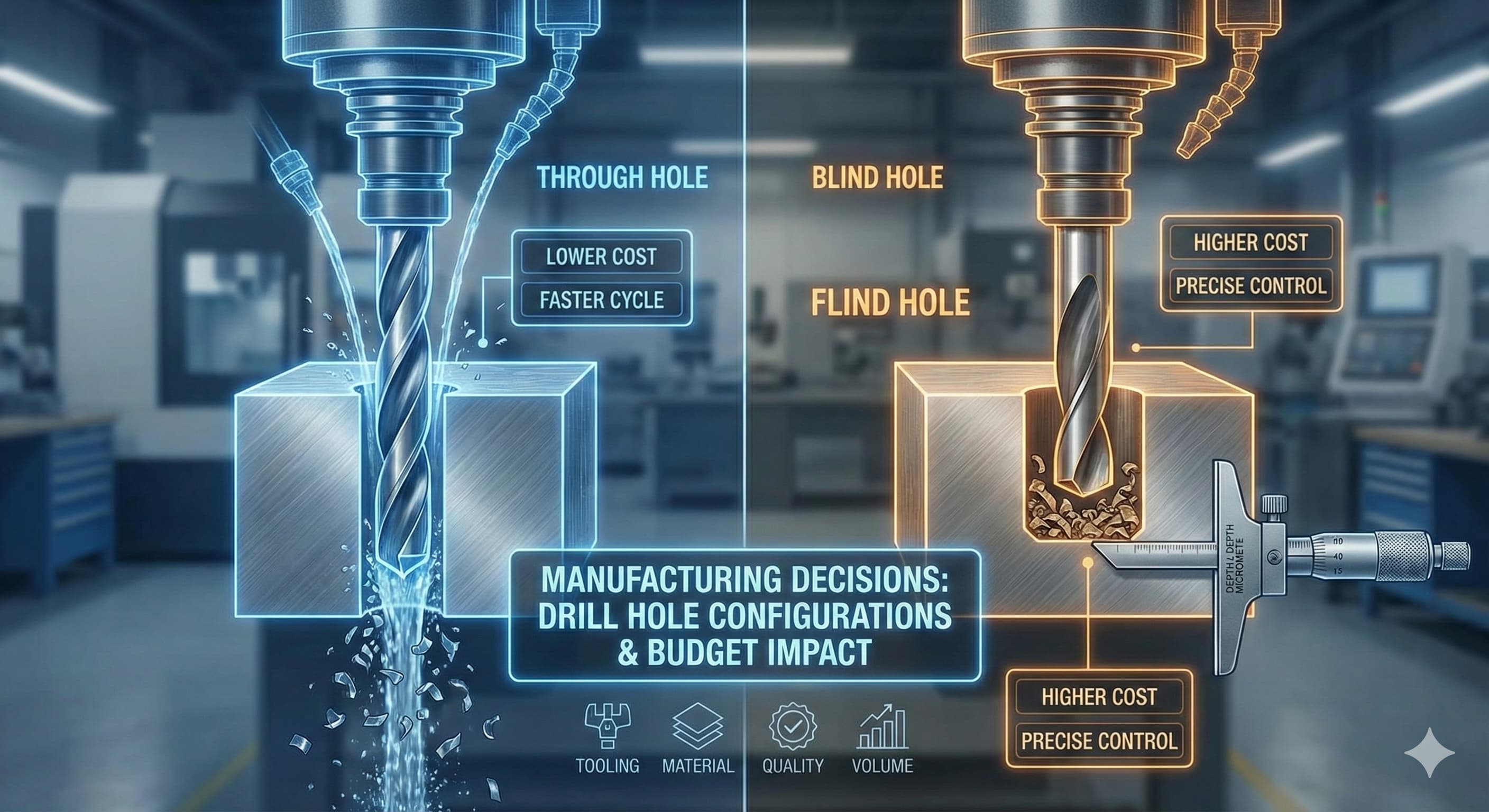
Drill hole configuration decisions can make or break your manufacturing budget. The choice between blind holes and through holes in CNC drilling operations directly impacts cycle times, tooling costs, and part quality—with cost differentials often ranging from 15% to 40% depending on material specifications and geometric complexity.
Key Takeaways:
- Through holes typically cost 20-30% less than blind holes due to simplified tooling and reduced cycle times
- Blind hole drilling requires specialized tooling and precise depth control, increasing setup costs by €150-€300 per operation
- Material removal efficiency drops by 35-45% when drilling blind holes in hardened steels above 45 HRC
- Quality control expenses increase by €0.50-€1.20 per part for blind hole verification versus through hole inspection
Fundamental Differences in Drilling Operations
Through holes and blind holes represent fundamentally different manufacturing challenges in CNC drilling operations. Through holes penetrate completely through the workpiece, allowing for continuous chip evacuation and straightforward tool exit strategies. Blind holes terminate at a specified depth within the material, creating enclosed cavities that demand precise depth control and specialized chip removal techniques.
The geometric constraints of blind holes necessitate different tooling approaches. Standard twist drills with 118° or 135° point angles work effectively for through holes, but blind hole applications often require specialized geometries including flat-bottom drills, gun drills for deep holes, or custom ground tools with specific point configurations. These specialized tools typically cost 40-60% more than standard drilling tools, with replacement intervals shortened due to increased cutting loads and heat generation.
Chip evacuation mechanisms differ significantly between these configurations. Through holes benefit from gravity-assisted chip removal and continuous coolant flow, while blind holes trap chips within the cavity, requiring peck drilling cycles, high-pressure coolant systems, or specialized chip-breaking geometries. This fundamental difference drives substantial variations in cycle times and tool life expectations.
Cost Analysis Framework
Manufacturing cost analysis for hole configurations requires evaluation across five primary categories: tooling costs, cycle time implications, quality control requirements, setup expenses, and material utilization factors. Each category contributes differently depending on production volume, material specifications, and geometric requirements.
Tooling costs encompass initial tool acquisition, replacement intervals, and specialized equipment requirements. Through holes typically utilize standard HSS or carbide twist drills ranging from €15-€45 for common diameters (3-12 mm), while blind hole operations often require specialized tools costing €25-€75 for equivalent diameters. Deep blind holes (L/D ratios exceeding 5:1) may necessitate gun drills or custom geometries costing €100-€300 per tool.
| Cost Factor | Through Holes | Blind Holes | Cost Difference |
|---|---|---|---|
| Standard Tooling (6mm drill) | €22 | €35 | +59% |
| Deep Hole Tooling (L/D > 5:1) | €25 | €145 | +480% |
| Setup Time (minutes) | 8-12 | 15-25 | +87% |
| Cycle Time per Hole (seconds) | 15-20 | 25-40 | +67% |
| Quality Control Time | 30 sec | 90 sec | +200% |
Cycle time variations stem from fundamental differences in drilling strategies. Through hole operations can utilize aggressive feed rates throughout the entire drilling cycle, while blind holes require controlled approach rates, multiple peck cycles for chip evacuation, and precise depth measurement protocols. These factors combine to increase cycle times by 40-85% depending on hole depth and diameter specifications.
Material-Specific Cost Implications
Material properties significantly influence the cost differential between blind and through hole drilling operations. Aluminum alloys such as 6061-T6 and 7075-T6 exhibit excellent machinability characteristics, minimizing the cost gap between hole configurations to approximately 15-25%. However, hardened steels, titanium alloys, and superalloys amplify these differences substantially.
For hardened tool steels exceeding 45 HRC, blind hole drilling presents exceptional challenges. The enclosed cutting environment prevents effective heat dissipation, accelerating tool wear and potentially causing work hardening in the hole bottom. Carbide tools with specialized coatings become mandatory, increasing tool costs from €30-€50 for standard applications to €80-€150 for hardened steel blind holes. Tool life reductions of 60-70% are common, further escalating per-part tooling costs.
| Material Grade | Through Hole Tool Life | Blind Hole Tool Life | Cost Impact per 100 Holes |
|---|---|---|---|
| Al 6061-T6 | 2500 holes | 1800 holes | +€8.50 |
| SS 316L | 800 holes | 450 holes | +€22.30 |
| Ti-6Al-4V | 350 holes | 180 holes | +€45.80 |
| 4140 Steel (45 HRC) | 180 holes | 65 holes | +€78.20 |
Stainless steel grades like 316L and 17-4 PH present intermediate challenges. Their work-hardening characteristics become pronounced in blind hole applications where cutting speeds cannot be maintained consistently.Advanced cutting strategies for hardened materials often become necessary, requiring specialized programming and extended cycle times that can double operational costs compared to through hole equivalents.
Geometric Complexity and Dimensional Control
Hole geometry requirements dramatically influence manufacturing costs through their impact on tooling selection, quality control procedures, and achievable tolerances. Through holes offer inherent advantages for dimensional control since measurements can be taken from both entry and exit surfaces, providing comprehensive verification of hole quality and positional accuracy.
Blind holes present measurement challenges that escalate quality control costs significantly. Standard pin gauges work effectively for through holes, while blind holes often require specialized measuring equipment including depth micrometers, coordinate measuring machines (CMM), or optical measurement systems. These measurement requirements can add €0.75-€1.50 per part to inspection costs for critical applications requiring full dimensional verification.
Positional tolerance requirements (per ISO 2768-fH standards) become more challenging to maintain in blind hole applications. The drilling forces and chip evacuation dynamics can cause drill wandering, particularly in deep holes where L/D ratios exceed 3:1. Achieving ±0.05 mm positional accuracy in blind holes often requires pilot hole operations, increasing machining time by 25-35% compared to single-pass through hole drilling.
Surface finish specifications add another layer of complexity. Through holes can be reamed, honed, or finish-bored using standard tooling configurations. Blind holes require specialized reaming tools with chip evacuation features, limiting tool selection and increasing costs by 30-50% for equivalent surface finish requirements (Ra 0.8 μm or better).
Production Volume Considerations
Production volume significantly impacts the economic trade-offs between blind and through hole configurations. Low-volume production (quantities below 100 pieces) tends to amplify setup cost differences, while high-volume runs can amortize tooling costs more effectively, shifting focus toward cycle time optimization.
For prototype and low-volume applications, through holes offer substantial cost advantages through reduced setup complexity and standard tooling requirements. Setup costs for blind hole operations typically range €150-€300 higher than through hole equivalents due to specialized tooling, depth setting procedures, and quality verification requirements. These costs become prohibitive for quantities below 50-75 pieces unless part functionality absolutely requires blind hole configurations.
Medium-volume production (500-5000 pieces) represents the crossover point where blind hole applications may justify investment in specialized tooling and optimized processes. Custom drill geometries, dedicated fixtures, and automated depth control systems can reduce per-part costs significantly, though initial investment requirements range €2000-€8000 depending on complexity requirements.
For high-precision results, Request a free quote and get pricing in 24 hours from Microns Hub.
High-volume production environments (quantities exceeding 10,000 pieces) enable advanced manufacturing strategies including dedicated drilling modules, automated tool changers, and statistical process control systems. In these applications, cycle time optimization becomes paramount, and through holes maintain their cost advantage through superior material removal rates and simplified automation integration.
Advanced Drilling Technologies and Cost Impact
Modern CNC drilling technologies offer sophisticated solutions for both hole configurations, though implementation costs and complexity vary substantially. High-speed drilling spindles (15,000-40,000 RPM) can reduce cycle times for small diameter holes (under 6 mm) by 35-55%, but benefits apply more readily to through hole applications where chip evacuation doesn't constrain cutting parameters.
Through-spindle coolant systems represent essential technology for blind hole drilling operations, particularly in demanding materials like titanium or hardened steels. These systems typically add €8000-€15000 to machine tool costs but enable aggressive cutting parameters that can reduce blind hole drilling times by 25-40%. The technology benefits through holes as well, but the improvement margins are less dramatic since conventional flood coolant often suffices.
Vibration damping systems become critical for deep blind holes where L/D ratios exceed 4:1. Boring bar stabilizers, tuned mass dampers, and active vibration control systems can add €5000-€12000 to specialized tooling costs but enable successful completion of challenging blind hole applications that would otherwise require alternative manufacturing approaches like injection molding services or EDM operations.
| Technology | Initial Cost | Through Hole Benefit | Blind Hole Benefit | Payback Volume |
|---|---|---|---|---|
| High-Speed Spindle | €25000 | 15-25% cycle reduction | 8-15% cycle reduction | 15000 pieces |
| Through-Spindle Coolant | €12000 | 10-20% improvement | 30-40% improvement | 8000 pieces |
| Vibration Control | €8500 | 5-10% improvement | 25-35% improvement | 12000 pieces |
| Automated Depth Control | €6000 | N/A | 20-30% setup reduction | 5000 pieces |
Quality Control and Inspection Costs
Quality assurance requirements create substantial cost differentials between blind and through hole configurations. Through holes enable comprehensive inspection using simple go/no-go gauges, standard pin gauges, or optical measurement systems with direct line-of-sight access. Total inspection time typically ranges 15-30 seconds per hole for dimensional verification.
Blind holes present complex inspection challenges requiring specialized equipment and extended measurement times. Depth measurement requires dedicated depth micrometers, coordinate measuring machines with appropriate probe configurations, or optical systems with sufficient depth of field. Inspection times increase to 60-120 seconds per hole, adding €0.50-€1.20 to per-part quality control costs depending on tolerance requirements and batch sizes.
Statistical process control (SPC) implementation differs significantly between hole configurations. Through holes can utilize automated gauging systems with pass/fail indicators, enabling 100% inspection at high production rates. Blind holes typically require sampling inspection protocols due to measurement complexity, potentially allowing defective parts to reach customers if sampling plans are inadequate.
Non-destructive testing requirements can escalate costs further for critical applications. Through holes can be inspected using simple borescopes or optical measurement systems costing €3000-€8000. Blind holes in critical applications may require specialized ultrasonic thickness gauges, eddy current systems, or micro-CT scanning equipment costing €15000-€50000 for comprehensive defect detection.
Alternative Manufacturing Considerations
When blind hole requirements drive manufacturing costs beyond acceptable limits, alternative production methods merit evaluation.Advanced machining strategies can sometimes eliminate blind hole requirements through creative part design or manufacturing sequence optimization.
Electrical discharge machining (EDM) provides cost-effective blind hole solutions for hardened materials where conventional drilling becomes prohibitively expensive. EDM holes exhibit excellent dimensional control and surface finish characteristics, though cycle times range 5-15 times longer than conventional drilling. For applications requiring fewer than 200 holes in hardened materials, EDM often presents lower total costs than specialized drilling operations.
Laser drilling technology offers rapid blind hole creation for thin-walled components and specialized materials. Initial equipment costs range €150000-€400000, but per-hole processing times can be reduced to 2-8 seconds for holes up to 2 mm diameter. The technology works particularly well for aerospace and medical applications where conventional drilling creates unacceptable heat-affected zones or dimensional distortions.
When ordering from Microns Hub, you benefit from direct manufacturer relationships that ensure superior quality control and competitive pricing compared to marketplace platforms. Our technical expertise spans conventional drilling, EDM, and laser processing technologies, enabling optimal manufacturing method selection for your specific requirements. This comprehensive approach through our manufacturing services ensures cost-effective solutions regardless of hole configuration complexity.
Cost Optimization Strategies
Effective cost optimization for hole drilling operations requires systematic evaluation of design requirements, production volumes, and manufacturing constraints. Design modifications can often reduce blind hole requirements through creative engineering approaches including split-part designs, pressed-in inserts, or alternative fastening methods that utilize through holes exclusively.
Tool life optimization represents a critical cost reduction opportunity, particularly for blind hole applications. Implementing optimized cutting parameters, advanced tool coatings, and predictive tool replacement strategies can extend tool life by 40-70% in challenging applications. Carbide tools with TiAlN or diamond-like carbon (DLC) coatings typically cost 60-80% more than standard tools but can provide 200-300% longer service life in blind hole applications.
Batch processing strategies can amortize setup costs more effectively across production runs. Grouping similar blind hole operations enables efficient tool changes, depth setting optimization, and quality control standardization. These approaches can reduce per-part setup costs by 35-50% for medium-volume applications while maintaining quality standards.
Automated systems integration provides long-term cost reduction opportunities for high-volume applications. Robotic part loading, automated tool changing, and integrated quality control systems can reduce labor costs by €8-€15 per hour while improving consistency and throughput rates. Initial investment requirements range €50000-€200000 depending on automation complexity, with typical payback periods of 18-36 months for applications exceeding 10000 pieces annually.
Material Waste and Environmental Considerations
Material utilization efficiency varies significantly between hole configurations, impacting both direct material costs and waste disposal expenses. Through holes remove material completely from the workpiece, creating chips that can be recycled efficiently through standard metal recovery processes. Blind holes create similar chip volumes but may complicate chip handling due to peck drilling cycles and interrupted cutting conditions.
Coolant consumption represents an often-overlooked cost factor that favors through hole applications. Blind holes typically require 40-70% more coolant volume due to extended cycle times, increased pressure requirements, and enhanced chip flushing needs. For facilities processing thousands of holes monthly, this difference can add €200-€500 to monthly operating costs.
Environmental compliance costs may differ between configurations depending on material specifications and coolant requirements. Blind hole operations in aerospace alloys or medical-grade materials often require specialized waste handling procedures that can add €0.15-€0.40 per part to processing costs. Through holes in equivalent materials typically require standard waste processing protocols with minimal cost impact.
Frequently Asked Questions
What is the typical cost difference between drilling blind holes versus through holes?
Through holes typically cost 20-30% less than blind holes due to reduced cycle times, standard tooling requirements, and simplified quality control procedures. The exact difference varies based on material specifications, hole geometry, and production volume, with cost differentials ranging from 15% for aluminum alloys to 45% for hardened steels above 45 HRC.
Why do blind holes require more expensive tooling than through holes?
Blind holes necessitate specialized drill geometries, enhanced chip evacuation features, and precise depth control capabilities. Standard twist drills cost €15-€45 for common diameters, while blind hole applications require specialized tools costing €25-€75 for equivalent sizes. Deep blind holes (L/D ratios exceeding 5:1) may require gun drills or custom geometries costing €100-€300 per tool.
How does material hardness affect the cost difference between hole types?
Material hardness significantly amplifies cost differences between blind and through hole configurations. For aluminum alloys, the cost differential typically remains under 25%. However, hardened steels above 45 HRC can exhibit cost differences of 60-80% due to reduced tool life, specialized cutting parameters, and extended cycle times required for successful blind hole completion.
What quality control challenges increase blind hole inspection costs?
Blind holes require specialized measurement equipment including depth micrometers, CMM systems with appropriate probes, or optical measurement systems. Inspection times increase from 15-30 seconds per through hole to 60-120 seconds per blind hole, adding €0.50-€1.20 to per-part quality control costs depending on tolerance requirements and measurement complexity.
When should manufacturers consider alternatives to conventional blind hole drilling?
Alternative manufacturing methods become cost-effective when blind hole drilling costs exceed 40-50% of total part manufacturing expenses. EDM provides economical solutions for fewer than 200 holes in hardened materials, while laser drilling offers rapid processing for thin-walled components. Design modifications to eliminate blind holes through split-part designs or pressed inserts often provide the most cost-effective solutions.
How does production volume affect the economic choice between hole configurations?
Low-volume production (under 100 pieces) favors through holes due to setup cost advantages of €150-€300 per operation. Medium volumes (500-5000 pieces) represent the crossover point where specialized blind hole tooling becomes economically justified. High-volume applications (over 10,000 pieces) enable advanced automation that maintains through hole cost advantages through superior cycle time efficiency.
What advanced technologies can reduce blind hole drilling costs?
Through-spindle coolant systems can reduce blind hole cycle times by 25-40% but require €8000-€15000 initial investment. Vibration damping systems enable successful deep blind hole completion for €5000-€12000 additional tooling costs. High-speed spindles provide 8-15% cycle time improvements for blind holes compared to 15-25% improvements for through holes, making the technology more beneficial for through hole applications.
MICRONS HUB DV Ε.Ε. · VAT: EL803129638 · GEMI: 190254227000 · Industrial Area, Street B, Number 4, 71601 Heraklion, Crete, Greece