Minimizing Chatter in Deep Pocket Milling: Design Tips for Engineers
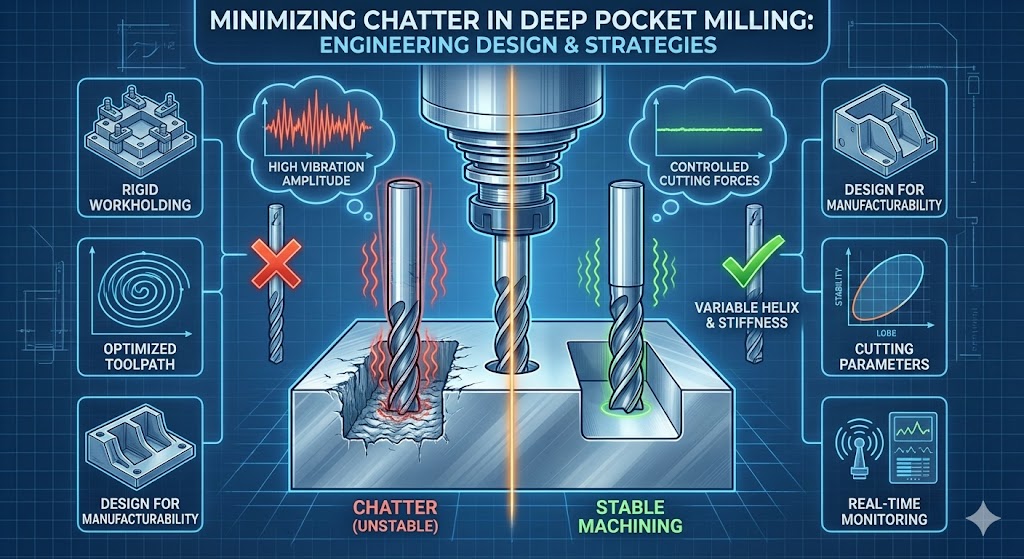
Deep pocket milling operations represent one of the most challenging aspects of precision machining, where chatter vibration can transform a promising setup into scrapped parts and damaged tooling. When machining components with length-to-diameter ratios exceeding 4:1, the physics of cutting forces, structural dynamics, and material removal create a perfect storm for unstable vibrations that compromise surface finish and dimensional accuracy.
The economic impact of chatter in deep pocket operations extends far beyond surface quality issues. Tool life reductions of 40-60% are common when chatter occurs, while the resulting surface waviness often requires expensive secondary finishing operations or complete part rejection. For European manufacturers working with aerospace-grade materials like Ti-6Al-4V or Inconel 718, where raw material costs can exceed €200 per kilogram, chatter-induced scrap represents a significant financial burden.
Key Takeaways
- Implement proper workholding strategies to achieve rigidity values exceeding 50 N/μm for deep pocket operations
- Select cutting parameters within stability lobe boundaries to maintain cutting forces below 800 N for typical 12 mm end mills
- Design part geometry with adequate wall thickness (minimum 3-5 mm) and strategic ribbing to prevent workpiece deformation
- Apply advanced tool path strategies including trochoidal milling and variable helix cutters to distribute cutting forces
Understanding Chatter Mechanics in Deep Pocket Milling
Chatter vibration in deep pocket milling occurs when the cutting system lacks sufficient dynamic stiffness to maintain stable material removal. The phenomenon manifests as self-excited vibrations where the tool regenerates surface waves from previous cuts, creating an amplifying feedback loop that quickly escalates to destructive levels.
The critical frequency range for chatter typically falls between 500-3000 Hz, coinciding with the natural frequencies of extended cutting tools and thin-walled workpieces. When the tooth passing frequency approaches these natural frequencies, even small disturbances can trigger exponential vibration growth. This is particularly problematic in deep pockets where tool overhang often exceeds 150 mm, reducing tool stiffness by factors of 8-16 compared to standard operations.
Dynamic cutting forces during chatter can peak at values 3-5 times higher than stable cutting conditions. For a typical 12 mm carbide end mill operating at 2000 RPM with 0,5 mm axial depth of cut, stable cutting forces might reach 300-400 N, while chatter-induced peaks can exceed 1500 N. These force spikes not only damage the cutting edge but also transmit destructive vibrations throughout the machine structure.
Material-Specific Chatter Characteristics
Different workpiece materials exhibit distinct chatter behaviors that must be considered during process design. Aluminum alloys like 6061-T6 and 7075-T6 generally provide good damping characteristics due to their lower elastic modulus (70 GPa vs 210 GPa for steel), but their lower strength can lead to workpiece deflection issues in thin-walled sections.
MaterialDamping RatioCritical Speed Range (RPM)Recommended Wall Thickness (mm)Al 6061-T60.02-0.041500-40003-5Al 7075-T60.015-0.0351200-35004-6Steel 41400.005-0.015800-25005-8Ti-6Al-4V0.008-0.020600-18006-10Inconel 7180.010-0.025400-12008-12
Titanium alloys present unique challenges due to their low thermal conductivity (6.7 W/mK for Ti-6Al-4V vs 205 W/mK for aluminum), which concentrates cutting heat at the tool-workpiece interface. This thermal loading combines with titanium's work hardening characteristics to create unstable cutting conditions that promote chatter initiation.
Workholding Design for Maximum Rigidity
Effective chatter suppression begins with workholding system design that maximizes structural rigidity while providing adequate access for deep pocket machining. The fundamental principle involves creating the shortest, most direct load path from the cutting forces to the machine table, minimizing compliance in the system.
Vise jaw modifications represent the most accessible improvement for many operations. Standard smooth jaws provide limited contact area and concentrate clamping forces, creating stress concentrations that can induce workpiece distortion. Custom soft jaws machined to match the workpiece profile distribute clamping forces over larger areas while providing better surface conformity.
For complex geometries requiring 4th or 5th axis positioning, tombstone fixtures offer superior rigidity compared to traditional vise setups. A properly designed tombstone can achieve system rigidity values exceeding 100 N/μm, compared to 20-40 N/μm for typical vise arrangements. The key design elements include large base cross-sections, minimal fixture height, and strategic placement of workpiece clamps to counteract cutting force directions.
Hydraulic and Pneumatic Workholding Considerations
High-pressure hydraulic workholding systems operating at 70-210 bar can provide uniform clamping forces while accommodating workpiece thermal expansion during cutting. However, the compliance of hydraulic systems under dynamic loading can actually contribute to chatter if not properly designed. The fluid column acts as a spring-damper system with natural frequencies that may coincide with problematic cutting frequencies.
Pneumatic systems offer advantages for thin-walled workpieces where excessive clamping forces could cause distortion. Operating pressures of 6-8 bar provide adequate holding force for many deep pocket operations while allowing controlled workpiece movement that can actually help dissipate chatter energy. The key is matching the pneumatic pressure to the workpiece rigidity to maintain stability without over-constraint.
Tool Selection and Geometry Optimization
Tool selection for deep pocket milling requires careful balance between rigidity, cutting performance, and chip evacuation. The fundamental challenge lies in maximizing tool stiffness while maintaining adequate flute volume for chip removal from extended cavities. Standard length-to-diameter ratios should remain below 4:1 whenever possible, though deep pocket operations often require ratios of 6:1 or higher.
Variable helix end mills provide significant advantages for chatter suppression by distributing cutting forces across different frequencies. A typical variable helix design might combine 30°, 35°, and 40° helix angles on adjacent flutes, creating different tooth passing frequencies that prevent harmonic reinforcement. This approach can reduce chatter amplitude by 40-60% compared to conventional constant helix tools.
Unequal spacing of cutting edges further disrupts chatter-inducing frequencies. A four-flute end mill with 85°, 95°, 85°, 95° spacing breaks up the regular tooth passing pattern that often triggers regenerative chatter. Combined with variable helix angles, unequal spacing creates a more randomized excitation pattern that improves stability across wider parameter ranges.
Cutting Edge Preparation and Coatings
Edge preparation significantly influences chatter tendency through its effect on cutting forces and built-up edge formation. Sharp edges (5-10 μm radius) minimize cutting forces but may be prone to chipping and built-up edge formation, particularly in aluminum alloys. Slightly radiused edges (15-25 μm) provide better edge stability while maintaining reasonable cutting forces.
Advanced coating systems like TiAlN and AlCrN reduce friction and improve thermal stability, helping maintain consistent cutting conditions that resist chatter initiation. For deep pocket operations in aluminum, diamond-like carbon (DLC) coatings virtually eliminate built-up edge formation while reducing cutting temperatures by 15-25°.
When designing deep pocket components, engineers should consider how manufacturing processes like injection molding services might offer alternative solutions for complex internal geometries, potentially eliminating the need for challenging deep pocket machining operations entirely.
Part Design Strategies for Chatter Resistance
Geometric design decisions made during the CAD phase have profound impacts on machining stability and chatter susceptibility. Wall thickness represents the most critical parameter, with thin sections acting as dynamic amplifiers that magnify cutting vibrations. Maintaining minimum wall thickness of 3-5 mm in aluminum components provides adequate structural rigidity while allowing reasonable tool access.
Strategic rib placement can dramatically improve workpiece rigidity without significantly increasing material volume. Vertical ribs oriented perpendicular to primary cutting force directions provide maximum stiffening effect. A 2 mm thick rib can increase local stiffness by 300-400% while adding minimal weight. Rib spacing of 25-40 mm typically provides optimal stiffening without interfering with tool paths.
Corner radius design affects both tool life and chatter resistance. Sharp internal corners require small end mills with reduced rigidity, while generous radii allow larger, stiffer tools. Minimum corner radii should exceed 1,5 times the desired tool diameter, with 3-5 mm radii preferred for most deep pocket operations. This approach enables the use of 12-16 mm end mills instead of 6-8 mm tools, providing 4-8 times greater rigidity.
Advanced Geometric Features
Progressive depth changes help manage cutting forces and improve chip evacuation in deep pockets. Instead of machining full depth immediately, stepped geometry with 5-10 mm depth increments allows optimization of cutting parameters at each level. This approach also provides opportunities for workpiece inspection and tool condition monitoring during the operation.
Feature TypeMinimum DimensionOptimal RangeImpact on ChatterWall Thickness2 mm4-8 mmHigh - primary stability factorCorner Radius1,5 × tool diameter3-5 mmMedium - enables larger toolsRib Thickness1,5 mm2-4 mmHigh - structural reinforcementStep Height3 mm5-10 mmMedium - force management
For high-precision results,Get a quote in 24 hours from Microns Hub.
Cutting Parameter Optimization
Cutting parameter selection for deep pocket milling requires understanding of stability lobe diagrams that map chatter-free operating regions. These diagrams plot spindle speed versus axial depth of cut, revealing islands of stability where material removal can proceed without vibration. The challenge lies in operating within these stable regions while maintaining productive material removal rates.
Spindle speed selection should avoid critical frequencies that coincide with system natural frequencies. For typical deep pocket setups with tool overhangs of 100-150 mm, critical frequencies often fall between 800-2400 Hz. Converting to spindle speeds for common end mill geometries, this translates to avoiding speed ranges of 6000-18000 RPM for 4-flute 12 mm tools.
Feed rate optimization balances chip load requirements with dynamic stability. Excessive feed rates increase cutting forces and vibration amplitude, while insufficient feeds promote built-up edge formation and work hardening. For aluminum alloys, chip loads of 0,08-0,15 mm/tooth typically provide good results, requiring careful coordination with spindle speed to achieve target surface speeds.
Adaptive Machining Strategies
Trochoidal milling represents an advanced approach that maintains constant tool engagement while reducing cutting forces. Instead of conventional slot milling that creates high radial forces, trochoidal paths use small radial cuts (typically 8-15% of tool diameter) with continuous tool motion. This approach can reduce cutting forces by 40-70% while improving tool life and surface finish.
Climb milling orientation should be maintained whenever possible to minimize built-up edge formation and achieve superior surface finish. However, the higher cutting forces associated with climb milling may require reduced axial depths in marginal stability conditions. The trade-off between surface quality and stability limits must be evaluated for each specific application.
Understanding these complex interactions is where our manufacturing services prove invaluable, combining advanced process knowledge with practical machining experience to optimize parameters for each unique application.
Advanced Toolpath Strategies
Modern CAM software provides sophisticated toolpath options specifically designed to minimize chatter in challenging applications. Rest machining strategies identify and machine only remaining material, reducing air cutting and maintaining consistent tool engagement. This approach minimizes the thermal cycling that can contribute to chatter initiation while maximizing material removal efficiency.
Pencil milling represents an essential strategy for tight corner radii and detailed features within deep pockets. Using ball end mills with small step-downs (0,1-0,3 mm), pencil toolpaths can achieve excellent surface finishes while avoiding the high radial forces associated with conventional finishing passes. Tool selection becomes critical, with long-reach ball mills requiring careful balance between reach and rigidity.
Parallel finishing passes should follow consistent climb milling orientation with step-overs of 15-25% of tool diameter for optimal surface finish. The finishing pass strategy must account for workpiece deflection under cutting forces, with spring passes often necessary to achieve final dimensional requirements.
Multi-Axis Toolpath Considerations
Five-axis toolpaths enable significant improvements in deep pocket machining by optimizing tool orientation throughout the cutting cycle. By tilting the spindle to maintain optimal chip evacuation angles and minimize tool overhang, 5-axis strategies can reduce effective tool length by 30-50% compared to 3-axis approaches.
Simultaneous 5-axis roughing allows the tool to follow complex contours while maintaining consistent chip loads and optimal cutting geometries. This approach proves particularly valuable for aerospace components with complex internal passages or automotive components requiring precise flow characteristics. The undercuts in CNC machining strategies demonstrate how multi-axis approaches can solve seemingly impossible geometric challenges.
Monitoring and Control Systems
Real-time chatter detection systems provide immediate feedback on cutting stability, enabling automatic parameter adjustment before damage occurs. Accelerometer-based systems can detect chatter onset within 0,1-0,2 seconds, triggering spindle speed changes or feed rate reductions to restore stability. Modern systems operate in the 20 kHz frequency range, capturing the high-frequency components that characterize chatter vibration.
Spindle power monitoring offers a complementary approach to chatter detection, with power fluctuations of 15-25% indicating developing instability. Combined with acoustic emission sensors that detect the high-frequency noise associated with unstable cutting, multi-sensor systems provide robust chatter detection across various operating conditions.
Adaptive control systems automatically adjust cutting parameters based on real-time feedback, maintaining optimal material removal rates while avoiding chatter conditions. These systems continuously monitor cutting forces, spindle power, and vibration signatures, making micro-adjustments to feed rate and spindle speed hundreds of times per second.
Cost Optimization Strategies
Deep pocket milling operations typically incur costs of €15-45 per hour depending on machine type and complexity, making efficient parameter selection crucial for project economics. Tool costs represent 15-25% of total machining costs, with premature tool failure due to chatter potentially doubling cutting tool expenses.
Workpiece scrap costs vary dramatically with material type, from €8-12 per kilogram for aluminum alloys to €150-200 per kilogram for aerospace titanium alloys. A single chatter-induced scrap part in titanium can cost more than €500 in material alone, not including the associated machining time and overhead costs.
Cost ElementPercentage of TotalChatter ImpactOptimization PotentialMachine Time40-50%+50-100% (rework)20-30% reductionTooling15-25%+100-200% (premature failure)40-60% reductionMaterial20-35%+100% (scrap)5-10% reductionSetup/Programming10-20%+25-50% (rework)30-40% reduction
When ordering from Microns Hub, you benefit from direct manufacturer relationships that ensure superior quality control and competitive pricing compared to marketplace platforms. Our technical expertise and personalized service approach means every project receives the attention to detail it deserves, with specialized knowledge in chatter suppression techniques that can save significant costs over the project lifecycle.
Quality Control and Measurement
Surface finish measurement in deep pockets requires specialized techniques due to access limitations and geometric constraints. Portable surface roughness testers with extended probe arms can reach depths up to 200 mm, providing Ra measurements that indicate chatter-induced surface degradation. Target surface finishes for deep pocket operations typically range from Ra 0,8-3,2 μm depending on functional requirements.
Dimensional accuracy verification becomes challenging as pocket depth increases due to probe access limitations and thermal effects. Coordinate measuring machines (CMMs) with articulating probe heads can access most deep pocket features, but measurement uncertainty increases with probe extension length. For critical dimensions, in-process measurement using on-machine probing systems provides better accuracy by eliminating thermal and fixturing variations.
Vibration analysis during cutting operations provides valuable insight into process stability and optimization opportunities. FFT analysis of cutting vibrations can identify dominant frequency components and their relationship to chatter phenomena, enabling predictive maintenance and parameter optimization strategies.
Troubleshooting Common Issues
Built-up edge formation represents one of the most common issues in deep pocket aluminum machining, particularly at lower cutting speeds. The adhesive properties of aluminum cause material to weld onto the cutting edge, creating an effectively duller tool that requires higher cutting forces. This increased force requirement often triggers chatter in marginally stable setups.
Chip evacuation problems compound as pocket depth increases, with long chips creating bird-nesting effects that interfere with cutting action. High-pressure coolant systems operating at 20-70 bar can improve chip evacuation, but nozzle positioning becomes critical in deep, narrow pockets. Programmable coolant nozzles that follow the tool path provide optimal chip clearing throughout the machining cycle.
Tool deflection effects become pronounced in deep pocket operations, with cutting forces creating lateral tool displacement that affects dimensional accuracy. Tool deflection can be calculated using beam theory, with a 12 mm carbide end mill extended 100 mm deflecting approximately 0,025 mm under 500 N radial force. This deflection must be compensated through tool path programming or adaptive control systems.
Frequently Asked Questions
What spindle speeds should be avoided in deep pocket milling?
Critical spindle speeds that coincide with system natural frequencies should be avoided, typically falling between 800-2400 Hz for extended tool setups. For 4-flute 12 mm end mills, this translates to avoiding 6000-18000 RPM ranges where chatter is most likely to occur.
How does wall thickness affect chatter resistance?
Wall thickness directly impacts workpiece rigidity and chatter resistance. Minimum thickness of 3-5 mm in aluminum provides adequate structural stability, while thinner sections act as dynamic amplifiers that magnify cutting vibrations and promote chatter initiation.
What cutting parameters minimize chatter risk?
Optimal parameters fall within stability lobe boundaries, typically requiring spindle speeds that avoid natural frequencies, feed rates providing 0,08-0,15 mm/tooth chip loads in aluminum, and axial depths below 2-4 mm depending on tool overhang and system rigidity.
How can toolpath strategies reduce chatter?
Trochoidal milling reduces cutting forces by 40-70% through constant tool engagement with small radial cuts, while variable helix end mills distribute cutting forces across different frequencies to prevent harmonic reinforcement and reduce chatter amplitude.
What workholding improvements help prevent chatter?
Maximizing system rigidity through tombstone fixtures, custom soft jaws, and strategic clamping can achieve rigidity values exceeding 100 N/μm. Proper workholding creates shorter load paths and minimizes compliance that contributes to chatter susceptibility.
How do material properties influence chatter behavior?
Material damping characteristics significantly affect chatter tendency, with aluminum alloys providing better natural damping (0.02-0.04 ratio) compared to steel (0.005-0.015), while titanium's low thermal conductivity and work hardening properties create additional stability challenges.
What monitoring systems detect chatter effectively?
Accelerometer-based systems operating at 20 kHz frequency ranges can detect chatter onset within 0,1-0,2 seconds, while spindle power monitoring identifies 15-25% power fluctuations that indicate developing instability, enabling automatic parameter adjustment before damage occurs.
MICRONS HUB DV Ε.Ε. · VAT: EL803129638 · GEMI: 190254227000 · Industrial Area, Street B, Number 4, 71601 Heraklion, Crete, Greece