Aerospace Machining Standards: Meeting AS9100 Requirements
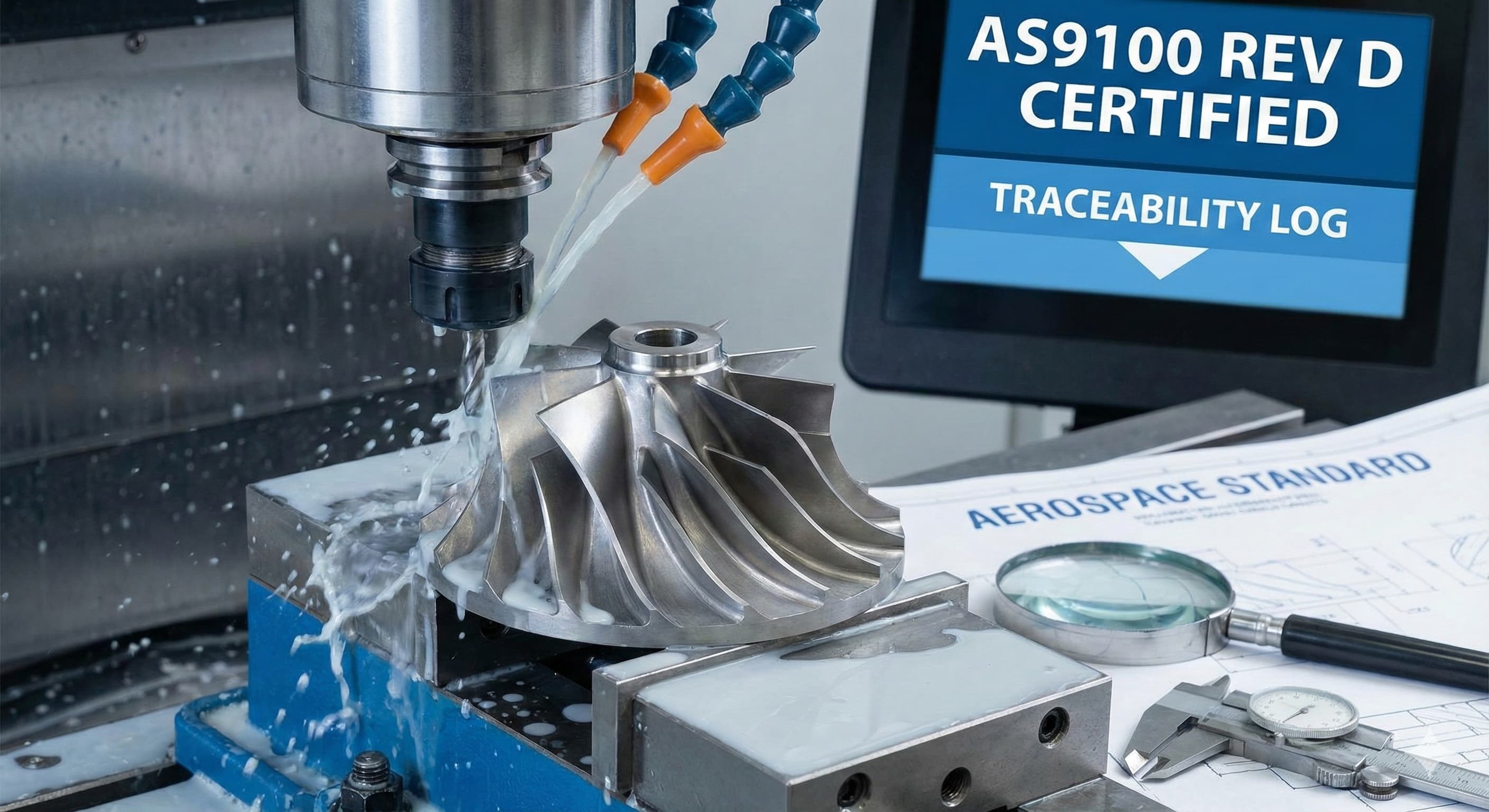
Aerospace components demand the highest levels of precision, traceability, and quality control. A single machining defect in a critical flight component can result in catastrophic failure, making AS9100 compliance not just a business requirement but a matter of safety. The standard extends ISO 9001 with aerospace-specific requirements that govern everything from material traceability to first article inspection protocols.
Key Takeaways:
- AS9100 requires full material traceability from raw stock to finished component with documented chain of custody
- First Article Inspection (FAI) must validate 100% of drawing dimensions before production release
- Risk management processes must identify and mitigate potential failure modes throughout the manufacturing process
- Configuration management ensures design changes are properly controlled and documented
Understanding AS9100 Core Requirements
AS9100 Rev D represents the current standard for aerospace quality management systems, building upon ISO 9001:2015 with aviation-specific clauses. The standard addresses critical aerospace concerns including product safety, configuration management, and risk-based thinking throughout the manufacturing lifecycle.
The key differentiator lies in the standard's emphasis on preventing non-conforming products from reaching the customer. Unlike general manufacturing where defects might be acceptable within certain limits, aerospace machining operates under zero-defect expectations. This translates to rigorous process controls, extensive documentation requirements, and comprehensive verification at each manufacturing stage.
Material certification requirements under AS9100 go beyond basic chemical composition verification. Each raw material batch must include heat lot traceability, mechanical property certification, and compliance with aerospace material specifications such as AMS 4037 for aluminum 6061-T6 or AMS 4911 for titanium Ti-6Al-4V. The certification chain must remain unbroken from mill source to final machined component.
Process validation requirements mandate that critical machining parameters be identified, monitored, and controlled within established limits. For precision aerospace components requiring tolerances of ±0.005 mm or tighter, this includes spindle thermal monitoring, tool wear tracking, and real-time dimensional verification during production runs.
Material Traceability and Certification
Aerospace machining begins with properly certified raw materials that meet strict traceability requirements. Every piece of stock must be accompanied by a Material Test Report (MTR) or Certificate of Conformance (CoC) that documents the material's chemical composition, mechanical properties, and compliance with applicable specifications.
| Material Grade | Specification | Required Certifications | Typical Cost Premium |
|---|---|---|---|
| Aluminum 6061-T6 | AMS 4037 | Chemical analysis, mechanical properties, heat treatment records | €2.50-€3.20/kg |
| Aluminum 7075-T6 | AMS 4045 | Chemical analysis, mechanical properties, stress corrosion testing | €4.80-€6.10/kg |
| Titanium Ti-6Al-4V | AMS 4911 | Chemical analysis, mechanical properties, microstructure verification | €28.50-€35.40/kg |
| Inconel 718 | AMS 5662 | Chemical analysis, mechanical properties, grain size verification | €45.20-€58.70/kg |
The traceability chain must be maintained throughout the machining process using heat lot numbers or unique identifiers that link each finished component back to its source material. This becomes critical during failure investigations where the ability to identify all components manufactured from the same material batch can prevent widespread aircraft groundings.
Material handling procedures must prevent contamination or mixing of different grades. Segregated storage areas, clearly marked tooling, and dedicated cutting fluids for different material families help maintain material integrity. Cross-contamination between materials like aluminum and steel can create galvanic corrosion issues in service, making strict separation protocols essential.
First Article Inspection Requirements
First Article Inspection (FAI) represents one of the most critical AS9100 requirements for aerospace machining. The process validates that manufacturing methods can consistently produce parts meeting all engineering requirements before full production begins. FAI documentation must demonstrate capability across dimensional, material, and functional characteristics.
The inspection process follows AS9102 standard, requiring measurement of 100% of drawing dimensions on the first production article. This includes not only critical dimensions but also general tolerances, surface finish requirements, and any special characteristics identified on the engineering drawing. Measurement uncertainty analysis ensures that inspection equipment capability is adequate for the required tolerance verification.
For high-precision aerospace components, measurement equipment selection becomes crucial. Coordinate measuring machines (CMMs) with measurement uncertainty ratios of 10:1 or better relative to part tolerance provide adequate discrimination. Components with tolerances approaching ±0.01 mm may require specialized metrology equipment such as laser interferometry or optical measurement systems.
Documentation requirements include detailed measurement reports, statistical process control charts demonstrating process stability, and correlation studies between different measurement methods. The FAI package must be approved by both manufacturing and quality organizations before production release, with copies maintained for the life of the manufacturing program.
Process Control and Statistical Methods
AS9100 mandates statistical process control (SPC) for critical manufacturing processes, requiring ongoing monitoring of process capability and stability. Key machining parameters such as spindle speed, feed rate, cutting depth, and coolant flow must be monitored and controlled within established limits to ensure consistent part quality.
Control charts track critical dimensions over time, identifying trends or shifts that might indicate process deterioration before defective parts are produced. For aerospace components, control limits are typically set tighter than specification limits to provide early warning of potential issues. A process capability index (Cpk) of 1.67 or higher is often required for critical characteristics.
Tool management programs ensure cutting tools are changed based on actual wear rather than arbitrary cycle counts. Tool life monitoring using acoustic emission sensors or spindle power analysis can detect tool degradation in real-time, preventing the production of parts with compromised surface finish or dimensional accuracy.
For high-precision results,Get a quote in 24 hours from Microns Hub.
Process validation studies demonstrate that machining processes can consistently meet specification requirements under normal production conditions. These studies include designed experiments to optimize cutting parameters, capability studies to verify process stability, and correlation analysis between process parameters and part quality characteristics.
Risk Management in Aerospace Machining
Risk-based thinking permeates AS9100, requiring organizations to identify and mitigate risks that could impact product quality, delivery, or safety. In aerospace machining, risks span from material defects and process variations to equipment failures and human error.
[Image of failure mode and effects analysis FMEA workflow diagram]Failure Mode and Effects Analysis (FMEA) systematically evaluates potential failure modes in the machining process, assessing their likelihood, detectability, and potential impact. High-risk items receive additional process controls, inspection requirements, or backup procedures to minimize the probability of defective products reaching customers.
Machine tool reliability programs include predictive maintenance schedules, spare parts inventory management, and backup capacity planning. Critical machining operations may require redundant equipment capability to prevent production disruptions that could impact aircraft delivery schedules.
Human factors analysis addresses risks associated with operator error, training deficiencies, or communication breakdowns. Standardized work instructions, operator certification programs, and mistake-proofing techniques help minimize variability introduced by human intervention in the manufacturing process.
Configuration Management and Change Control
Configuration management ensures that design changes are properly evaluated, approved, and implemented without compromising product quality or introducing new risks. In aerospace manufacturing, unauthorized changes can void airworthiness certifications and create significant liability exposure.
Engineering change control processes require formal evaluation of proposed modifications, including impact assessment on manufacturing processes, tooling requirements, and inspection procedures. Changes must be approved by appropriate technical authorities and communicated to all affected organizations before implementation.
Drawing control systems ensure that manufacturing personnel always work from the latest approved revision. Obsolete drawings must be removed from production areas to prevent inadvertent use, and revision status must be clearly marked on all controlled documents.
Manufacturing process changes, even seemingly minor ones like cutting tool substitutions or machining parameter adjustments, require formal evaluation and approval. Changes that could affect part quality must be validated through process capability studies or first article inspection before implementation.
Advanced Machining Techniques and AS9100 Compliance
Modern aerospace components often require advanced machining techniques such as 5-axis simultaneous machining, high-speed machining, or specialized processes like precision knurling operations for control surfaces. These processes introduce additional complexity in meeting AS9100 requirements.
5-axis machining programs require extensive validation to ensure tool path accuracy and collision avoidance. Simulation software verification, machine tool calibration, and fixture qualification become critical elements in the process validation chain. Post-processor accuracy must be verified through coordinate measurement of complex curved surfaces.
High-speed machining introduces thermal management challenges that can affect dimensional accuracy and surface integrity. Spindle thermal growth compensation, cutting fluid management, and workpiece temperature monitoring help maintain process control under high-speed conditions.
When aerospace projects require integration with other manufacturing processes, our comprehensive manufacturing services ensure seamless coordination while maintaining AS9100 compliance across all operations.
Integration with Sheet Metal Components
Many aerospace assemblies combine machined components with sheet metal structures, requiring coordination between different manufacturing processes while maintaining AS9100 compliance throughout. The integration challenges span material compatibility, tolerance stack-up analysis, and assembly sequence optimization.
Material compatibility analysis ensures that dissimilar metals used in machined and sheet metal components won't create galvanic corrosion issues in service. Proper material selection and protective coatings help prevent degradation in harsh aerospace environments.
Tolerance analysis across the entire assembly helps optimize manufacturing tolerances for both machined and sheet metal components. Statistical tolerance analysis techniques account for variation in both processes, ensuring assembly requirements can be consistently met without excessive manufacturing costs.
Our specialized sheet metal fabrication services work seamlessly with precision machining operations to deliver complete aerospace assemblies that meet AS9100 requirements across all manufacturing processes.
Quality Records and Documentation Management
AS9100 documentation requirements extend far beyond basic inspection reports, encompassing complete manufacturing history for each aerospace component. Quality records must demonstrate compliance with all applicable requirements and provide traceability for failure investigations or service bulletins.
| Document Type | Retention Period | Required Content | Distribution |
|---|---|---|---|
| Material Certifications | Life of aircraft + 10 years | Chemical analysis, mechanical properties, heat treatment records | Customer, internal quality files |
| First Article Inspection | Life of production program | Complete dimensional report, process validation data | Customer, manufacturing, quality |
| In-Process Inspection | 7-10 years minimum | Critical dimension measurements, SPC data | Internal quality files |
| Final Inspection Reports | Life of aircraft + 10 years | Complete dimensional verification, material compliance | Customer, internal quality files |
Electronic document management systems provide secure storage, version control, and rapid retrieval capabilities essential for aerospace documentation. Backup procedures ensure document availability even in case of system failures or natural disasters.
Calibration records for all measurement equipment must demonstrate traceability to national standards and compliance with scheduled calibration intervals. Out-of-tolerance conditions require evaluation of all measurements performed since the last successful calibration to determine potential impact on product quality.
Supplier Management and Outsourcing Control
AS9100 places significant emphasis on supplier control, recognizing that subcontracted operations can introduce risks to product quality and delivery performance. Supplier qualification, ongoing monitoring, and performance management become critical elements of the quality system.
Supplier audits evaluate not only technical capabilities but also quality system maturity and risk management processes. Aerospace suppliers must demonstrate AS9100 certification or equivalent quality system implementation, with regular surveillance audits to ensure continued compliance.
Purchase order specifications must clearly communicate all applicable requirements including material specifications, dimensional tolerances, inspection requirements, and delivery expectations. Special requirements such as Foreign Object Debris (FOD) prevention or clean room manufacturing must be explicitly specified.
Supplier performance monitoring tracks quality, delivery, and cost performance over time. Corrective action processes address deficiencies before they impact production schedules or product quality, with escalation procedures for persistent problems.
Advantages of Direct Manufacturing Partnerships
When ordering from Microns Hub, you benefit from direct manufacturer relationships that ensure superior quality control and competitive pricing compared to marketplace platforms. Our AS9100-compliant processes and technical expertise mean every aerospace project receives the rigorous attention to detail and documentation accuracy that aviation applications demand, with full traceability and certification support.
Continuous Improvement and Management Review
AS9100 requires systematic continuous improvement processes that go beyond corrective action to include proactive identification of improvement opportunities. Management review processes evaluate quality system effectiveness and resource allocation to support ongoing enhancement initiatives.
Internal audit programs assess compliance with AS9100 requirements and identify opportunities for process improvement. Audit findings drive corrective and preventive action programs that address root causes rather than symptoms, preventing recurrence of quality issues.
Customer feedback analysis, including warranty claims and service difficulty reports, provides insights into field performance that can drive manufacturing process improvements. Lessons learned from field experience help refine manufacturing processes and prevent similar issues in future programs.
Management commitment to quality and continuous improvement must be demonstrated through resource allocation, training investments, and active participation in quality system activities. Leadership engagement ensures that quality considerations receive appropriate priority in business decisions.
Frequently Asked Questions
What is the difference between AS9100 and ISO 9001 for aerospace machining?
AS9100 builds upon ISO 9001 with additional aerospace-specific requirements including configuration management, risk management, first article inspection, and enhanced supplier control. The standard adds 106 aerospace requirements to the base ISO 9001 framework, addressing critical aviation concerns such as product safety and airworthiness.
How long does AS9100 certification typically take for a machine shop?
AS9100 certification typically requires 12-18 months for implementation, depending on existing quality system maturity. The process includes gap analysis, system development, internal audits, management review, and third-party certification audit. Ongoing surveillance audits occur every 6 months with recertification every 3 years.
What documentation is required for First Article Inspection under AS9100?
First Article Inspection requires AS9102 forms documenting 100% dimensional verification, material compliance, functional testing results, and process validation data. The package includes detailed measurement reports, statistical capability studies, and correlation analysis between different measurement methods, all approved by qualified personnel.
How does AS9100 address material traceability requirements?
AS9100 requires complete material traceability from mill source through finished component using heat lot numbers or unique identifiers. Material certifications must include chemical analysis, mechanical properties, and compliance with aerospace specifications. The traceability chain must be maintained throughout manufacturing with proper segregation and handling procedures.
What are the key risk management requirements under AS9100?
AS9100 requires systematic risk identification, assessment, and mitigation throughout the product lifecycle. This includes Failure Mode and Effects Analysis (FMEA), process risk assessment, supplier risk evaluation, and contingency planning. Risk management must address product safety, quality, delivery, and cost considerations with documented controls for high-risk items.
How does AS9100 handle engineering change control?
Engineering changes require formal evaluation including impact assessment on manufacturing processes, tooling, and inspection procedures. Changes must be approved by appropriate technical authorities, validated through process studies or first article inspection, and communicated to all affected organizations before implementation. Configuration management ensures drawing control and revision status tracking.
What statistical methods are required for AS9100 compliance?
AS9100 requires statistical process control for critical manufacturing processes with control charts monitoring key parameters over time. Process capability studies must demonstrate Cpk values typically 1.67 or higher for critical characteristics. Statistical analysis includes measurement system analysis, designed experiments for process optimization, and correlation studies between process parameters and quality outcomes.
MICRONS HUB DV Ε.Ε. · VAT: EL803129638 · GEMI: 190254227000 · Industrial Area, Street B, Number 4, 71601 Heraklion, Crete, Greece