CNC Machining Post-Casting: Holding Tight Tolerances on Cast Faces
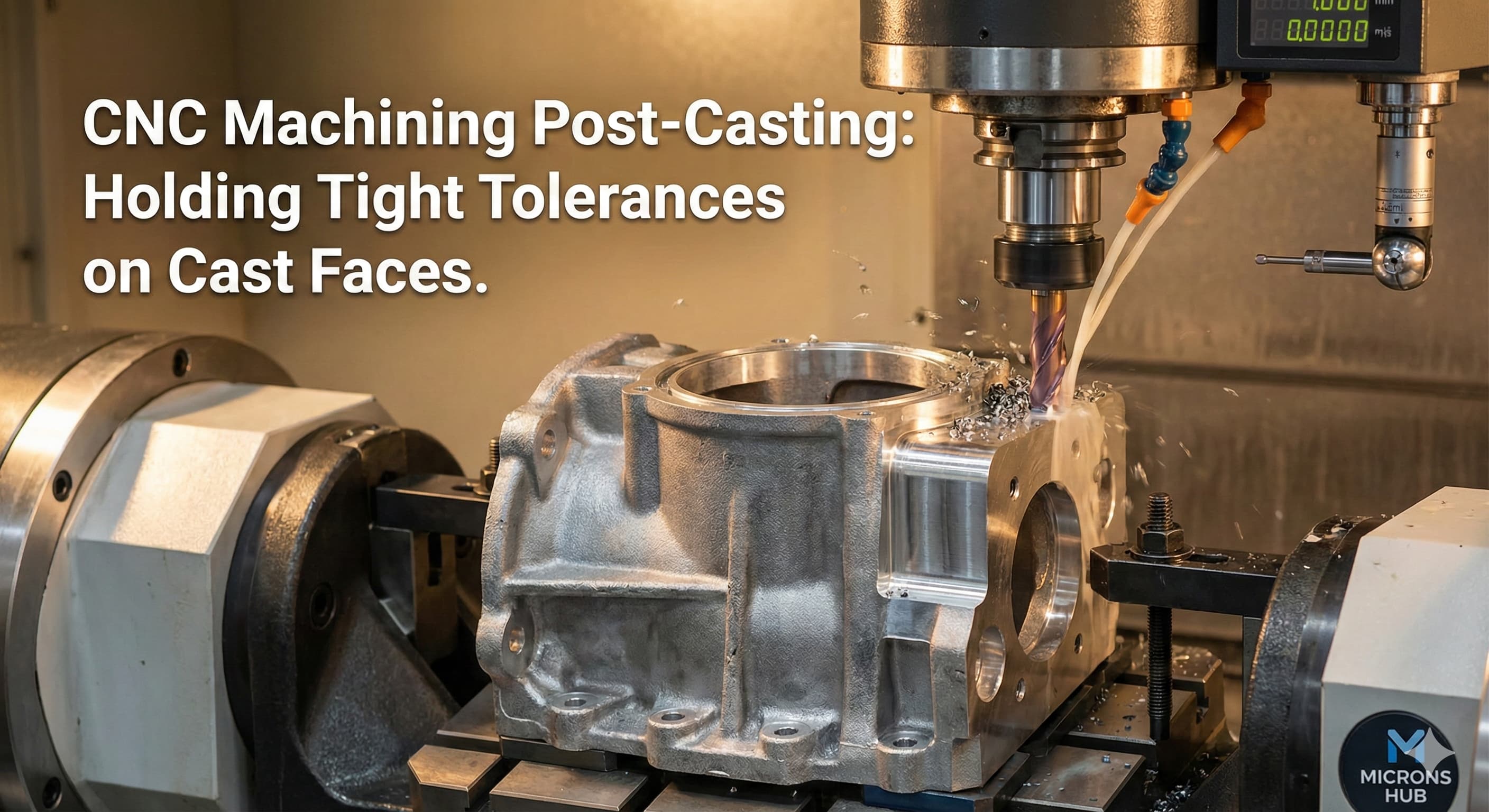
Cast components present a fundamental challenge in precision manufacturing: achieving tight tolerances on as-cast surfaces that were never intended for high-precision applications. The metallurgical structure and surface characteristics of cast faces create unique machining obstacles that require specialized approaches, tooling strategies, and quality control measures.
Post-casting CNC machining transforms rough cast surfaces into precision-engineered components, but success depends on understanding the inherent limitations of cast materials and implementing proven strategies to overcome them. From porosity management to thermal stress control, every aspect of the machining process must be optimized for cast material properties.
Key Takeaways
- Cast surface porosity and microstructure variations require specialized machining parameters and cutting tool geometries to achieve tolerances tighter than ±0.1 mm
- Material selection between aluminum A356-T6, ductile iron 65-45-12, and steel 1045 directly impacts achievable tolerance ranges and machining costs
- Workholding strategies must account for casting stresses and dimensional variations, often requiring custom fixtures and multiple setup operations
- Quality control integration throughout the machining process prevents costly rework and ensures consistent dimensional accuracy across production batches
Understanding Cast Material Challenges
Cast components inherently contain microstructural inconsistencies that directly impact machining performance and dimensional stability. The solidification process creates grain boundaries, porosity, and inclusion distributions that vary significantly from wrought materials. These characteristics manifest as tool wear acceleration, surface finish degradation, and dimensional instability during machining operations.
Porosity represents the most significant challenge when machining cast faces. Subsurface voids, typically ranging from 0.05 mm to 2.0 mm in diameter, create interrupted cutting conditions that cause tool chatter and premature wear. Vacuum impregnation techniques can address porosity in critical applications, but machining parameters must still accommodate residual void structures.
Residual stresses from the casting process add another layer of complexity. These stresses, often exceeding 150 MPa in aluminum alloys and 300 MPa in ferrous materials, redistribute during material removal, causing dimensional drift and part distortion. Stress relief heat treatment prior to machining can reduce these effects but adds cost and lead time to the manufacturing process.
Material hardness variations across cast sections create additional machining challenges. Chill zones near mold surfaces typically exhibit hardness values 20-40% higher than core regions, requiring adaptive cutting parameters or multiple machining passes to maintain consistent surface quality and dimensional accuracy.
Material Selection and Machinability Analysis
The choice of casting alloy fundamentally determines achievable tolerances and machining efficiency. Each material family presents distinct characteristics that influence cutting tool selection, machining parameters, and quality control requirements.
| Material Grade | Typical Tolerance Range | Surface Finish (Ra) | Machining Rate | Relative Cost |
|---|---|---|---|---|
| Aluminum A356-T6 | ±0.05 to ±0.15 mm | 0.8 to 1.6 μm | High (300-600 m/min) | 1.0x |
| Aluminum A380 | ±0.08 to ±0.20 mm | 1.2 to 2.5 μm | Medium (200-400 m/min) | 0.8x |
| Ductile Iron 65-45-12 | ±0.10 to ±0.25 mm | 1.6 to 3.2 μm | Medium (120-250 m/min) | 1.2x |
| Gray Iron Class 30 | ±0.15 to ±0.30 mm | 2.0 to 4.0 μm | High (180-350 m/min) | 1.1x |
| Steel 1045 Cast | ±0.12 to ±0.28 mm | 1.8 to 3.5 μm | Low (80-150 m/min) | 1.5x |
Aluminum A356-T6 offers the best combination of machinability and dimensional stability for precision applications. The T6 heat treatment provides uniform hardness distribution and reduced residual stress levels compared to as-cast conditions. Silicon content (6.5-7.5%) enhances machinability but can cause abrasive tool wear with improper cutting parameters.
Ductile iron grades provide excellent dimensional stability due to their higher elastic modulus but require carbide tooling and optimized cutting fluids to manage work hardening tendencies. The graphite nodule structure creates favorable chip breaking characteristics but can cause surface finish variations in precision applications.
Cast steel alloys present the greatest machining challenges due to hard carbide phases and potential for work hardening. However, they offer superior mechanical properties and dimensional stability for high-stress applications requiring tight tolerances.
Cutting Tool Selection and Geometry Optimization
Successful machining of cast faces demands cutting tools specifically designed for interrupted cutting conditions and varying material hardness. Tool geometry, substrate selection, and coating technology must work together to handle the unique challenges presented by cast materials.
Carbide insert grades with enhanced toughness perform best in cast material applications. ISO application groups K15-K30 provide the optimal balance of wear resistance and impact strength for most aluminum casting alloys. For ferrous castings, grades in the P15-P25 range offer superior crater resistance and thermal stability.
Tool geometry modifications significantly impact performance in cast materials. Positive rake angles (5-15°) reduce cutting forces and minimize work hardening, while larger relief angles (8-12°) prevent rubbing in areas with dimensional variations. Sharp cutting edges with light honing (0.01-0.02 mm) provide clean cuts through porous structures while maintaining edge strength.
Cutting speeds must be optimized for the specific casting alloy and desired surface finish. Aluminum castings typically perform best at speeds of 300-600 m/min with feed rates of 0.1-0.3 mm/tooth. Ferrous materials require more conservative parameters, with speeds of 120-250 m/min and feeds of 0.05-0.15 mm/tooth to prevent excessive tool wear.
Coolant selection and application method critically influence tool life and surface finish quality. High-pressure coolant delivery (20-40 bar) helps clear chips from interrupted cuts and prevents built-up edge formation. Synthetic coolants with extreme pressure additives work best for ferrous materials, while semi-synthetic formulations optimize aluminum machining performance.
For high-precision results, Get a quote in 24 hours from Microns Hub.
Workholding Strategies for Cast Components
Effective workholding of cast components requires accommodation of dimensional variations, irregular surfaces, and internal stress distributions. Standard fixture designs often prove inadequate due to the unique challenges presented by as-cast surfaces and varying wall thicknesses.
Six-point location principles must be modified for cast components due to surface irregularities and dimensional variations. Primary datum surfaces should be selected on the most stable casting areas, typically away from gate and riser locations. Secondary and tertiary datums may require custom machining or shimming to establish proper part orientation.
Soft jaw configurations provide optimal clamping for irregular cast surfaces. Aluminum or polymer jaw materials conform to surface variations while distributing clamping forces evenly. Jaw profiles should be machined to match specific casting contours, with relief areas provided for anticipated dimensional variations.
Hydrostatic and pneumatic workholding systems excel in cast component applications where uniform clamping pressure is critical. These systems automatically compensate for dimensional variations while maintaining consistent holding force throughout the machining cycle. Pressure levels typically range from 20-50 bar depending on component geometry and material removal requirements.
Multi-setup fixturing becomes necessary when tight tolerances are required on multiple cast faces. Progressive machining operations allow stress relief between setups while maintaining datum relationships. Fixture design must incorporate reference surfaces established in previous operations to ensure dimensional continuity.
Machining Parameters and Process Control
Achieving tight tolerances on cast faces requires precise control of cutting parameters, tool paths, and process variables. Unlike wrought materials, cast components demand adaptive strategies that account for material property variations and structural irregularities.
Spindle speed selection must balance productivity with surface finish requirements. Variable speed control during roughing operations helps manage tool engagement variations in irregular cast surfaces. Finishing passes typically require constant surface speed to maintain consistent surface quality across varying component geometries.
Feed rate optimization depends on both material properties and geometric complexity. Constant chip load per tooth maintains consistent cutting forces, but may require feed rate modulation in areas with significant diameter variations. Adaptive feed control systems can automatically adjust parameters based on real-time cutting force feedback.
Depth of cut strategy significantly impacts dimensional accuracy and surface finish quality. Roughing passes should remove scale, porosity, and heat-affected zones from the casting process. Finishing passes of 0.1-0.3 mm depth typically provide optimal surface finish while maintaining dimensional control.
| Operation Type | Aluminum Castings | Iron Castings | Steel Castings |
|---|---|---|---|
| Roughing Speed (m/min) | 400-600 | 150-250 | 80-120 |
| Finishing Speed (m/min) | 500-800 | 200-300 | 100-150 |
| Roughing Feed (mm/tooth) | 0.2-0.4 | 0.1-0.2 | 0.08-0.15 |
| Finishing Feed (mm/tooth) | 0.05-0.15 | 0.03-0.08 | 0.02-0.06 |
| Axial Depth (mm) | 2.0-5.0 | 1.0-3.0 | 0.5-2.0 |
Tool path strategies must minimize thermal buildup and maintain consistent chip evacuation. Trochoidal milling paths reduce tool engagement angles while maintaining high metal removal rates. Climb milling generally produces better surface finishes in cast materials, but conventional milling may be necessary in areas with severe porosity or inclusions.
Quality Control and Measurement Strategies
Quality control for cast component machining requires measurement strategies that account for material variations and process-induced changes. Traditional inspection methods may prove inadequate for components with complex geometries and tight tolerance requirements.
Coordinate measuring machine (CMM) inspection provides the most comprehensive dimensional analysis for precision cast components. Temperature compensation becomes critical due to thermal expansion differences between cast materials and measurement standards. Measurement uncertainty typically ranges from ±0.005 to ±0.015 mm depending on component size and complexity.
In-process measurement systems enable real-time dimensional feedback during machining operations. Touch probe systems can verify critical dimensions between operations, allowing parameter adjustments before tolerances drift out of specification. Laser measurement systems provide non-contact verification of surface profiles and dimensional characteristics.
Surface finish measurement requires specialized techniques for cast materials due to porosity and inclusion effects. Stylus-based profilometers may bridge over small pores, giving optimistic readings. Optical measurement systems provide more representative surface finish data by capturing the complete surface topography including porosity effects.
Statistical process control (SPC) implementation helps identify trends and prevent systematic dimensional drift. Control charts for critical dimensions should account for material lot variations and tool wear patterns specific to cast material machining. Capability studies typically show Cpk values of 1.0-1.3 for cast components compared to 1.3-2.0 for wrought materials.
When ordering from Microns Hub, you benefit from direct manufacturer relationships that ensure superior quality control and competitive pricing compared to marketplace platforms. Our technical expertise in cast component machining and personalized service approach means every project receives the specialized attention required for achieving tight tolerances on challenging cast faces.
Cost Optimization and Production Efficiency
Balancing tolerance requirements with production costs requires careful analysis of process alternatives and their associated trade-offs. Cost optimization in cast component machining involves material selection, process sequence planning, and quality system integration.
Material cost analysis must include both raw material pricing and machining efficiency factors. While premium casting alloys may cost 20-40% more initially, their improved machinability can reduce total manufacturing costs through higher cutting speeds and extended tool life. A356-T6 aluminum typically provides 30-50% better machining efficiency compared to A380 die cast alloys.
Process planning optimization considers the interaction between casting design and machining requirements. Components designed with machining allowances of 1.5-3.0 mm enable efficient roughing operations while ensuring complete removal of casting skin and porosity. Insufficient allowances may require multiple light cuts, significantly increasing cycle time and costs.
Batch processing strategies can reduce setup costs and improve consistency across multiple parts. Dedicated fixtures and proven parameter sets amortize development costs across larger production quantities. Minimum batch sizes of 25-50 pieces typically justify custom fixture development for precision cast components.
Tool cost management requires balancing initial tool investment with productive tool life. Premium cutting tools may cost 50-100% more than standard grades but often provide 200-300% longer tool life in cast material applications. Total cost per part typically decreases with higher-grade tooling despite increased initial investment.
Advanced Techniques and Technologies
Emerging technologies offer new approaches to the persistent challenges of machining cast faces to tight tolerances. These advanced techniques address fundamental limitations of conventional machining while opening new possibilities for precision and efficiency.
High-speed machining (HSM) techniques enable new strategies for cast component processing. Spindle speeds exceeding 15,000 rpm with reduced axial depths of cut can improve surface finish while reducing cutting forces. This approach minimizes work hardening and thermal damage while achieving superior dimensional control in thin-walled cast sections.
Cryogenic machining applications show promise for difficult-to-machine cast alloys. Liquid nitrogen delivery to the cutting zone reduces tool temperatures by 150-200°C while increasing material brittleness for improved chip formation. Tool life improvements of 200-400% are common in ferrous casting applications, though system complexity and operating costs must be considered.
Adaptive control systems automatically adjust cutting parameters based on real-time process feedback. Force, vibration, and acoustic emission sensors provide input for parameter optimization algorithms. These systems can maintain consistent surface finish and dimensional accuracy despite material property variations inherent in cast components.
Multi-axis machining centers enable complex cast components to be completed in single setups, eliminating tolerance stack-up from multiple operations. Five-axis continuous contouring capabilities allow optimal tool orientation for varying surface geometries while maintaining consistent surface finish quality.
Our comprehensive precision CNC machining services incorporate these advanced techniques to achieve the tight tolerances your cast components demand. Whether your project requires conventional or cutting-edge approaches, our manufacturing services deliver consistent results through proven process expertise.
Frequently Asked Questions
What tolerances are achievable on cast aluminum faces?
Cast aluminum faces can typically achieve tolerances of ±0.05 to ±0.15 mm depending on the alloy grade and component geometry. A356-T6 provides the tightest tolerances due to its uniform microstructure and reduced residual stresses. Factors like porosity, casting skin condition, and workholding stability directly influence achievable precision levels.
How does porosity in castings affect machining tolerances?
Porosity creates interrupted cutting conditions that cause tool chatter and dimensional variations. Subsurface voids ranging from 0.05 to 2.0 mm diameter can break through during machining, creating surface defects and dimensional deviations. Proper cutting tool selection and parameter optimization help minimize these effects, but inherent porosity typically limits tolerances to ±0.1 mm or greater.
What cutting speeds work best for machining cast iron faces?
Ductile iron castings perform optimally at cutting speeds of 120-250 m/min for roughing operations and 200-300 m/min for finishing. Gray iron can handle slightly higher speeds due to its excellent machinability. Feed rates should range from 0.1-0.2 mm/tooth for roughing and 0.03-0.08 mm/tooth for finishing to achieve optimal surface finish and tool life.
How do residual casting stresses affect dimensional accuracy?
Residual stresses from the casting process, often exceeding 150 MPa in aluminum and 300 MPa in ferrous alloys, redistribute during material removal causing part distortion. This stress redistribution can cause dimensional drift of 0.05-0.25 mm during machining. Stress relief heat treatment prior to machining or careful material removal sequencing helps minimize these effects.
What workholding strategies work best for irregular cast surfaces?
Soft jaw fixtures with aluminum or polymer contact surfaces provide optimal clamping for irregular cast geometries. Hydrostatic or pneumatic workholding systems automatically compensate for dimensional variations while maintaining uniform clamping pressure. Multi-point location strategies must account for casting tolerances and surface irregularities typical of as-cast conditions.
Can post-casting heat treatment improve machining tolerances?
Yes, stress relief heat treatment at 300-400°C for aluminum or 550-650°C for ferrous materials reduces residual stresses and improves dimensional stability during machining. T6 heat treatment for aluminum castings provides the most uniform properties and enables the tightest tolerances. However, heat treatment adds cost and lead time to the manufacturing process.
What surface finishes are achievable on machined cast faces?
Surface finish quality depends on material type and machining parameters. Aluminum A356-T6 can achieve Ra values of 0.8-1.6 μm with proper tool selection and cutting conditions. Ductile iron typically achieves 1.6-3.2 μm Ra, while cast steel ranges from 1.8-3.5 μm. Porosity and inclusion content in the casting directly influence achievable surface quality.
MICRONS HUB DV Ε.Ε. · VAT: EL803129638 · GEMI: 190254227000 · Industrial Area, Street B, Number 4, 71601 Heraklion, Crete, Greece